James T. Cushing – författare
Visar alla böcker från författaren James T. Cushing. Handla med fri frakt och snabb leverans.
7 produkter
7 produkter
Häftad, Engelska, 1994
473 kr
Skickas inom 5-8 vardagar
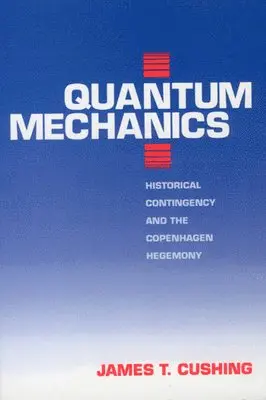
Why does one theory "succeed" while another, possibly clearer interpretation, fails? By exploring two observationally equivalent, yet conceptually incompatible, views of quantum mechanics, James T. Cushing shows how historical contingency can be crucial to determining a theory's construction and its position among competing views. Since the late 1920s, the theory formulated by Niels Bohr and his colleagues at Copenhagen has been the dominant interpretation of quantum mechanics. Yet an alternative interpretation, rooted in the work of Louis de Broglie in the early 1920s and reformulated and extended by David Bohm in the 1950s, equally well explains the observational data. Through a detailed historical and sociological study of the physicists who developed different theories of quantum mechanics, the debates within and between opposing camps, and the receptions given to each theory, Cushing shows that despite the preeminence of the Copenhagen view, the Bohm interpretation cannot be ignored. Cushing contends that the Copenhagen interpretation became widely accepted not because it is a better explanation of subatomic phenomena than Bohm's, but because it happened to appear first.Focusing on the philosophical, social and cultural forces that shaped one of the most important developments in modern physics, this book examines the role that timing can play in the establishment of theory and explanation.
Inbunden, Engelska, 1989
1 118 kr
Skickas inom 10-15 vardagar
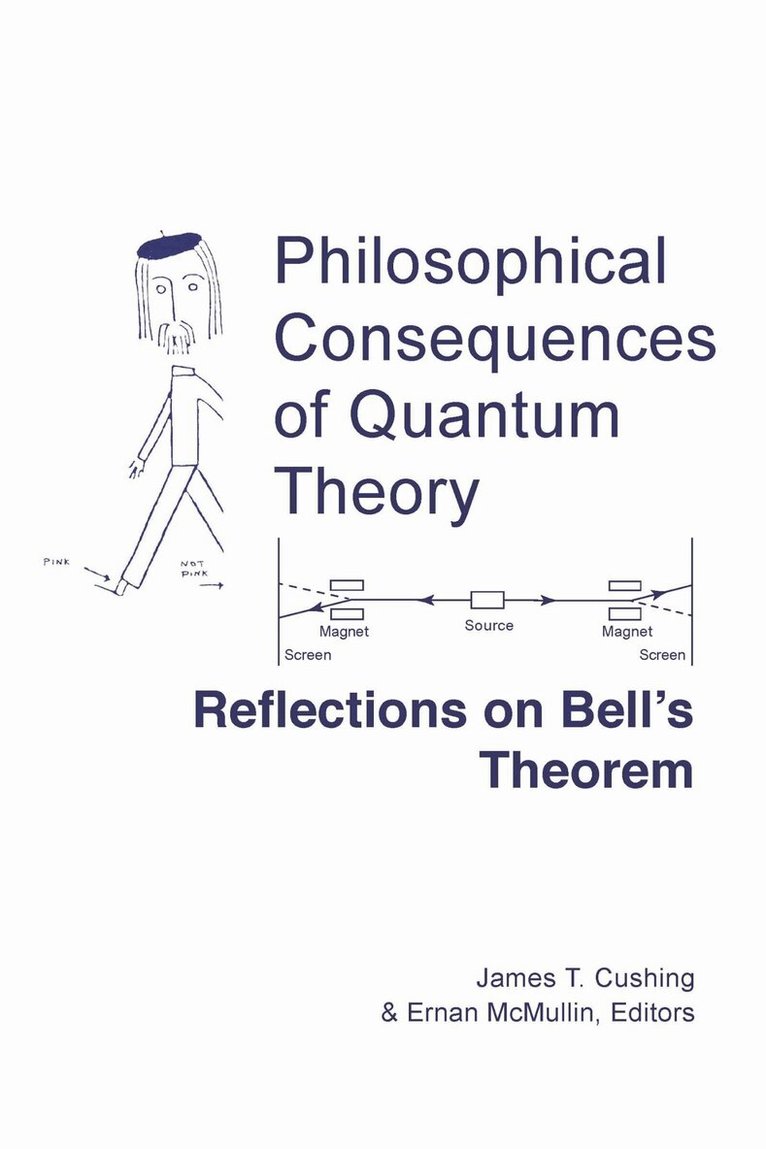
From the beginning, the implications of quantum theory for our most general understanding of the world have been a matter of intense debate. Einstein argues that the theory had to be regarded as fundamentally incomplete. Its inability, for example, to predict the exact time of decay of a single radioactive atom had to be due to a failure of the theory and not due to a permanent inability on our part or a fundamental indeterminism in nature itself.In 1964, John Bell derived a theorem which showed that any deterministic theory which preserved "locality" (i.e., which rejected action at a distance) would have certain consequences for measurements performed at a distance from one another. An experimental check seems to show that these consequences are not, in fact, realized. The correlation between the sets of events is much stronger than any "local" deterministic theory could allow. What is more, this stronger correlation is precisely that which is predicted by quantum theory. The astonishing result is that local deterministic theories of the classical sort seem to be permanently excluded. Not only can the individual decay not be predicted, but no future theory can ever predict it.The contributors in this volume wrestle with this conclusion. Some welcome it; others leave open a return to at lease some kind of deterministic world, one which must however allow something like action-at-a distance. How much lit it? And how can one avoid violating relativity theory, which excludes action-at-a-distance? How can a clash between the two fundamental theories of modern physics, relativity and quantum theory, be avoided? What are the consequences for the traditional philosophic issue of causality explanation and objectivity? One thing is certain; we can never return to the comfortable Newtonian world where everything that happened was, in principle, predictable and where what happened at one measurement site could not affect another set of measurements being performed light-years away, at a distance that a light-signal could not bridge.Contributors: James T. Cushing, Abner Shimony, N. David Mermin, Jon P. Jarrett, Linda Wessels, Bas C. van Fraassen, Jeremy Butterfield, Michael L. G. Redhead, Henry P. Stapp, Arthur Fine, R. I. G. Hughes, Paul Teller, Don Howard, Henry J. Folse, and Ernan McMullin.
Häftad, Engelska, 1992
263 kr
Skickas inom 5-8 vardagar
From the beginning, the implications of quantum theory for our most general understanding of the world have been a matter of intense debate. Einstein argues that the theory had to be regarded as fundamentally incomplete. Its inability, for example, to predict the exact time of decay of a single radioactive atom had to be due to a failure of the theory and not due to a permanent inability on our part or a fundamental indeterminism in nature itself.In 1964, John Bell derived a theorem which showed that any deterministic theory which preserved "locality" (i.e., which rejected action at a distance) would have certain consequences for measurements performed at a distance from one another. An experimental check seems to show that these consequences are not, in fact, realized. The correlation between the sets of events is much stronger than any "local" deterministic theory could allow. What is more, this stronger correlation is precisely that which is predicted by quantum theory. The astonishing result is that local deterministic theories of the classical sort seem to be permanently excluded. Not only can the individual decay not be predicted, but no future theory can ever predict it.The contributors in this volume wrestle with this conclusion. Some welcome it; others leave open a return to at lease some kind of deterministic world, one which must however allow something like action-at-a distance. How much lit it? And how can one avoid violating relativity theory, which excludes action-at-a-distance? How can a clash between the two fundamental theories of modern physics, relativity and quantum theory, be avoided? What are the consequences for the traditional philosophic issue of causality explanation and objectivity? One thing is certain; we can never return to the comfortable Newtonian world where everything that happened was, in principle, predictable and where what happened at one measurement site could not affect another set of measurements being performed light-years away, at a distance that a light-signal could not bridge.Contributors: James T. Cushing, Abner Shimony, N. David Mermin, Jon P. Jarrett, Linda Wessels, Bas C. van Fraassen, Jeremy Butterfield, Michael L. G. Redhead, Henry P. Stapp, Arthur Fine, R. I. G. Hughes, Paul Teller, Don Howard, Henry J. Folse, and Ernan McMullin.
Häftad, Engelska, 2005
1 001 kr
Skickas inom 7-10 vardagar
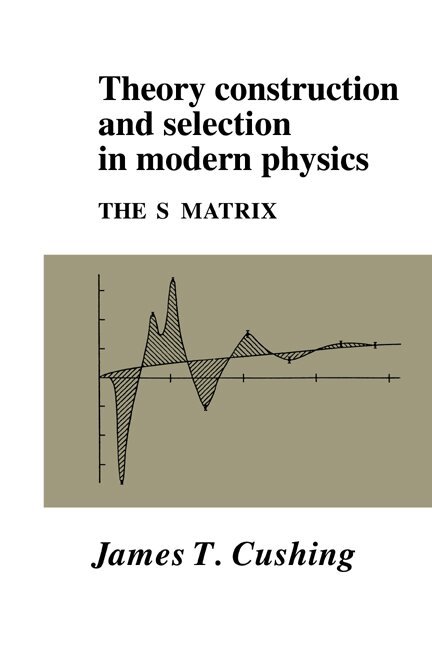
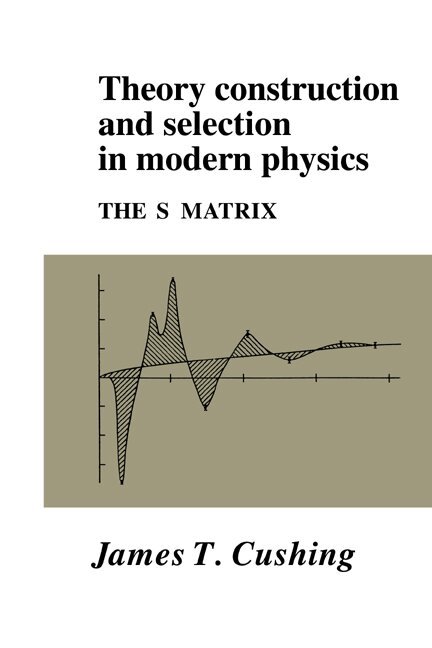
One of the major philosophical problems in physical sciences is what criteria should determine how scientific theories are selected and justified in practice and whether, in describing observable physical phenomena, such theories are effectively constrained to be unique. This book studies the example of a particular theory, the S-matrix theory. The S-matrix program was initiated by Heisenberg to deal with difficulties encountered in quantum field theories in describing particular phenomena. Since then, each theory has at different times been favoured as the explanation of observed phenomena. Certainly the S-matrix theory was adequate, feasible and fertile. However, the quantum field theory interpretation is now widely accepted and the study of alternative theories is all but abandoned. By examining the philosophy which influenced the turns in this story, the author explains how an adequate and viable theory fell out of favour and concludes with a critique of different methodologies in the history of science. This book will be of value to both philosophers of science and physicists interested in the philosophical background to their field.
Inbunden, Engelska, 1990
2 034 kr
Skickas inom 7-10 vardagar
One of the major philosophical problems in physical sciences is what criteria should determine how scientific theories are selected and justified in practice and whether, in describing observable physical phenomena, such theories are effectively constrained to be unique. This book studies the example of a particular theory, the S-matrix theory. The S-matrix program was initiated by Heisenberg to deal with difficulties encountered in quantum field theories in describing particular phenomena. Since then, each theory has at different times been favoured as the explanation of observed phenomena. Certainly the S-matrix theory was adequate, feasible and fertile. However, the quantum field theory interpretation is now widely accepted and the study of alternative theories is all but abandoned. By examining the philosophy which influenced the turns in this story, the author explains how an adequate and viable theory fell out of favour and concludes with a critique of different methodologies in the history of science. This book will be of value to both philosophers of science and physicists interested in the philosophical background to their field.
Häftad, Engelska, 1998
1 027 kr
Skickas inom 7-10 vardagar
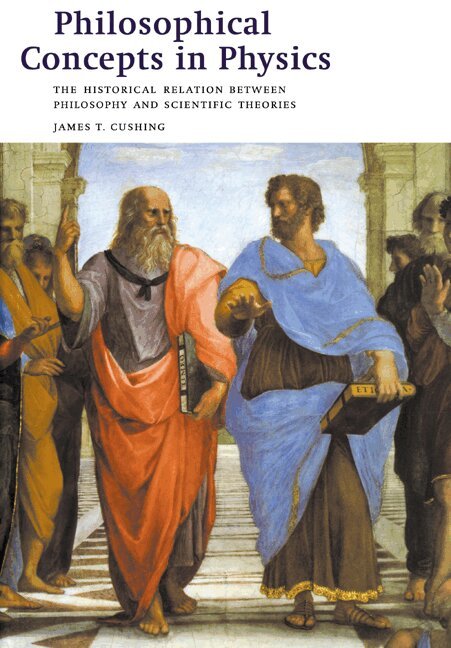
This book examines a selection of philosophical issues in the context of specific episodes in the development of physical theories. Advances in science are presented against the historical and philosophical backgrounds in which they occurred. A major aim is to impress upon the reader the essential role that philosophical considerations have played in the actual practice of science. The book begins with some necessary introduction to the history of ancient and early modern science, with major emphasis being given to the two great watersheds of twentieth-century physics: relativity and, especially, quantum mechanics. At times the term 'construction' may seem more appropriate than 'discovery' for the way theories have developed and, especially in the later chapters, the question of the influence of historical, philosophical and even social factors on the very form and content of scientific theories is discussed.
Del 184 - Boston Studies in the Philosophy and History of Science
Bohmian Mechanics and Quantum Theory: An Appraisal
Inbunden, Engelska, 1996
2 160 kr
Skickas inom 10-15 vardagar
We are often told that quantum phenomena demand radical revisions of our scientific world view and that no physical theory describing well defined objects, such as particles described by their positions, evolving in a well defined way, let alone deterministically, can account for such phenomena. The great majority of physicists continue to subscribe to this view, despite the fact that just such a deterministic theory, accounting for all of the phe nomena of nonrelativistic quantum mechanics, was proposed by David Bohm more than four decades ago and has arguably been around almost since the inception of quantum mechanics itself. Our purpose in asking colleagues to write the essays for this volume has not been to produce a Festschrift in honor of David Bohm (worthy an undertaking as that would have been) or to gather together a collection of papers simply stating uncritically Bohm's views on quantum mechanics. The central theme around which the essays in this volume are arranged is David Bohm's version of quantum mechanics. It has by now become fairly standard practice to refer to his theory as Bohmian mechanics and to the larger conceptual framework within which this is located as the causal quantum theory program. While it is true that one can have reservations about the appropriateness of these specific labels, both do elicit distinc tive images characteristic of the key concepts of these approaches and such terminology does serve effectively to contrast this class of theories with more standard formulations of quantum theory.