• Fri frakt över 249 kr
  • •
  • Snabba leveranser
  • •
  • Billiga böcker
Kundservice

Du är på sajten för privatpersoner.

Företag, bibliotek eller offentlig verksamhet?

Du handlar på classic.bokus.com, där alla dina funktioner finns intakta.
Till classic.bokus.com
Bokus logotyp. Gå till startsidan.
  • Erbjudanden
  • Nyheter
  • Student
  • Topplistor
  • Barn & ungdom
  • Bokus Play
  • E-böcker
  • Pocketböcker
  • Spel & pussel

10% rabatt på allt med kod NYSTART10 →

Sidfot

Mina sidor

    Hjälp

    • Kundservice
    • Vanliga frågor och svar
    • Frakt och leverans
    • Retur vid ångerrätt
    • Reklamera vara
    • Betalning
    • Köpvillkor
    • Allmänna villkor
    • Information om webbplatsens tillgänglighet

    Om Bokus

    • Om oss
    • Pressrum
    • För studenter
    • För företag
    • För bibliotek och offentlig verksamhet
    • För leverantörer
    • Hållbarhet

    Populärt

    • Aktuella erbjudanden
    • Presentkort
    • Studentlitteratur
    • Nya böcker
    • Topplistor
    • Signerade böcker
    • Engelska böcker

    Inspiration

    • Boktips
    • BookTok
    • Populära bokserier
    • Barnbokskaraktärer
    • Populära författare
    Logotyp för Bokus
    Följ oss på Facebook (extern länk)Följ oss på Instagram (extern länk)Följ oss på YouTube (extern länk)Följ oss på TikTok (extern länk)
    bokus @ CookiesAnpassa cookiesIntegritetspolicyKöpvillkor
    Till Citymail hemsida (extern länk)Till Budbee hemsida (extern länk)Till Postnord hemsida (extern länk)Till Schenker hemsida (extern länk)Till Early Bird hemsida (extern länk)Till Walleys hemsida (extern länk)
    1. Naturvetenskap och teknik
    2. Matematik och naturvetenskap
    3. Fysik
    4. Kvantfysik

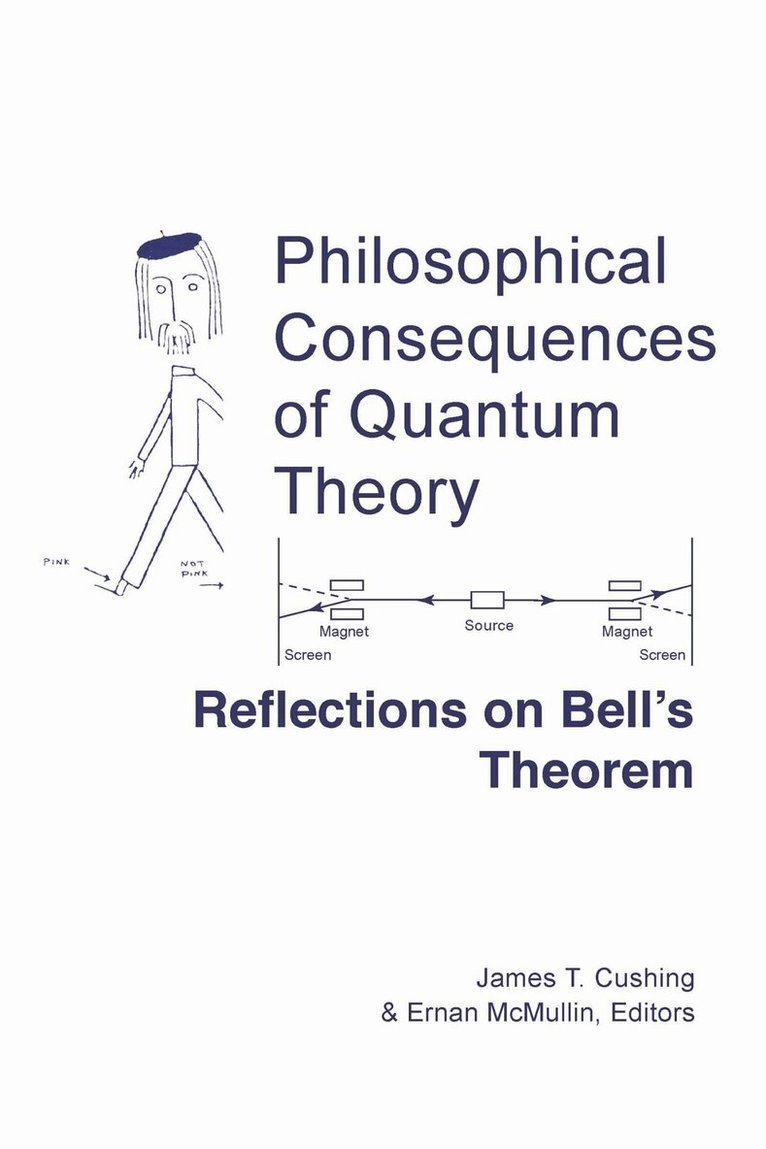
    Philosophical Consequences of Quantum Theory

    Reflections on Bell's Theorem

    AvJames T. Cushing,Ernan McMullin

    Häftad, Engelska, 1992

    Del i serien Studies in Science and the Humanities from the Reilly Center for Science, Technology, and Values

    307 kr

    Beställningsvara. Skickas inom 5-8 vardagar. Fri frakt över 249 kr.

    Beskrivning

    From the beginning, the implications of quantum theory for our most general understanding of the world have been a matter of intense debate. Einstein argues that the theory had to be regarded as fundamentally incomplete. Its inability, for example, to predict the exact time of decay of a single radioactive atom had to be due to a failure of the theory and not due to a permanent inability on our part or a fundamental indeterminism in nature itself.In 1964, John Bell derived a theorem which showed that any deterministic theory which preserved "locality" (i.e., which rejected action at a distance) would have certain consequences for measurements performed at a distance from one another. An experimental check seems to show that these consequences are not, in fact, realized. The correlation between the sets of events is much stronger than any "local" deterministic theory could allow. What is more, this stronger correlation is precisely that which is predicted by quantum theory. The astonishing result is that local deterministic theories of the classical sort seem to be permanently excluded. Not only can the individual decay not be predicted, but no future theory can ever predict it.The contributors in this volume wrestle with this conclusion. Some welcome it; others leave open a return to at lease some kind of deterministic world, one which must however allow something like action-at-a distance. How much lit it? And how can one avoid violating relativity theory, which excludes action-at-a-distance? How can a clash between the two fundamental theories of modern physics, relativity and quantum theory, be avoided? What are the consequences for the traditional philosophic issue of causality explanation and objectivity? One thing is certain; we can never return to the comfortable Newtonian world where everything that happened was, in principle, predictable and where what happened at one measurement site could not affect another set of measurements being performed light-years away, at a distance that a light-signal could not bridge.Contributors: James T. Cushing, Abner Shimony, N. David Mermin, Jon P. Jarrett, Linda Wessels, Bas C. van Fraassen, Jeremy Butterfield, Michael L. G. Redhead, Henry P. Stapp, Arthur Fine, R. I. G. Hughes, Paul Teller, Don Howard, Henry J. Folse, and Ernan McMullin.

    Produktinformation

    • Utgivningsdatum:1992-07-31
    • Mått:152 x 229 x 18 mm
    • Vikt:445 g
    • Format:Häftad
    • Språk:Engelska
    • Serie:Studies in Science and the Humanities from the Reilly Center for Science, Technology, and Values
    • Antal sidor:330
    • Förlag:University of Notre Dame Press
    • ISBN:9780268015794

    Utforska kategorier

    • Kvantfysik inom Naturvetenskap och teknik

    Mer om författaren

    James T. Cushing (1937 - 2002) was a US-American theoretical physicist and philosopher of science. He was professor of physics as well as professor of philosophy at the University of Notre Dame.Ernan McMullin (1924–2011) was John Cardinal O'Hara Professor Emeritus of Philosophy at the University of Notre Dame.

    Recensioner i media

    "These papers, collected from a 1986 conference focusing on John S. Bell's celebrated 1964 theorem, examine the philosophical issues posed by quantum theory. The book introduces Bell's theorem so that readers can understand the papers, but it is not a technical overview of the theorem or of quantum mechanics." —Science News"The papers collected here demonstrate how analytic philosophy of science should be done. Quantum mechanics may be mysterious in some of its aspects, but those who wish to peddle mysticism on the basis on quantum theory would do well to stay away from this excellent collection of philosophical essays." —Canadian Philosophical Reviews"Prominent philosopher-scientists, from Abner Shimony to Paul Teller, contribute articles (some revisions of seminal publications) detailing presumptions and ambiguities of quantum measurement, written especially for the nonspecialist. Some highlights include Mermin's powerful (and amusing) 'device' to highlight the 'paradox' of quantum correlations, Linda Wessels' thorough catalog of specific implicit 'axioms' of the discussion, and Cushing's prospective overview. Other gems, including some simplified models of Bell's arguments, and a range of ontological frameworks—from realism to 'holism'—make this an urgently recommended work for all colleges." —Choice