• Fri frakt över 249 kr
  • •
  • Snabba leveranser
  • •
  • Billiga böcker
Kundservice

Du är på sajten för privatpersoner.

Företag, bibliotek eller offentlig verksamhet?

Du handlar på classic.bokus.com, där alla dina funktioner finns intakta.
Till classic.bokus.com
Bokus logotyp. Gå till startsidan.
  • Erbjudanden
  • Nyheter
  • Student
  • Topplistor
  • Barn & ungdom
  • Bokus Play
  • E-böcker
  • Pocketböcker
  • Spel & pussel

10% rabatt på allt med kod NYSTART10 →

Sidfot

Mina sidor

    Hjälp

    • Kundservice
    • Vanliga frågor och svar
    • Frakt och leverans
    • Retur vid ångerrätt
    • Reklamera vara
    • Betalning
    • Köpvillkor
    • Allmänna villkor
    • Information om webbplatsens tillgänglighet

    Om Bokus

    • Om oss
    • Pressrum
    • För studenter
    • För företag
    • För bibliotek och offentlig verksamhet
    • För leverantörer
    • Hållbarhet

    Populärt

    • Aktuella erbjudanden
    • Presentkort
    • Studentlitteratur
    • Nya böcker
    • Topplistor
    • Signerade böcker
    • Engelska böcker

    Inspiration

    • Boktips
    • BookTok
    • Populära bokserier
    • Barnbokskaraktärer
    • Populära författare
    Logotyp för Bokus
    Följ oss på Facebook (extern länk)Följ oss på Instagram (extern länk)Följ oss på YouTube (extern länk)Följ oss på TikTok (extern länk)
    bokus @ CookiesAnpassa cookiesIntegritetspolicyKöpvillkor
    Till Citymail hemsida (extern länk)Till Budbee hemsida (extern länk)Till Postnord hemsida (extern länk)Till Schenker hemsida (extern länk)Till Early Bird hemsida (extern länk)Till Walleys hemsida (extern länk)
    1. Samhälle och politik
    2. Politik och statsskick
    3. Statsskick och politiska processer

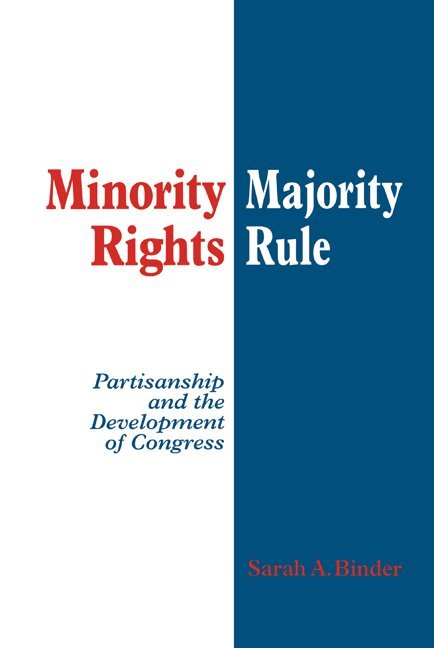
    Minority Rights, Majority Rule

    Partisanship and the Development of Congress

    AvSarah A. Binder

    Inbunden, Engelska, 1997

    1 281 kr

    Beställningsvara. Skickas inom 10-15 vardagar. Fri frakt över 249 kr.

    Fler format och utgåvor

    Häftad

    463 kr

    Beskrivning

    Minority Rights, Majority Rule seeks to explain a phenomenon evident to most observers of the US Congress. In the House of Representatives, majority parties rule and minorities are seldom able to influence national policy making. In the Senate, minorities quite often call the shots, empowered by the filibuster to frustrate the majority. Why did the two chambers develop such distinctive legislative styles? Conventional wisdom suggests that differences in the size and workload of the House and Senate led the two chambers to develop very different rules of procedure. Sarah Binder offers an alternative, partisan theory to explain the creation and suppression of minority rights, showing that contests between partisan coalitions have throughout congressional history altered the distribution of procedural rights. Most importantly, new majorities inherit procedural choices made in the past. This institutional dynamic has fuelled the power of partisan majorities in the House but stopped them in their tracks in the Senate.

    Produktinformation

    • Utgivningsdatum:1997-06-13
    • Mått:159 x 237 x 23 mm
    • Vikt:535 g
    • Format:Inbunden
    • Språk:Engelska
    • Antal sidor:256
    • Förlag:Cambridge University Press
    • ISBN:9780521582391

    Utforska kategorier

    • Statsskick och politiska processer inom Samhälle och politik

    Recensioner i media

    "This is an extremely interesting book and one in which the author makes a convincing case for her various positions. It will I am sure, be accepted for a long time as an important contribution to the history of the U.S. Congress, to the study of American Congressional Politics, and to our understanding of institutionalization processes in the United States." Allen G. Bogue, H-Net Reviews

    Innehållsförteckning

    • 1. The partisan basis of procedural choice; 2. The evolving concepts of house and Senate minority rights; 3. Procedural choice in the early congress: the case of the Previous Question; 4. Allocating minority rights in the house, 1789–1990; 5. Institutionalizing party in the nineteenth century house; 6. Stacking the partisan decks in the twentieth century house; 7. Inherited rules and procedural choice in the Senate; 8. Assessing the partisan theory; Appendices; References.