• Fri frakt över 249 kr
  • •
  • Snabba leveranser
  • •
  • Billiga böcker
Kundservice

Du är på sajten för privatpersoner.

Företag, bibliotek eller offentlig verksamhet?

Du handlar på classic.bokus.com, där alla dina funktioner finns intakta.
Till classic.bokus.com
Bokus logotyp. Gå till startsidan.
  • Erbjudanden
  • Nyheter
  • Student
  • Topplistor
  • Barn & ungdom
  • Bokus Play
  • E-böcker
  • Pocketböcker
  • Spel & pussel

10% rabatt på allt med kod: NYSTART10 →

Sidfot

Mina sidor

    Hjälp

    • Kundservice
    • Vanliga frågor och svar
    • Frakt och leverans
    • Retur vid ångerrätt
    • Reklamera vara
    • Betalning
    • Köpvillkor
    • Allmänna villkor
    • Information om webbplatsens tillgänglighet

    Om Bokus

    • Om oss
    • Pressrum
    • För studenter
    • För företag
    • För bibliotek och offentlig verksamhet
    • För leverantörer
    • Hållbarhet

    Populärt

    • Aktuella erbjudanden
    • Presentkort
    • Studentlitteratur
    • Nya böcker
    • Topplistor
    • Signerade böcker
    • Engelska böcker

    Inspiration

    • Boktips
    • BookTok
    • Populära bokserier
    • Barnbokskaraktärer
    • Populära författare
    Logotyp för Bokus
    Följ oss på Facebook (extern länk)Följ oss på Instagram (extern länk)Följ oss på YouTube (extern länk)Följ oss på TikTok (extern länk)
    bokus @ CookiesAnpassa cookiesIntegritetspolicyKöpvillkor
    Till Citymail hemsida (extern länk)Till Budbee hemsida (extern länk)Till Postnord hemsida (extern länk)Till Schenker hemsida (extern länk)Till Early Bird hemsida (extern länk)Till Walleys hemsida (extern länk)
    1. Medicin
    2. Andra medicinska specialiteter
    3. Psykiatri

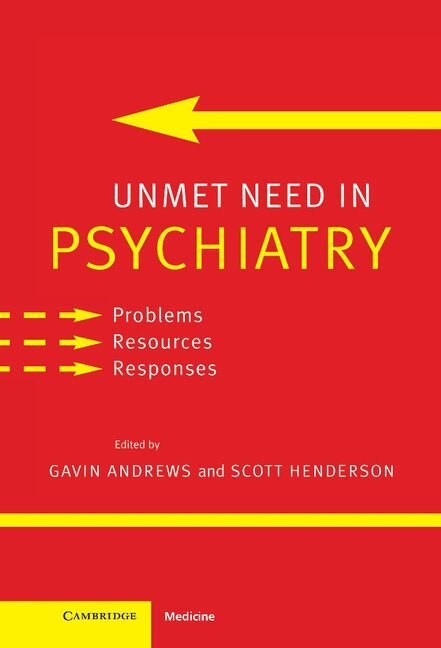
    Unmet Need in Psychiatry

    Problems, Resources, Responses

    AvGavin Andrews,Scott Henderson

    Inbunden, Engelska, 2000

    2 304 kr

    Beställningsvara. Skickas inom 10-15 vardagar. Fri frakt över 249 kr.

    Beskrivning

    This book considers ways to resolve the imbalance between the demand and supply of mental health services. Treatment services in most countries reach only a minority of people identified as suffering from a mental disorder. Few countries can provide adequate health services for all the mentally ill, yet none has developed a rational system to decide who should be treated. The questions are clear. Could we develop a staged treatment process to reach all in need? If not, how do we decide who to treat? What should the criteria be for deployment of scarce treatment resources? How do we determine such criteria? What are the ethical implications of applying such criteria? In this pioneering work, an international team of eminent psychiatrists, epidemiologists, health administrators, economists and health planners examine these questions. The result will inform and encourage all concerned with the equitable provision of mental health care.

    Produktinformation

    • Utgivningsdatum:2000-01-06
    • Mått:157 x 237 x 27 mm
    • Vikt:890 g
    • Format:Inbunden
    • Språk:Engelska
    • Antal sidor:462
    • Förlag:Cambridge University Press
    • ISBN:9780521662291

    Utforska kategorier

    • Psykiatri inom Medicin
    • Socialt arbete och välfärd inom Samhälle och politik

    Mer om författaren

    fm.author_biographical_note1 fm.author_biographical_note2

    Innehållsförteckning

    • List of contributors; Preface; Part I. Unmet Need: Defining the Problem: 1. Assessing needs for psychiatric services Norman Sartorius; 2. Unmet need: a challenge for governments Harvey Whiteford; 3. Meeting the unmet need with disease management Gavin Andrews; Part II. Unmet Need: General Problems and Solutions: Introduction Gavin Andrews; 4. The epidemiology of mental disorder treatment need: community estimates of 'medical necessity' Darrel A. Regier, William E. Narrow, Agnes Rupp, Donald S. Rae and Charles T. Kaelber; 5. Some considerations in making resource allocation decisions for the treatment of psychiatric disorders Ronald C. Kessler; 6. The need for psychiatric treatment in the general population Paul Bebbington; 7. Comparing data on mental health service use between countries Margarita Alegría, Ronald C. Kessler, Rob Bijl, Elizabeth Lin, Steven G. Heeringa, David T. Takeuchi and Bodhan Kolody; 8. The challenges of meeting the unmet need for treatment: economic perspectives Agnes Rupp and Helen Lapsley; 9. Unmet need for prevention Beverley Raphael; 10. Meeting unmet needs: can evidence-based approaches help? Harold Alan Pincus and Deborah A. Zarin; 11. Unmet need for management of mental disorders in primary care T. Bedirhan Üstün; 12. Is complementary medicine filling needs that could be met by orthodox medicine? John E. Cooper; Part III. Unmet Need: People with Specific Disorders: Introduction Gavin Andrews; 13. The unmet needs of people suffering from schizophrenia Graham Thornicroft, Sonia Johnson, Morven Leese and Mike Slade; 14. The early course of schizophrenia: new concepts for intervention Heinz Häfner and Kurt Maurer; 15. Unmet need in depression: varying perspectives on need Kay Wilhelm and Elizabeth Lin; 16. Unmet need following serious suicide attempt: follow-up of 302 individuals for 30 months Annette Beautrais, Peter Joyce and Roger Mulder; 17. Met and unmet need for interventions in community cases with anxiety disorders Hans-Ulrich Wittchen; 18. The unmet need for treatment in panic disorder and social phobia Caroline Hunt; 19. Alcohol-use disorders: who should be treated and how? Wayne Hall and Maree Teesson; 20. Putting epidemiology and public health in needs assessment: drug dependence and beyond James C. Anthony; 21. Why are somatoform disorders so poorly recognized and treated? Ian Hickie, Rene G. Pols, Annette Koschera and Tracey Davenport; Part IV. Unmet Need: Specific Issues: Introduction Scott Henderson; 22. Unmet need in mental health service delivery: children and adolescents Michael Sawyer and George Patton; 23. Assessing psychopathology among children aged four to eight Linda Cottler, Wendy Reich, Kathy Rourke, Renee M. Cunningham-Williams and Wilson M. Compton; 24. Unmet need in indigenous mental health: where to start? Ernest Hunter; 25. Health systems research: a pragmatic model for meeting mental health needs in low-income countries Vikram Patel; 26. Disablement associated with chronic psychosis as seen by two groups of key informants: patients and mental health professionals Charles B. Pull, Arnaud Sztantics, Steve Muller, Jean Marc Cloos and Jean Reggers; 27. The assessment of perceived need Graham Meadows, Ellie Fossey, Carol Harvey and Philip Burgess; 28. Public knowledge of and attitudes to mental disorders: a limiting factor in the optimal use of treatment services Anthony F. Jorm, Mattias Angermeyer and Heinz Katschnig; Part V. Unmet Need: Conclusion: 29. A personal overview John R. M. Copeland; 30. Conclusion: the central issues Scott Henderson; Index.