• Fri frakt över 249 kr
  • •
  • Snabba leveranser
  • •
  • Billiga böcker
Kundservice

Du är på sajten för privatpersoner.

Företag, bibliotek eller offentlig verksamhet?

Du handlar på classic.bokus.com, där alla dina funktioner finns intakta.
Till classic.bokus.com
Bokus logotyp. Gå till startsidan.
  • Erbjudanden
  • Nyheter
  • Student
  • Topplistor
  • Barn & ungdom
  • Bokus Play
  • E-böcker
  • Pocketböcker
  • Spel & pussel

10% rabatt på allt med kod: NYSTART10 →

Sidfot

Mina sidor

    Hjälp

    • Kundservice
    • Vanliga frågor och svar
    • Frakt och leverans
    • Retur vid ångerrätt
    • Reklamera vara
    • Betalning
    • Köpvillkor
    • Allmänna villkor
    • Information om webbplatsens tillgänglighet

    Om Bokus

    • Om oss
    • Pressrum
    • För studenter
    • För företag
    • För bibliotek och offentlig verksamhet
    • För leverantörer
    • Hållbarhet

    Populärt

    • Aktuella erbjudanden
    • Presentkort
    • Studentlitteratur
    • Nya böcker
    • Topplistor
    • Signerade böcker
    • Engelska böcker

    Inspiration

    • Boktips
    • BookTok
    • Populära bokserier
    • Barnbokskaraktärer
    • Populära författare
    Logotyp för Bokus
    Följ oss på Facebook (extern länk)Följ oss på Instagram (extern länk)Följ oss på YouTube (extern länk)Följ oss på TikTok (extern länk)
    bokus @ CookiesAnpassa cookiesIntegritetspolicyKöpvillkor
    Till Citymail hemsida (extern länk)Till Budbee hemsida (extern länk)Till Postnord hemsida (extern länk)Till Schenker hemsida (extern länk)Till Early Bird hemsida (extern länk)Till Walleys hemsida (extern länk)
    1. Samhälle och politik
    2. Politik och statsskick

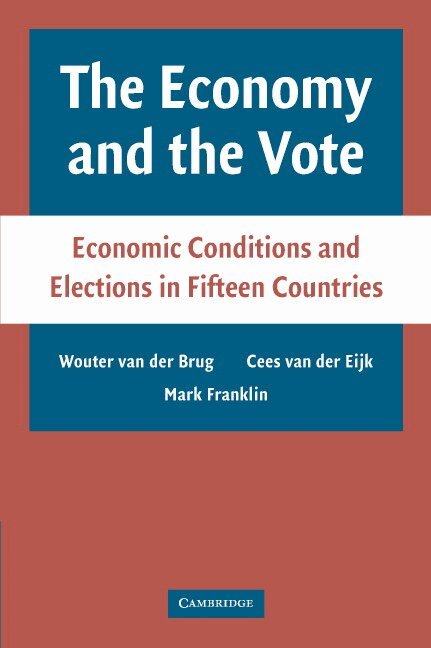
    The Economy and the Vote

    Economic Conditions and Elections in Fifteen Countries

    AvWouter van der Brug,Cees van der EijK

    Häftad, Engelska, 2007

    366 kr

    Beställningsvara. Skickas inom 10-15 vardagar. Fri frakt över 249 kr.

    Fler format och utgåvor

    Inbunden

    1 067 kr

    Beskrivning

    Economic conditions are said to affect election outcomes, but past research has produced unstable and contradictory findings. This book argues that these problems are caused by the failure to take account of electoral competition between parties. A research strategy to correct this problem is designed and applied to investigate effects of economic conditions on (individual) voter choices and (aggregate) election outcomes over 42 elections in 15 countries. It shows that economic conditions exert small effects on individual party preferences, which can have large consequences for election outcomes. In countries where responsibility for economic policy is clear, voters vote retrospectively and reward or punish incumbent parties - although in coalition systems smaller government parties often gain at the expense of the largest party when economic conditions deteriorate. Where clarity of responsibility for economic policy is less clear, voters vote more prospectively on the basis of expected party policies.

    Produktinformation

    • Utgivningsdatum:2007-04-30
    • Mått:152 x 230 x 16 mm
    • Vikt:338 g
    • Format:Häftad
    • Språk:Engelska
    • Antal sidor:246
    • Förlag:Cambridge University Press
    • ISBN:9780521682336

    Utforska kategorier

    • Politik och statsskick inom Samhälle och politik

    Mer om författaren

    Wouter van der Brug is associate professor in methods for the social sciences at the Amsterdam School for Communications Research, University of Amsterdam, Netherlands. His work has been published in Comparative Political Studies, the British Journal of Political Science, the European Journal of Political Research, Electoral Studies, Party Politics, the Journal of Theoretical Politics, West European Politics, and Acta Politica. He recently co-authored European Elections and Domestic Politics (with Cees van der Eijk, 2007). Cees van der Eijk is professor of social science research methods at the University of Nottingham. He taught at the University of Amsterdam from 1971 to 2004, was a Fulbright Scholar at the University of Wisconsin, Madison in 1976–7, and was a Visiting Scholar at the Netherlands Institute for Advanced Study in 1988–9. He is the author or co-author of fifteen books, including European Elections and Domestic Politics (with Wouter van der Brug, 2007), Citizen Participation in European Politics (with Hans Agné and others, 2000), In Search of Structure (with Meindert Fennema and Huib Schijf, 1998) and Choosing Europe? (with Mark Franklin and others, 1996), and of many articles and chapters in refereed journals and books. Mark Franklin is the Stein Rokkan Professor of Comparative Politics at the European University Institute in Florence while on leave from Trinity College, Connecticut, where he has been teaching since 1998. He has also taught at the universities of Chicago, Iowa, and Houston in the USA and at the University of Strathclyde in Glasgow. He has published eleven books, including Voter Turnout and the Dynamics of Electoral Competition in Established Democracies since 1945 (Cambridge, 2004), Choosing Europe? (with Cees van der Eijk and others, 1996), and Electoral Change (with Tom Mackie, Henry Valen, and others, Cambridge, 1992). He founded the Public Opinion and Participation Section of the European Union Studies Association, has been a director of the European Election Studies project since 1987, and has served on the editorial boards of six journals.

    Recensioner i media

    "Van der Brug and company hit conventional wisdom hard. By their analysis, the economy, after all, influences the voter decision relatively little. The investigation, unique in its construction and provocative in its conclusion, begs to be read by comparative election scholars." Michael Lewis-Beck, F. Wendell Miller Distinguished Professor of Political Science, University of Iowa

    Innehållsförteckning

    • 1. Studying economic voting; 2. Party choice as a two-stage process; 3. Hypotheses and data: the theoretical and empirical setting; 4. Effects of the economy on party support; 5. The economic voter; 6. From individual preferences to election outcomes; 7. The economy, party competition, and the vote.