• Fri frakt över 249 kr
  • •
  • Snabba leveranser
  • •
  • Billiga böcker
Kundservice

Du är på sajten för privatpersoner.

Företag, bibliotek eller offentlig verksamhet?

Du handlar på classic.bokus.com, där alla dina funktioner finns intakta.
Till classic.bokus.com
Bokus logotyp. Gå till startsidan.
  • Erbjudanden
  • Nyheter
  • Student
  • Topplistor
  • Barn & ungdom
  • Bokus Play
  • E-böcker
  • Pocketböcker
  • Spel & pussel

10% rabatt på allt med kod: NYSTART10 →

Sidfot

Mina sidor

    Hjälp

    • Kundservice
    • Vanliga frågor och svar
    • Frakt och leverans
    • Retur vid ångerrätt
    • Reklamera vara
    • Betalning
    • Köpvillkor
    • Allmänna villkor
    • Information om webbplatsens tillgänglighet

    Om Bokus

    • Om oss
    • Pressrum
    • För studenter
    • För företag
    • För bibliotek och offentlig verksamhet
    • För leverantörer
    • Hållbarhet

    Populärt

    • Aktuella erbjudanden
    • Presentkort
    • Studentlitteratur
    • Nya böcker
    • Topplistor
    • Signerade böcker
    • Engelska böcker

    Inspiration

    • Boktips
    • BookTok
    • Populära bokserier
    • Barnbokskaraktärer
    • Populära författare
    Logotyp för Bokus
    Följ oss på Facebook (extern länk)Följ oss på Instagram (extern länk)Följ oss på YouTube (extern länk)Följ oss på TikTok (extern länk)
    bokus @ CookiesAnpassa cookiesIntegritetspolicyKöpvillkor
    Till Citymail hemsida (extern länk)Till Budbee hemsida (extern länk)Till Postnord hemsida (extern länk)Till Schenker hemsida (extern länk)Till Early Bird hemsida (extern länk)Till Walleys hemsida (extern länk)
    1. Djur och Natur
    2. Djurböcker

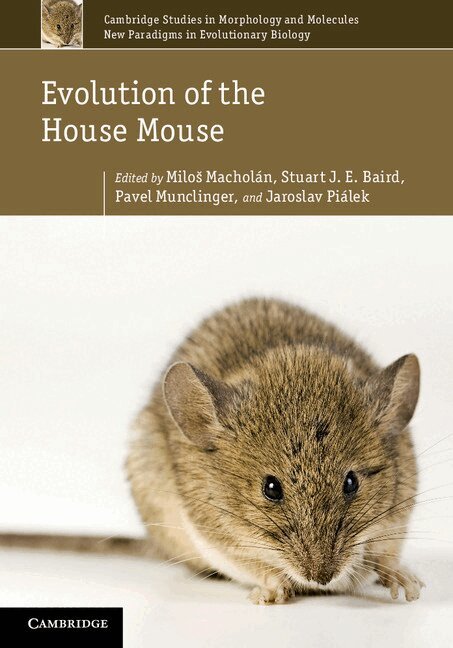
    Evolution of the House Mouse

    AvMiloš Macholán,Stuart J. E. Baird

    Inbunden, Engelska, 2012

    Del 3 i serien Cambridge Studies in Morphology and Molecules: New Paradigms in Evolutionary Bio

    1 523 kr

    Beställningsvara. Skickas inom 10-15 vardagar. Fri frakt över 249 kr.

    Beskrivning

    The house mouse is the source of almost all genetic variation in laboratory mice; its genome was sequenced alongside that of humans, and it has become the model for mammalian speciation. Featuring contributions from leaders in the field, this volume provides the evolutionary context necessary to interpret these patterns and processes in the age of genomics. The topics reviewed include mouse phylogeny, phylogeography, origins of commensalism, adaptation, and dynamics of secondary contacts between subspecies. Explorations of mouse behaviour cover the nature of chemical and ultrasonic signalling, recognition, and social environment. The importance of the mouse as an evolutionary model is highlighted in reviews of the first described example of meiotic drive (t-haplotype) and the first identified mammalian speciation gene (Prdm9). This detailed overview of house mouse evolution is a valuable resource for researchers of mouse biology as well as those interested in mouse genetics, evolutionary biology, behaviour, parasitology, and archaeozoology.

    Produktinformation

    • Utgivningsdatum:2012-07-19
    • Mått:180 x 254 x 29 mm
    • Vikt:1 250 g
    • Format:Inbunden
    • Språk:Engelska
    • Serie:Cambridge Studies in Morphology and Molecules: New Paradigms in Evolutionary Bio
    • Antal sidor:548
    • Förlag:Cambridge University Press
    • ISBN:9780521760669

    Utforska kategorier

    • Djurböcker inom Djur och Natur
    • Djurens beteende inom Naturvetenskap och teknik

    Mer om författaren

    Miloš Macholán is a senior scientist and head of the Laboratory of Mammalian Evolutionary Genetics at the Institute of Animal Physiology and Genetics, Academy of Sciences of the Czech Republic, and Professor of Zoology at Masaryk University, Brno, Czech Republic. He is a recipient of the Otto Wichterle Award for outstanding young scientists. Stuart J. E. Baird is Associate Professor at the Research Centre for Biodiversity and Genetic Resources (CIBIO), University of Porto, Portugal, and Chargé de Recherche (première classe), INRA, France. He has studied hybridisation on four continents and his current research interests include spatial genetics, speciation and inference from genomic data. Pavel Munclinger is head of the Department of Zoology at Charles University in Prague, Czech Republic. He teaches molecular ecology and evolutionary genetics and is particularly interested in mouse transposons and hybrid zones. Jaroslav Piálek is a senior scientist at the Institute of Vertebrate Biology, Academy of Sciences of the Czech Republic in Brno. He has developed dozens of wild-derived house mouse strains to study the evolution of genetic incompatibilities at incipient stages of speciation in two European mouse subspecies.

    Innehållsförteckning

    • List of contributors; Foreword: mice and (wo)men: an evolving relationship R. J. Berry; Preface; 1. The house mouse and its relatives: systematics and taxonomy Jean-Christophe Auffray and Janice Britton-Davidian; 2. Phylogeny and biogeography of the genus Mus in Eurasia Hitoshi Suzuki and Ken P. Aplin; 3. On the origin of the house mouse synanthropy and dispersal in the Near East and Europe: zooarchaeological review and perspectives Thomas Cucchi, Jean-Christophe Auffray and Jean-Denis Vigne; 4. Origin and genetic status of Mus musculus molossinus: a typical example of reticulate evolution in the genus Mus Hiromichi Yonekawa, Jun J. Sato, Hitoshi Suzuki and Kazuo Moriwaki; 5. The complex social environment of female house mice (Mus domesticus) Barbara König and Anna K. Lindholm; 6. Development of the mouse mandible: a model system for complex morphological structures Christian Peter Klingenberg and Nicolas Navarro; 7. Recognition of subspecies status mediated by androgen-binding protein (ABP) in the evolution of incipient reinforcement on the European house mouse hybrid zone Christina M. Laukaitis and Robert C. Karn; 8. Mechanisms of chemical communication Pavel Stopka, Romana Stopková and Kateřina Janotová; 9. The evolution of MHC diversity in house mice Dustin J. Penn and Kerstin Musolf; 10. Ultrasonic vocalizations in house mice: a cryptic mode of acoustic communication Kerstin Musolf and Dustin J. Penn; 11. House mouse phylogeography François Bonhomme and Jeremy B. Searle; 12. The mouse t-haplotype: a selfish chromosome – genetics, molecular mechanism and evolution Bernhard G. Herrmann and Hermann Bauer; 13. Tracing recent adaptations in natural populations of the house mouse Meike Teschke, Anna Büntge and Diethard Tautz; 14. What can the Mus musculus musculus/M. m. domesticus hybrid zone tell us about speciation? Stuart J. E. Baird and Miloš Macholán; 15. Behaviour, ecology and speciation in the house mouse Guila Ganem; 16. Chromosomal hybrid zones in the house mouse Heidi C. Hauffe, Mabel D. Giménez and Jeremy B. Searle; 17. The role of the X chromosome in house mouse speciation Ayako Oka and Toshihiko Shiroishi; 18. New insights into parasitism in the house mouse hybrid zone Joëlle Goüy de Bellocq, Alexis Ribas and Stuart J. E. Baird; 19. Hybrid male sterility genes in the mouse subspecific crosses Jiří Forejt, Jaroslav Piálek and Zdeněk Trachtulec; 20. Linkage disequilibrium approaches for detecting hybrid zone movement: a study of the house mouse hybrid zone in southern Bavaria Priscilla K. Tucker, Liuyang Wang, Ken Luzynski and Katherine Teeter; Index.