• Fri frakt över 249 kr
  • •
  • Snabba leveranser
  • •
  • Billiga böcker
Kundservice

Du är på sajten för privatpersoner.

Företag, bibliotek eller offentlig verksamhet?

Du handlar på classic.bokus.com, där alla dina funktioner finns intakta.
Till classic.bokus.com
Bokus logotyp. Gå till startsidan.
  • Erbjudanden
  • Student
  • Topplistor
  • Barn & ungdom
  • Bokus Play
  • E-böcker
  • Ljudböcker
  • Pocketböcker
  • Spel och pussel

5% studentrabatt – använd koden KURSBOK27 →

Sidfot

Mina sidor

    Hjälp

    • Kundservice
    • Vanliga frågor och svar
    • Frakt och leverans
    • Retur vid ångerrätt
    • Reklamera vara
    • Betalning
    • Köpvillkor
    • Allmänna villkor
    • Information om webbplatsens tillgänglighet

    Om Bokus

    • Om oss
    • Pressrum
    • För studenter
    • För företag
    • För bibliotek och offentlig verksamhet
    • För leverantörer
    • Hållbarhet

    Populärt

    • Aktuella erbjudanden
    • Presentkort
    • Studentlitteratur
    • Nya böcker
    • Topplistor
    • Signerade böcker
    • Engelska böcker

    Inspiration

    • Boktips
    • BookTok
    • Barnbokskaraktärer
    • Populära författare
    Logotyp för Bokus
    Följ oss på Facebook (extern länk)Följ oss på Instagram (extern länk)Följ oss på YouTube (extern länk)Följ oss på TikTok (extern länk)
    bokus @ CookiesAnpassa cookiesIntegritetspolicyKöpvillkor
    Till Citymail hemsida (extern länk)Till Budbee hemsida (extern länk)Till Postnord hemsida (extern länk)Till Schenker hemsida (extern länk)Till Early Bird hemsida (extern länk)Till Walleys hemsida (extern länk)
    1. Filosofi och religion
    2. Filosofi

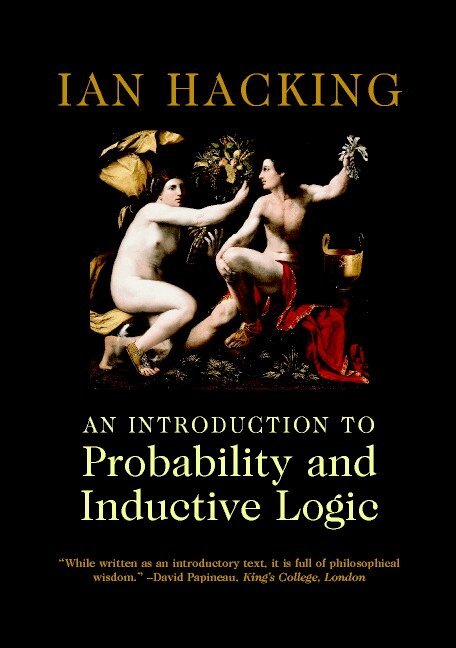
    An Introduction to Probability and Inductive Logic

    AvIan Hacking

    Inbunden, Engelska, 2001

    1 381 kr

    Beställningsvara. Skickas inom 7-10 vardagar. Fri frakt över 249 kr.

    Fler format och utgåvor

    Häftad

    536 kr

    Beskrivning

    This is an introductory 2001 textbook on probability and induction written by one of the world's foremost philosophers of science. The book has been designed to offer maximal accessibility to the widest range of students (not only those majoring in philosophy) and assumes no formal training in elementary symbolic logic. It offers a comprehensive course covering all basic definitions of induction and probability, and considers such topics as decision theory, Bayesianism, frequency ideas, and the philosophical problem of induction. The key features of this book are a lively and vigorous prose style; lucid and systematic organization and presentation of ideas; many practical applications; a rich supply of exercises drawing on examples from such fields as psychology, ecology, economics, bioethics, engineering, and political science; numerous brief historical accounts of how fundamental ideas of probability and induction developed; and a full bibliography of further reading.

    Produktinformation

    • Utgivningsdatum:2001-07-02
    • Mått:187 x 260 x 24 mm
    • Vikt:863 g
    • Format:Inbunden
    • Språk:Engelska
    • Antal sidor:322
    • Förlag:Cambridge University Press
    • ISBN:9780521772877

    Utforska kategorier

    • Filosofi inom Filosofi och religion

    Mer om författaren

    Ian Hacking is the winner of the Holberg International Memorial Prize 2009.

    Recensioner i media

    'Hacking's book excels … especially in the practical, concrete examples. It uses minimal mathematics and presumes no acquaintance with symbolic logic. It is well suited for graduate or advanced undergraduate courses in inductive logic or related areas (such as philosophy of science or methodology courses in particular empirical sciences). The book gives a nice introduction to inductive logic.' Harry Gensler, The Times Higher Education Supplement

    Innehållsförteckning

    • Part I. Logic: 1. Logic; 2. What is inductive logic?; Part II. How to Calculate Probabilities: 3. The gambler's fallacy; 4. Elementary probability; 5. Conditional probability; 6. Basic laws of probability; 7. Bayes' rule; Part III. How to Combine Probabilities and Utilities: 8. Expected value; 9. Maximizing expected value; 10. Decision under uncertainty; Part IV. Kinds of Probability: 11. What do you mean?; 12. Theories about probability; Part V. Probability as a Measure of Belief: 13. Personal probabilities; 14. Coherence; 15. Learning from experience; Part VI. Probability as Frequency: 16. Stability; 17. Normal approximations; 18. Significance; 19. Confidence and inductive behaviour; Part VII. Probability Applied to Philosophy: 20. The philosophical problem of induction; 21. Learning from experience as an evasion of the problem; 22. Inductive behaviour as an evasion of the problem.