• Fri frakt över 249 kr
  • •
  • Snabba leveranser
  • •
  • Billiga böcker
Kundservice

Du är på sajten för privatpersoner.

Företag, bibliotek eller offentlig verksamhet?

Du handlar på classic.bokus.com, där alla dina funktioner finns intakta.
Till classic.bokus.com
Bokus logotyp. Gå till startsidan.
  • Erbjudanden
  • Nyheter
  • Student
  • Topplistor
  • Barn & ungdom
  • Bokus Play
  • E-böcker
  • Pocketböcker
  • Spel & pussel

10% studentrabatt med kod TERM26

Sidfot

Mina sidor

    Hjälp

    • Kundservice
    • Vanliga frågor och svar
    • Frakt och leverans
    • Retur vid ångerrätt
    • Reklamera vara
    • Betalning
    • Köpvillkor
    • Allmänna villkor
    • Information om webbplatsens tillgänglighet

    Om Bokus

    • Om oss
    • Pressrum
    • För studenter
    • För företag
    • För bibliotek och offentlig verksamhet
    • För leverantörer
    • Hållbarhet

    Populärt

    • Aktuella erbjudanden
    • Presentkort
    • Studentlitteratur
    • Nya böcker
    • Topplistor
    • Signerade böcker
    • Engelska böcker

    Inspiration

    • Boktips
    • BookTok
    • Populära bokserier
    • Barnbokskaraktärer
    • Populära författare
    Logotyp för Bokus
    Följ oss på Facebook (extern länk)Följ oss på Instagram (extern länk)Följ oss på YouTube (extern länk)Följ oss på TikTok (extern länk)
    bokus @ CookiesAnpassa cookiesIntegritetspolicyKöpvillkor
    Till Citymail hemsida (extern länk)Till Budbee hemsida (extern länk)Till Postnord hemsida (extern länk)Till Schenker hemsida (extern länk)Till Early Bird hemsida (extern länk)Till Walleys hemsida (extern länk)
    1. Filosofi och religion
    2. Filosofi
    3. Filosofiska discipliner

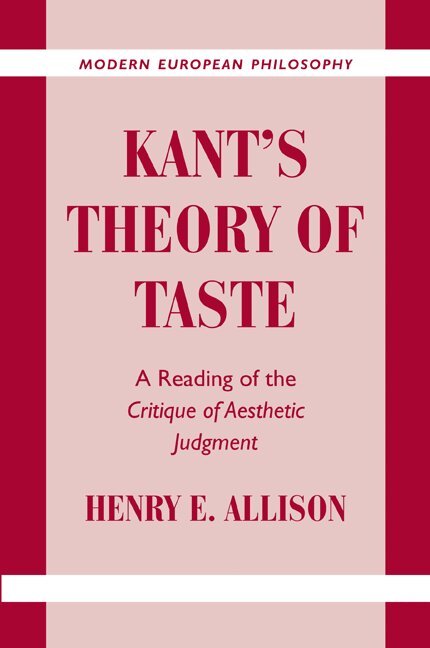
    Kant's Theory of Taste

    A Reading of the Critique of Aesthetic Judgment

    AvHenry E. Allison,Robert B. Pippin

    Häftad, Engelska, 2001

    Del i serien Modern European Philosophy

    494 kr

    Beställningsvara. Skickas inom 10-15 vardagar. Fri frakt över 249 kr.

    Fler format och utgåvor

    Inbunden

    906 kr

    Beskrivning

    This book constitutes one of the most important contributions to recent Kant scholarship. In it, one of the pre-eminent interpreters of Kant, Henry Allison, offers a comprehensive, systematic, and philosophically astute account of all aspects of Kant's views on aesthetics. The first part of the book analyses Kant's conception of reflective judgment and its connections with both empirical knowledge and judgments of taste. The second and third parts treat two questions that Allison insists must be kept distinct: the normativity of pure judgments of taste, and the moral and systematic significance of taste. The fourth part considers two important topics often neglected in the study of Kant's aesthetics: his conceptions of fine art, and the sublime.

    Produktinformation

    • Utgivningsdatum:2001-04-16
    • Mått:155 x 229 x 26 mm
    • Vikt:590 g
    • Format:Häftad
    • Språk:Engelska
    • Serie:Modern European Philosophy
    • Antal sidor:444
    • Förlag:Cambridge University Press
    • ISBN:9780521795340

    Utforska kategorier

    • Filosofiska discipliner inom Filosofi och religion

    Recensioner i media

    'Kant's Theory of Taste is a well produced volume usefully equipped at the end with a compendious bibliography.' Mind

    Innehållsförteckning

    • Acknowledgments; Note on sources and key to abbreviations and translations; Introduction; Part I. Kant's Conception of Reflective Judgment: 1. Reflective judgment and the purposiveness of nature; 2. Reflection and taste in the introductions; Part II. Te Quid Facti and the Quid Juris in the Domain of Taste: 3. The analytic of the beautiful and the quid facti: an overview; 4. The disinterestedness of the pure judgment of taste; 5. Subjective universality, the universal voice, and the harmony of the faculties; 6. Beauty, purposiveness, and form; 7. The modality of taste and the sensus communis; 8. The deduction of pure judgments of taste; Part III. The Moral and Systematic Significance of Taste: 9. Reflective judgment and the transition from nature to freedom; 10. Beauty, duty, and interest: the moral significance of natural beauty; 11. The antinomy of taste and beauty as a symbol of morality; Part IV. Parerga to the Theory of Taste: 12. Fine art and genius; 13. The sublime; Notes; Bibliography; Index.