• Fri frakt över 249 kr
  • •
  • Snabba leveranser
  • •
  • Billiga böcker
Kundservice

Du är på sajten för privatpersoner.

Företag, bibliotek eller offentlig verksamhet?

Du handlar på classic.bokus.com, där alla dina funktioner finns intakta.
Till classic.bokus.com
Bokus logotyp. Gå till startsidan.
  • Erbjudanden
  • Nyheter
  • Student
  • Topplistor
  • Barn & ungdom
  • Bokus Play
  • E-böcker
  • Pocketböcker
  • Spel & pussel

10% rabatt på allt med kod NYSTART10 →

Sidfot

Mina sidor

    Hjälp

    • Kundservice
    • Vanliga frågor och svar
    • Frakt och leverans
    • Retur vid ångerrätt
    • Reklamera vara
    • Betalning
    • Köpvillkor
    • Allmänna villkor
    • Information om webbplatsens tillgänglighet

    Om Bokus

    • Om oss
    • Pressrum
    • För studenter
    • För företag
    • För bibliotek och offentlig verksamhet
    • För leverantörer
    • Hållbarhet

    Populärt

    • Aktuella erbjudanden
    • Presentkort
    • Studentlitteratur
    • Nya böcker
    • Topplistor
    • Signerade böcker
    • Engelska böcker

    Inspiration

    • Boktips
    • BookTok
    • Populära bokserier
    • Barnbokskaraktärer
    • Populära författare
    Logotyp för Bokus
    Följ oss på Facebook (extern länk)Följ oss på Instagram (extern länk)Följ oss på YouTube (extern länk)Följ oss på TikTok (extern länk)
    bokus @ CookiesAnpassa cookiesIntegritetspolicyKöpvillkor
    Till Citymail hemsida (extern länk)Till Budbee hemsida (extern länk)Till Postnord hemsida (extern länk)Till Schenker hemsida (extern länk)Till Early Bird hemsida (extern länk)Till Walleys hemsida (extern länk)
    1. Naturvetenskap och teknik
    2. Matematik och naturvetenskap
    3. Matematik
    4. Talteori

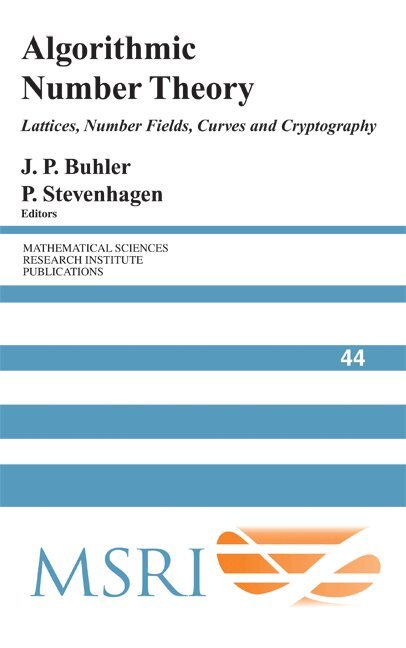
    Algorithmic Number Theory

    Lattices, Number Fields, Curves and Cryptography

    AvJ. P. Buhler,P. Stevenhagen

    Inbunden, Engelska, 2008

    Del 44 i serien Mathematical Sciences Research Institute Publications

    2 408 kr

    Beställningsvara. Skickas inom 10-15 vardagar. Fri frakt över 249 kr.

    Beskrivning

    Number theory is one of the oldest and most appealing areas of mathematics. Computation has always played a role in number theory, a role which has increased dramatically in the last 20 or 30 years, both because of the advent of modern computers, and because of the discovery of surprising and powerful algorithms. As a consequence, algorithmic number theory has gradually emerged as an important and distinct field with connections to computer science and cryptography as well as other areas of mathematics. This text provides a comprehensive introduction to algorithmic number theory for beginning graduate students, written by the leading experts in the field. It includes several articles that cover the essential topics in this area, and in addition, there are contributions pointing in broader directions, including cryptography, computational class field theory, zeta functions and L-series, discrete logarithm algorithms, and quantum computing.

    Produktinformation

    • Utgivningsdatum:2008-10-20
    • Mått:156 x 234 x 37 mm
    • Vikt:1 030 g
    • Format:Inbunden
    • Språk:Engelska
    • Serie:Mathematical Sciences Research Institute Publications
    • Antal sidor:664
    • Förlag:Cambridge University Press
    • ISBN:9780521808545

    Utforska kategorier

    • Talteori inom Naturvetenskap och teknik

    Mer om författaren

    Joe Buhler received his Ph.D. from Harvard University in 1977, writing a thesis on algebraic number theory. He has taught at the Pennsylvania State Universtiy, Harvard University, and Reed College, and served as the Deputy Director at the Mathematical Sciences Research Institute in Berkeley, California. His research interests include number theory, combinatorics, algebra, and algorithmic aspects of these fields. In addition to research papers and monographs he has written popular articles on mathematics, and the mathematics of juggling. He has served on various committees of the American Mathematical Society and the Mathematics Association of America, is an editor for several journals, and has organized several major conferences in number theory. Peter Stevenhagen obtained his PhD from the University of California at Berkeley in 1988. He was charge de recherche in the CNRS in Besancon, France before forming a small number theory group at the University of Amsterdam. Since 1993, he is the organizer of the biweekly Intercity Number Theory Seminar, the Dutch national platform for research in number theory. In 2000 he was appointed at Leiden University, the oldest university in the Netherlands, which was founded in 1575. Besides his research papers, his bibliography counts various papers in number theory of popularizing and historical nature. He is a member of the board of the Dutch Mathematical Society, the Wiskundig Genootschap.

    Recensioner i media

    Review of the hardback: '… can be warmly recommended to anyone interested in the fascinating area of computational number theory.' EMS Newsletter

    Innehållsförteckning

    • 1. Solving Pell's equation Hendrik Lenstra; 2. Basic algorithms in number theory Joe Buhler and Stan Wagon; 3. Elliptic curves Bjorn Poonen; 4. The arithmetic of number rings Peter Stevenhagen; 5. Fast multiplication and applications Dan Bernstein; 6. Primality testing Rene Schoof; 7. Smooth numbers: computational number theory and beyond Andrew Granville; 8. Smooth numbers and the quadratic sieve Carl Pomerance; 9. The number field sieve Peter Stevenhagen; 10. Elementary thoughts on discrete logarithms Carl Pomerance; 11. The impact of the number field sieve on the discrete logarithm problem in finite fields Oliver Schirokauer; 12. Lattices Hendrik Lenstra; 13. Reducing lattices to find small-height values of univariate polynomials Dan Bernstein; 14. Protecting communications against forgery Dan Bernstein; 15. Computing Arakelov class groups Rene Schoof; 16. Computational class field theory Henri Cohen and Peter Stevenhagen; 17. Zeta functions over finite fields Daqing Wan; 18. Counting points on varieties over finite fields Alan Lauder and Daqing Wan; 19. How to get your hands on modular forms using modular symbols William Stein; 20. Congruent number problems in dimension one and two Jaap Top and Noriko Yui.