• Fri frakt över 249 kr
  • •
  • Snabba leveranser
  • •
  • Billiga böcker
Kundservice

Du är på sajten för privatpersoner.

Företag, bibliotek eller offentlig verksamhet?

Du handlar på classic.bokus.com, där alla dina funktioner finns intakta.
Till classic.bokus.com
Bokus logotyp. Gå till startsidan.
  • Erbjudanden
  • Nyheter
  • Student
  • Topplistor
  • Barn & ungdom
  • Bokus Play
  • E-böcker
  • Pocketböcker
  • Spel & pussel

10% rabatt på allt med kod NYSTART10 →

Sidfot

Mina sidor

    Hjälp

    • Kundservice
    • Vanliga frågor och svar
    • Frakt och leverans
    • Retur vid ångerrätt
    • Reklamera vara
    • Betalning
    • Köpvillkor
    • Allmänna villkor
    • Information om webbplatsens tillgänglighet

    Om Bokus

    • Om oss
    • Pressrum
    • För studenter
    • För företag
    • För bibliotek och offentlig verksamhet
    • För leverantörer
    • Hållbarhet

    Populärt

    • Aktuella erbjudanden
    • Presentkort
    • Studentlitteratur
    • Nya böcker
    • Topplistor
    • Signerade böcker
    • Engelska böcker

    Inspiration

    • Boktips
    • BookTok
    • Populära bokserier
    • Barnbokskaraktärer
    • Populära författare
    Logotyp för Bokus
    Följ oss på Facebook (extern länk)Följ oss på Instagram (extern länk)Följ oss på YouTube (extern länk)Följ oss på TikTok (extern länk)
    bokus @ CookiesAnpassa cookiesIntegritetspolicyKöpvillkor
    Till Citymail hemsida (extern länk)Till Budbee hemsida (extern länk)Till Postnord hemsida (extern länk)Till Schenker hemsida (extern länk)Till Early Bird hemsida (extern länk)Till Walleys hemsida (extern länk)
    1. Naturvetenskap och teknik
    2. Matematik och naturvetenskap
    3. Matematik

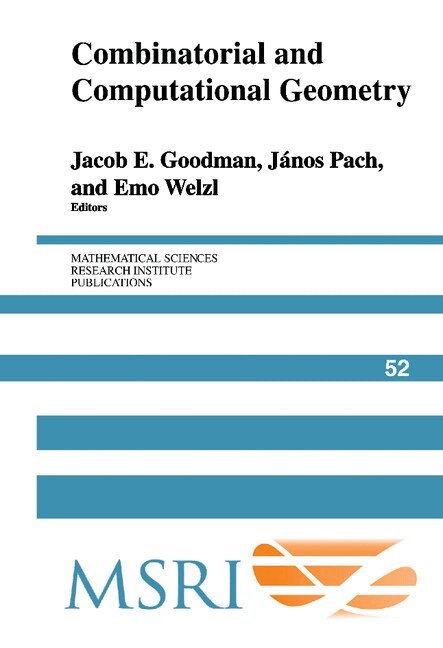
    Combinatorial and Computational Geometry

    AvJacob E. Goodman,Janos Pach

    Inbunden, Engelska, 2005

    Del 52 i serien Mathematical Sciences Research Institute Publications

    1 362 kr

    Beställningsvara. Skickas inom 10-15 vardagar. Fri frakt över 249 kr.

    Beskrivning

    During the past few decades, the gradual merger of Discrete Geometry and the newer discipline of Computational Geometry has provided enormous impetus to mathematicians and computer scientists interested in geometric problems. This 2005 volume, which contains 32 papers on a broad range of topics of interest in the field, is an outgrowth of that synergism. It includes surveys and research articles exploring geometric arrangements, polytopes, packing, covering, discrete convexity, geometric algorithms and their complexity, and the combinatorial complexity of geometric objects, particularly in low dimension. There are points of contact with many applied areas such as mathematical programming, visibility problems, kinetic data structures, and biochemistry, as well as with algebraic topology, geometric probability, real algebraic geometry, and combinatorics.

    Produktinformation

    • Utgivningsdatum:2005-08-08
    • Mått:160 x 242 x 39 mm
    • Vikt:1 010 g
    • Format:Inbunden
    • Språk:Engelska
    • Serie:Mathematical Sciences Research Institute Publications
    • Antal sidor:630
    • Förlag:Cambridge University Press
    • ISBN:9780521848626

    Utforska kategorier

    • Matematik inom Naturvetenskap och teknik

    Mer om författaren

    Jacob E. Goodman is a professor of Mathematics at City College, CUNY, and the author of a number of papers in Geometry. He is the co-founder and co-editor-in-chief of The Journal of Discrete and Computational Geometry. He is also the co-editor of many other leading books in the field, most notably, The Handbook of Discrete and Computational Geometry, published by CRC Press, whose second edition has just appeared, and several volumes published by the American Mathematical Society. A past winner of the MAA's Lester R. Ford award, Goodman was also the founder and first president of the New York Composers Circle. He is a member of the American Mathematical Society. Janos Pach is a distinguished professor of Computer Science at City College, New York, Senior Research Fellow at the Mathematical Institute of the Hungarian Academy of Sciences, and Research Professor at New York University. His main fields of interest are Discrete and Computational Geometry, Convexity and Combinatorics. He has written more than 180 research papers. His book, Combinatorial Geometry (with Pankaj Agarwal) was published by Wiley in 1995. He serves on the editorial boards of seven professional journals. For his scientific achievements, he received the Grunwald medal from The Janos Bolyai Mathematical Society (1982), The Lester R. Ford award from The Mathematical Association of America (1990), The Renyi Prize, and the Academy Award from the Hungarian Academy of Sciences (1993, 1998). Emo Welzl is a full professor of Computer Science at the Institute for Theoretical Computer Science of Eth Zurich. His research interests are in the Foundations of Computer Science, mainly Algorithms and Data Structures, in particular, Computational Geometry and Applications, Analysis of Geometric Structures, Randomized Methods, and Discrete Gometry. He was awarded the Max Planck Prize in 1992 and the Gottfried Wilhelm Leibniz Prize in 1995. He has been an ACM Fellow since 1998.

    Innehållsförteckning

    • 1. Geometric approximation via core sets Pankaj K. Agarwal, Sariel Har-Peled and Kasturi Varadarajan; 2. Applications of graph and hypergraph theory in geometry Imre Barany; 3. Convex geometry of orbits Alexander Barvinok and Grigoriy Blekherman; 4. The Hadwiger transversal theorem for pseudolines Saugata Basu, Jacob E. Goodman, Andreas Holmsen and Richard Pollack; 5. Betti number bounds, applications, and algorithms Saugata Basu, Richard Pollack and Marie-Francoise Roy; 6. Shelling and the h-vector of the (extra-)ordinary polytope Margaret M. Bayer; 7. On the number of mutually touching cylinders Andras Bezdek; 8. Edge-antipodal 3-polytopes Karoly Bezdek, Tibor Bisztriczky and Karoly Boroczky; 9. A conformal energy for simplicial surfaces Alexander Bobenko; 10. On the size of higher-dimensional triangulations Peter Brass; 11. The carpenter's ruler folding problem Gruia Calinescu and Adrian Dumitrescu; 12. A survey of folding and unfolding in computational geometry Erik D. Demaine and Joseph O'Rourke; 13. On the rank of a tropical matrix Mike Develin, Francisco Santos and Bernd Sturmfels; 14. The geometry of biomolecular solvation Herbert Edelsbrunner and Patrice Koehl; 15. Inequalities for zonotopes Richard G. Ehrenborg; 16. Quasiconvex programming David Eppstein; 17. De Concini-Procesi wonderful arrangement models - a discrete geometer's point of view Eva Maria Feichtner; 18. Thinnest covering of a circle by eight, nine, or ten congruent circles Gabor Fejes Toth; 19. On the complexity of visibility problems with moving viewpoints Peter Gritzmann and Thorsten Theobald; 20. Cylindrical partitions of convex bodies Aladar Heppes and Wlodzimierz Kuperberg; 21. Tropical halfspaces Michael Joswig; 22. Two proofs for Sylvester's problem using an allowable sequence of permutations Hagit Last; 23. A comparison of five implementations of 3d Delaunay tessellation Yuanxin Liu and Jack Snoeyink; 24. Bernstein's basis and real root isolation Bernard Mourrain, Fabrice Rouillier and Marie-Francoise Roy; 25. On some extremal problems in combinatorial geometry Niranjan Nilakantan; 26. A long non-crossing path among disjoint segments in the plane Janos Pach and Rom Pinchasi; 27. On a generalization of Schoenhardt's polyhedron Joerg Rambau; 28. On Hadwiger numbers of direct products of convex bodies Istvan Talata; 29. Binary space partitions - recent developments Csaba D. Toth; 30. Erdos-Szekeres theorem: upper bounds and related results Geza Toth and Pavel Valtr; 31. On the pair-crossing number Pavel Valtr; 32. Geometric random walks: a survey Santosh Vempala.