• Fri frakt över 249 kr
  • •
  • Snabba leveranser
  • •
  • Billiga böcker
Kundservice

Du är på sajten för privatpersoner.

Företag, bibliotek eller offentlig verksamhet?

Du handlar på classic.bokus.com, där alla dina funktioner finns intakta.
Till classic.bokus.com
Bokus logotyp. Gå till startsidan.
  • Erbjudanden
  • Student
  • Topplistor
  • Barn & ungdom
  • Bokus Play
  • E-böcker
  • Ljudböcker
  • Pocketböcker
  • Spel & pussel

10% rabatt på allt med kod NYSTART10 →

Sidfot

Mina sidor

    Hjälp

    • Kundservice
    • Vanliga frågor och svar
    • Frakt och leverans
    • Retur vid ångerrätt
    • Reklamera vara
    • Betalning
    • Köpvillkor
    • Allmänna villkor
    • Information om webbplatsens tillgänglighet

    Om Bokus

    • Om oss
    • Pressrum
    • För studenter
    • För företag
    • För bibliotek och offentlig verksamhet
    • För leverantörer
    • Hållbarhet

    Populärt

    • Aktuella erbjudanden
    • Presentkort
    • Studentlitteratur
    • Nya böcker
    • Topplistor
    • Signerade böcker
    • Engelska böcker

    Inspiration

    • Boktips
    • BookTok
    • Populära bokserier
    • Barnbokskaraktärer
    • Populära författare
    Logotyp för Bokus
    Följ oss på Facebook (extern länk)Följ oss på Instagram (extern länk)Följ oss på YouTube (extern länk)Följ oss på TikTok (extern länk)
    bokus @ CookiesAnpassa cookiesIntegritetspolicyKöpvillkor
    Till Citymail hemsida (extern länk)Till Budbee hemsida (extern länk)Till Postnord hemsida (extern länk)Till Schenker hemsida (extern länk)Till Early Bird hemsida (extern länk)Till Walleys hemsida (extern länk)
    1. Samhälle och politik
    2. Politik och statsskick
    3. Statsvetenskap och politisk teori

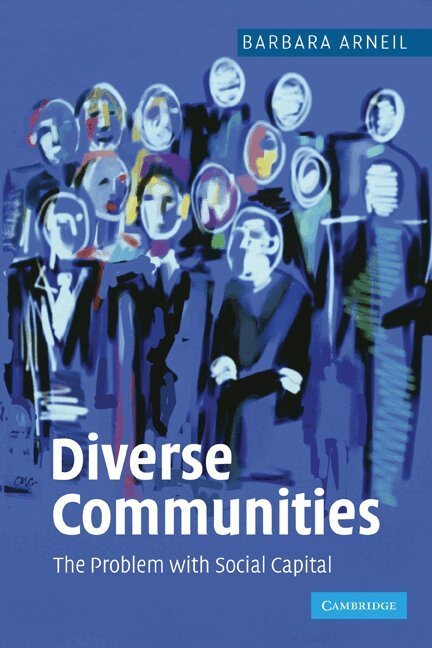
    Diverse Communities

    The Problem with Social Capital

    AvBarbara Arneil

    Inbunden, Engelska, 2006

    1 281 kr

    Beställningsvara. Skickas inom 10-15 vardagar. Fri frakt över 249 kr.

    Fler format och utgåvor

    Häftad

    463 kr

    Beskrivning

    Diverse Communities is a critique of Robert Putnam's social capital thesis, re-examined from the perspective of women and cultural minorities in America over the last century. Barbara Arneil argues that the idyllic communities of the past were less positive than Putnam envisions and that the current 'collapse' in participation is better understood as change rather than decline. Arneil suggests that the changes in American civil society in the last half century are not so much the result of generational change or television as the unleashing of powerful economic, social and cultural forces that, despite leading to division and distrust within American society, also contributed to greater justice for women and cultural minorities. She concludes by proposing that the lessons learned from this fuller history of American civil society provide the normative foundation to enumerate the principles of justice by which diverse communities might be governed in the twenty-first century.

    Produktinformation

    • Utgivningsdatum:2006-09-14
    • Mått:157 x 235 x 21 mm
    • Vikt:570 g
    • Format:Inbunden
    • Språk:Engelska
    • Antal sidor:280
    • Förlag:Cambridge University Press
    • ISBN:9780521857192

    Utforska kategorier

    • Statsvetenskap och politisk teori inom Samhälle och politik

    Mer om författaren

    Barbara Arneil is Associate Professor in the Department of Political Science at the University of British Columbia. She won the Harrison Prize for the best article published in Political Studies in 1996 and is the author of Feminism and Politics (1999) and John Locke and America: A Defense of English Colonialism (1996).

    Recensioner i media

    'Arneil should be required reading alongside Bowling Alone. Her arguments about the power dynamics undergirding social capital and the importance of conflict offer a critical corrective to a rose-coloured view of social cohesion and trust.' Canadian Journal of Sociology

    Innehållsförteckning

    • 1. Social capital, justice and diversity: an introduction; 2. The progressive era: past paradise?; 3. The present malaise in civic participation: empirical and normative dimensions; 4. The causes of 'decline' in social capital theory; 5. Civic trust and shared norms; 6. Beyond Bowling Alone: social capital in twenty-first century America; 7. Justice in diverse communities: lessons for the future.