• Fri frakt över 249 kr
  • •
  • Snabba leveranser
  • •
  • Billiga böcker
Kundservice

Du är på sajten för privatpersoner.

Företag, bibliotek eller offentlig verksamhet?

Du handlar på classic.bokus.com, där alla dina funktioner finns intakta.
Till classic.bokus.com
Bokus logotyp. Gå till startsidan.
  • Erbjudanden
  • Nyheter
  • Student
  • Topplistor
  • Barn & ungdom
  • Bokus Play
  • E-böcker
  • Pocketböcker
  • Spel & pussel

10% rabatt på allt med kod NYSTART10 →

Sidfot

Mina sidor

    Hjälp

    • Kundservice
    • Vanliga frågor och svar
    • Frakt och leverans
    • Retur vid ångerrätt
    • Reklamera vara
    • Betalning
    • Köpvillkor
    • Allmänna villkor
    • Information om webbplatsens tillgänglighet

    Om Bokus

    • Om oss
    • Pressrum
    • För studenter
    • För företag
    • För bibliotek och offentlig verksamhet
    • För leverantörer
    • Hållbarhet

    Populärt

    • Aktuella erbjudanden
    • Presentkort
    • Studentlitteratur
    • Nya böcker
    • Topplistor
    • Signerade böcker
    • Engelska böcker

    Inspiration

    • Boktips
    • BookTok
    • Populära bokserier
    • Barnbokskaraktärer
    • Populära författare
    Logotyp för Bokus
    Följ oss på Facebook (extern länk)Följ oss på Instagram (extern länk)Följ oss på YouTube (extern länk)Följ oss på TikTok (extern länk)
    bokus @ CookiesAnpassa cookiesIntegritetspolicyKöpvillkor
    Till Citymail hemsida (extern länk)Till Budbee hemsida (extern länk)Till Postnord hemsida (extern länk)Till Schenker hemsida (extern länk)Till Early Bird hemsida (extern länk)Till Walleys hemsida (extern länk)
    1. Samhälle och politik
    2. Politik och statsskick

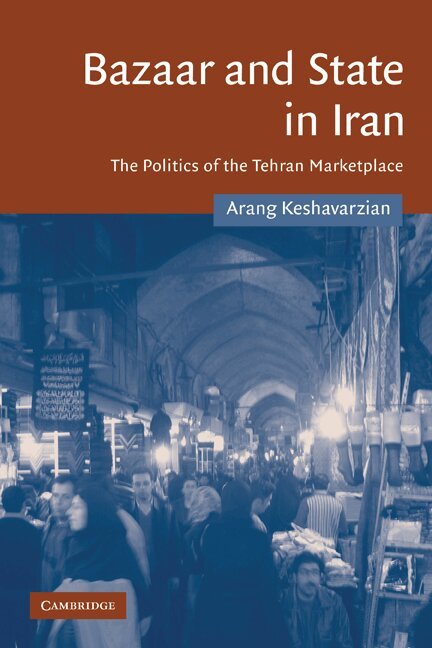
    Bazaar and State in Iran

    The Politics of the Tehran Marketplace

    AvArang Keshavarzian

    Inbunden, Engelska, 2007

    Del 26 i serien Cambridge Middle East Studies

    1 271 kr

    Beställningsvara. Skickas inom 10-15 vardagar. Fri frakt över 249 kr.

    Fler format och utgåvor

    Häftad

    463 kr

    Beskrivning

    The Tehran Bazaar has always been central to the Iranian economy and indeed, to the Iranian urban experience. Arang Keshavarzian's fascinating book compares the economics and politics of the marketplace under the Pahlavis, who sought to undermine it in the drive for modernisation and under the subsequent revolutionary regime, which came to power with a mandate to preserve the bazaar as an 'Islamic' institution. The outcomes of their respective policies were completely at odds with their intentions. Despite the Shah's hostile approach, the bazaar flourished under his rule and maintained its organisational autonomy to such an extent that it played an integral role in the Islamic revolution. Conversely, the Islamic Republic implemented policies that unwittingly transformed the ways in which the bazaar operated, thus undermining its capacity for political mobilisation. Arang Keshavarizian's book affords unusual insights into the politics, economics and society of Iran across four decades.

    Produktinformation

    • Utgivningsdatum:2007-04-12
    • Mått:162 x 235 x 25 mm
    • Vikt:655 g
    • Format:Inbunden
    • Språk:Engelska
    • Serie:Cambridge Middle East Studies
    • Antal sidor:320
    • Förlag:Cambridge University Press
    • ISBN:9780521866187

    Utforska kategorier

    • Politik och statsskick inom Samhälle och politik

    Mer om författaren

    Arang Keshavarzian is Assistant Professor in Political Science at Concordia University, Montréal.

    Recensioner i media

    'Keshavarzian casts his study within an intelligent and provocative theoretical framework, while providing the reader with rich empirical detail … He makes new contributions to the study of the Tehran bazaar.' Ervand Abrahamian, Baruch College

    Innehållsförteckning

    • 1. The puzzle of the Tehran Bazaar under the Pahlavi monarchy and the Islamic Republic; 2. Conceptualising the bazaar; 3. Bazaar transformations: networks, reputations and solidarities; 4. Networks in the context of transformative agendas; 5. Carpets, tea and teacups: commodity types and sectoral trajectories; 6. Networks of mobilisation under two regimes; 7. Conclusions; Selected bibliography; Index.