• Fri frakt över 249 kr
  • •
  • Snabba leveranser
  • •
  • Billiga böcker
Kundservice

Du är på sajten för privatpersoner.

Företag, bibliotek eller offentlig verksamhet?

Du handlar på classic.bokus.com, där alla dina funktioner finns intakta.
Till classic.bokus.com
Bokus logotyp. Gå till startsidan.
  • Erbjudanden
  • Nyheter
  • Student
  • Topplistor
  • Barn & ungdom
  • Bokus Play
  • E-böcker
  • Pocketböcker
  • Spel & pussel

Må bättre, för mindre! Upp till 50% rabatt på hälsoböcker

Sidfot

Mina sidor

    Hjälp

    • Kundservice
    • Vanliga frågor och svar
    • Frakt och leverans
    • Retur vid ångerrätt
    • Reklamera vara
    • Betalning
    • Köpvillkor
    • Allmänna villkor
    • Information om webbplatsens tillgänglighet

    Om Bokus

    • Om oss
    • Pressrum
    • För studenter
    • För företag
    • För bibliotek och offentlig verksamhet
    • För leverantörer
    • Hållbarhet

    Populärt

    • Aktuella erbjudanden
    • Presentkort
    • Studentlitteratur
    • Nya böcker
    • Topplistor
    • Signerade böcker
    • Engelska böcker

    Inspiration

    • Boktips
    • BookTok
    • Populära bokserier
    • Barnbokskaraktärer
    • Populära författare
    Logotyp för Bokus
    Följ oss på Facebook (extern länk)Följ oss på Instagram (extern länk)Följ oss på YouTube (extern länk)Följ oss på TikTok (extern länk)
    bokus @ CookiesAnpassa cookiesIntegritetspolicyKöpvillkor
    Till Citymail hemsida (extern länk)Till Budbee hemsida (extern länk)Till Postnord hemsida (extern länk)Till Schenker hemsida (extern länk)Till Early Bird hemsida (extern länk)Till Walleys hemsida (extern länk)
    1. Ekonomi och Ledarskap
    2. Nationalekonomi
    3. Mikroekonomi

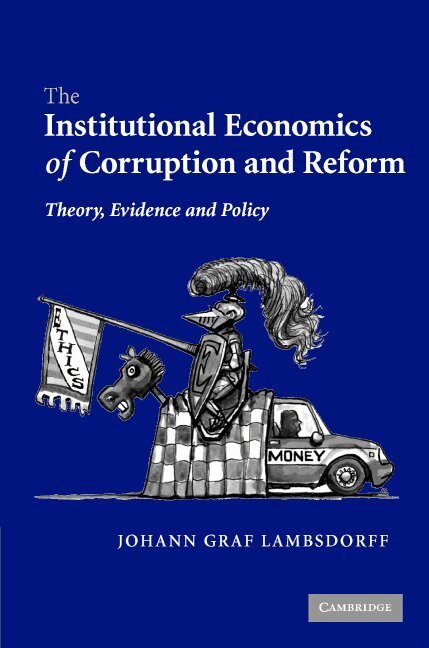
    The Institutional Economics of Corruption and Reform

    Theory, Evidence and Policy

    AvJohann Graf Lambsdorff

    Inbunden, Engelska, 2007

    1 513 kr

    Beställningsvara. Skickas inom 10-15 vardagar. Fri frakt över 249 kr.

    Fler format och utgåvor

    Häftad

    615 kr

    Beskrivning

    Corruption has been a feature of public institutions for centuries yet only relatively recently has it been made the subject of sustained scientific analysis. Lambsdorff shows how insights from institutional economics can be used to develop a better understanding of why corruption occurs and the best policies to combat it. He argues that rather than being deterred by penalties, corrupt actors are more influenced by other factors such as the opportunism of their criminal counterparts and the danger of acquiring an unreliable reputation. This suggests a novel strategy for fighting corruption similar to the invisible hand that governs competitive markets. This strategy - the 'invisible foot' - shows that the unreliability of corrupt counterparts induces honesty and good governance even in the absence of good intentions. Combining theoretical research with state-of-the-art empirical investigations, this book will be an invaluable resource for researchers and policy-makers concerned with anti-corruption reform.

    Produktinformation

    • Utgivningsdatum:2007-03-08
    • Mått:160 x 234 x 27 mm
    • Vikt:617 g
    • Format:Inbunden
    • Språk:Engelska
    • Antal sidor:304
    • Förlag:Cambridge University Press
    • ISBN:9780521872751

    Utforska kategorier

    • Mikroekonomi inom Ekonomi och Ledarskap

    Mer om författaren

    Johann Graf Lambsdorff is Chair in Economic Theory at the University of Passau, Germany, and senior research consultant to Transparency International.

    Recensioner i media

    Review of the hardback: 'Lambsdorff provides a sound institutional economic analysis of corruption and possible reforms. This book will improve our understanding of the difficult topic of corruption and will help policy makers to better cope with its consequences. It will be the standard treatment of this subject for many years to come.' Friedrich Schneider, Professor of Economics, Johannes Kepler University of Linz

    Innehållsförteckning

    • Acknowledgements; A roadmap to this book; 1. Introduction; 2. Enemies of corruption; 3. What is bad about bureaucratic corruption? An institutional economic approach; 4. The dilemma of the kleptocrat: what is bad about political corruption?; 5. Corruption and transactions costs: the rent-seeking perspective; 6. Making corrupt deals: contracting in the shadow of the law; 7. Exporters' ethics and the art of bribery; 8. How confidence facilitates illegal transactions: an empirical approach; 9. Corrupt relational contracting; 10. Concluding thoughts; Annex: Technical details to the Transparency International Corruption Perceptions Index; References; Index.