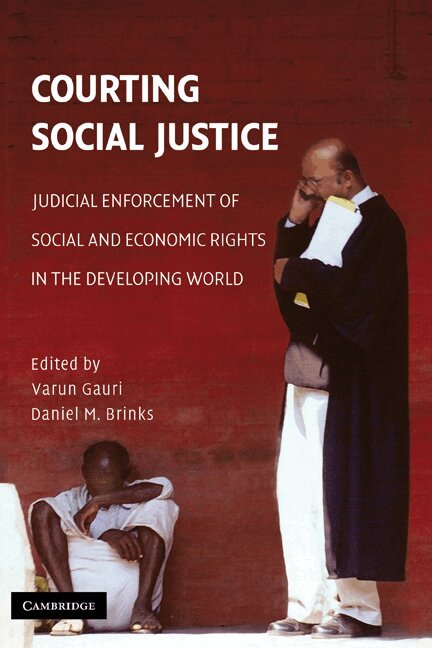
Courting Social Justice
Judicial Enforcement of Social and Economic Rights in the Developing World
AvVarun Gauri,Daniel M. Brinks
835 kr
Beställningsvara. Skickas inom 5-8 vardagar. Fri frakt över 249 kr.
Du är på sajten för privatpersoner.
AvVarun Gauri,Daniel M. Brinks
835 kr
Beställningsvara. Skickas inom 5-8 vardagar. Fri frakt över 249 kr.
Varun Gauri is Senior Economist in the Development Research Group of the World Bank. His research focuses on politics and governance in the social sectors and aims to combine quantitative and qualitative methods in economics and social science research. His research has addressed HIV/AIDS policies in Brazil, South Africa, and Mozambique; basic immunization in Pakistan; the behavior of development nongovernmental organizations (NGOs) in Bangladesh; payment modalities for health-care providers in Costa Rica and Nigeria; litigation for social and economic rights in developing countries; and the relationship between international human rights treaties and development outcomes. He is the author of School Choice in Chile: Two Decades of Educational Reform. He has published widely in development journals, including World Development, the Journal of Development Studies, Studies in Comparative International Development, World Bank Research Observer, and Health Policy and Planning. Since joining the World Bank in 1996, he has also worked on and led a variety of operational and analytic tasks, including project and program evaluations, investments in privately owned hospitals, health-care decentralization, and public expenditure reviews. Daniel M. Brinks is Assistant Professor of Government at the University of Texas at Austin. He teaches in comparative politics and public law, with emphasis on comparative judicial politics and democracy in Latin America, and his research focuses on the role of the law and courts in supporting or deepening democracy. In addition to his research on the judicial response to police violence in Brazil, Argentina, and Uruguay, he has written on judicial independence, the role of informal norms in the legal order, and the use of law-based approaches to extend social and economic rights in developing countries. His research appears in journals such as Comparative Politics, Studies in Comparative International Development, Comparative Political Studies, and the Texas International Law Journal.
'Human rights are meaningless if they cannot be claimed. The formal court system is playing an increasingly important role in enforcing human rights claims in many countries, frequently with life-saving impacts, as part of the overarching institutional architecture and social mobilization for human rights accountability. Gauri and Brinks have produced a timely, distinctive and important comparative empirical analysis of prerequisites for effective legal claims to socio-economic rights, and their social policy implications. I have no doubt that this book will appeal to a wide readership of public policy makers, economists, social scientists and lawyers, transcending stale theoretical dichotomies between rights of different kinds and showing vividly what a cross-disciplinary field human rights has become.' Louise Arbour, UN Commissioner for Human Rights
Maria Victoria Murillo, Steven Levitsky, Daniel M. Brinks
287 kr
Sandra Botero, Daniel M. Brinks, Ezequiel A. Gonzalez-Ocantos
Inbunden, 2022
1 593 kr
Maria Victoria Murillo, Steven Levitsky, Daniel M. Brinks
543 kr
Du är på sajten för privatpersoner.
AvVarun Gauri,Daniel M. Brinks
835 kr
Beställningsvara. Skickas inom 5-8 vardagar. Fri frakt över 249 kr.
Varun Gauri is Senior Economist in the Development Research Group of the World Bank. His research focuses on politics and governance in the social sectors and aims to combine quantitative and qualitative methods in economics and social science research. His research has addressed HIV/AIDS policies in Brazil, South Africa, and Mozambique; basic immunization in Pakistan; the behavior of development nongovernmental organizations (NGOs) in Bangladesh; payment modalities for health-care providers in Costa Rica and Nigeria; litigation for social and economic rights in developing countries; and the relationship between international human rights treaties and development outcomes. He is the author of School Choice in Chile: Two Decades of Educational Reform. He has published widely in development journals, including World Development, the Journal of Development Studies, Studies in Comparative International Development, World Bank Research Observer, and Health Policy and Planning. Since joining the World Bank in 1996, he has also worked on and led a variety of operational and analytic tasks, including project and program evaluations, investments in privately owned hospitals, health-care decentralization, and public expenditure reviews. Daniel M. Brinks is Assistant Professor of Government at the University of Texas at Austin. He teaches in comparative politics and public law, with emphasis on comparative judicial politics and democracy in Latin America, and his research focuses on the role of the law and courts in supporting or deepening democracy. In addition to his research on the judicial response to police violence in Brazil, Argentina, and Uruguay, he has written on judicial independence, the role of informal norms in the legal order, and the use of law-based approaches to extend social and economic rights in developing countries. His research appears in journals such as Comparative Politics, Studies in Comparative International Development, Comparative Political Studies, and the Texas International Law Journal.
'Human rights are meaningless if they cannot be claimed. The formal court system is playing an increasingly important role in enforcing human rights claims in many countries, frequently with life-saving impacts, as part of the overarching institutional architecture and social mobilization for human rights accountability. Gauri and Brinks have produced a timely, distinctive and important comparative empirical analysis of prerequisites for effective legal claims to socio-economic rights, and their social policy implications. I have no doubt that this book will appeal to a wide readership of public policy makers, economists, social scientists and lawyers, transcending stale theoretical dichotomies between rights of different kinds and showing vividly what a cross-disciplinary field human rights has become.' Louise Arbour, UN Commissioner for Human Rights
Maria Victoria Murillo, Steven Levitsky, Daniel M. Brinks
287 kr
Sandra Botero, Daniel M. Brinks, Ezequiel A. Gonzalez-Ocantos
Inbunden, 2022
1 593 kr
Maria Victoria Murillo, Steven Levitsky, Daniel M. Brinks
543 kr