• Fri frakt över 249 kr
  • •
  • Snabba leveranser
  • •
  • Billiga böcker
Kundservice

Du är på sajten för privatpersoner.

Företag, bibliotek eller offentlig verksamhet?

Du handlar på classic.bokus.com, där alla dina funktioner finns intakta.
Till classic.bokus.com
Bokus logotyp. Gå till startsidan.
  • Erbjudanden
  • Student
  • Topplistor
  • Barn & ungdom
  • Bokus Play
  • E-böcker
  • Ljudböcker
  • Pocketböcker
  • Spel och pussel

Skapa nya rutiner – hälsoböcker upp till 50% →

Sidfot

Mina sidor

    Hjälp

    • Kundservice
    • Vanliga frågor och svar
    • Frakt och leverans
    • Retur vid ångerrätt
    • Reklamera vara
    • Betalning
    • Köpvillkor
    • Allmänna villkor
    • Information om webbplatsens tillgänglighet

    Om Bokus

    • Om oss
    • Pressrum
    • För studenter
    • För företag
    • För bibliotek och offentlig verksamhet
    • För leverantörer
    • Hållbarhet

    Populärt

    • Aktuella erbjudanden
    • Presentkort
    • Studentlitteratur
    • Nya böcker
    • Topplistor
    • Signerade böcker
    • Engelska böcker

    Inspiration

    • Boktips
    • BookTok
    • Barnbokskaraktärer
    • Populära författare
    Logotyp för Bokus
    Följ oss på Facebook (extern länk)Följ oss på Instagram (extern länk)Följ oss på YouTube (extern länk)Följ oss på TikTok (extern länk)
    bokus @ CookiesAnpassa cookiesIntegritetspolicyKöpvillkor
    Till Citymail hemsida (extern länk)Till Budbee hemsida (extern länk)Till Postnord hemsida (extern länk)Till Schenker hemsida (extern länk)Till Early Bird hemsida (extern länk)Till Walleys hemsida (extern länk)
    1. Språk och ordböcker
    2. Språkvetenskap och lingvistik

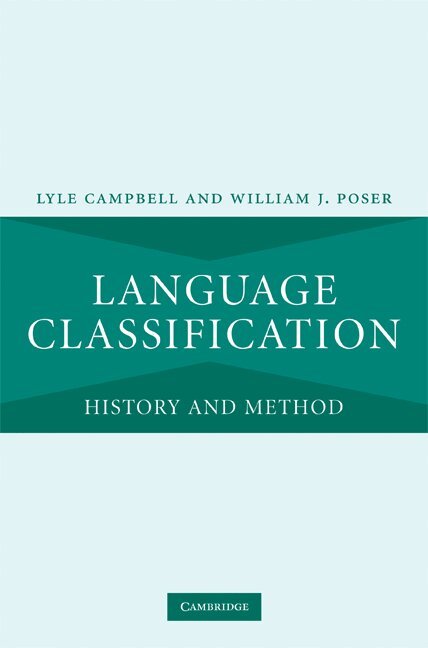
    Language Classification

    History and Method

    AvLyle Campbell,William J. Poser

    Inbunden, Engelska, 2008

    1 900 kr

    Beställningsvara. Skickas inom 7-10 vardagar. Fri frakt över 249 kr.

    Beskrivning

    How are relationships established between the world's languages? This is one of the most topical and most controversial questions in contemporary linguistics. The central aims of this book are to answer this question, to cut through the controversies, and to contribute to research in distant genetic relationships. In doing this the authors aim to: (1) show how the methods have been employed; (2) reveal which methods, techniques, and strategies have proven successful and which ones have proven ineffective; (3) determine how particular language families were established; (4) evaluate several of the most prominent and more controversial proposals of distant genetic relationship (such as Amerind, Nostratic, Eurasiatic, Proto-World, and others); and (5) make recommendations for practice in future research. This book will contribute significantly to understanding language classification in general.

    Produktinformation

    • Utgivningsdatum:2008-06-26
    • Mått:152 x 229 x 35 mm
    • Vikt:970 g
    • Format:Inbunden
    • Språk:Engelska
    • Antal sidor:548
    • Förlag:Cambridge University Press
    • ISBN:9780521880053

    Utforska kategorier

    • Språkvetenskap och lingvistik inom Språk och ordböcker

    Mer om författaren

    Lyle Campbell is Professor of Linguistics in the Department of Linguistics at the University of Utah. William J. Poser is Adjunct Professor of Linguistics in the Department of Linguistics at the University of British Columbia.

    Innehållsförteckning

    • 1. Introduction: how are languages shown to be related to one another?; 2. The beginning of comparative linguistics; 3. 'Asiatic Jones, Oriental Jones': Sir William Jones' role in the rise of comparative linguistics; 4. Consolidation of the comparative linguistics; 5. How some languages were shown to belong to Indo-European; 6. Comparative linguistics of other languages and regions; 7. How to show languages are related: the methods; 8. The philosophical-psychological-typological-evolutionary approach to language relationships; 9. Assessment of proposed distant genetic relationships; 10. Beyond the comparative method?; 11. Why and how do languages diversify and spread?; 12. What can we learn about the earliest human language by comparing languages known today?; 13. Conclusions: anticipating the future.