• Fri frakt över 249 kr
  • •
  • Snabba leveranser
  • •
  • Billiga böcker
Kundservice

Du är på sajten för privatpersoner.

Företag, bibliotek eller offentlig verksamhet?

Du handlar på classic.bokus.com, där alla dina funktioner finns intakta.
Till classic.bokus.com
Bokus logotyp. Gå till startsidan.
  • Erbjudanden
  • Student
  • Topplistor
  • Barn & ungdom
  • Bokus Play
  • E-böcker
  • Ljudböcker
  • Pocketböcker
  • Spel och pussel

5% studentrabatt – använd koden KURSBOK27 →

Sidfot

Mina sidor

    Hjälp

    • Kundservice
    • Vanliga frågor och svar
    • Frakt och leverans
    • Retur vid ångerrätt
    • Reklamera vara
    • Betalning
    • Köpvillkor
    • Allmänna villkor
    • Information om webbplatsens tillgänglighet

    Om Bokus

    • Om oss
    • Pressrum
    • För studenter
    • För företag
    • För bibliotek och offentlig verksamhet
    • För leverantörer
    • Hållbarhet

    Populärt

    • Aktuella erbjudanden
    • Presentkort
    • Studentlitteratur
    • Nya böcker
    • Topplistor
    • Signerade böcker
    • Engelska böcker

    Inspiration

    • Boktips
    • BookTok
    • Barnbokskaraktärer
    • Populära författare
    Logotyp för Bokus
    Följ oss på Facebook (extern länk)Följ oss på Instagram (extern länk)Följ oss på YouTube (extern länk)Följ oss på TikTok (extern länk)
    bokus @ CookiesAnpassa cookiesIntegritetspolicyKöpvillkor
    Till Citymail hemsida (extern länk)Till Budbee hemsida (extern länk)Till Postnord hemsida (extern länk)Till Schenker hemsida (extern länk)Till Early Bird hemsida (extern länk)Till Walleys hemsida (extern länk)
    1. Språk och ordböcker
    2. Språkvetenskap och lingvistik

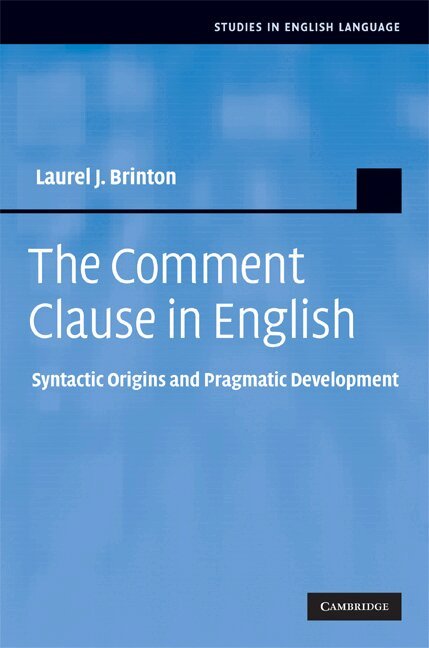
    The Comment Clause in English

    Syntactic Origins and Pragmatic Development

    AvLaurel J. Brinton

    Inbunden, Engelska, 2008

    Del i serien Studies in English Language

    877 kr

    Beställningsvara. Skickas inom 7-10 vardagar. Fri frakt över 249 kr.

    Fler format och utgåvor

    Häftad

    477 kr

    Beskrivning

    Although English comment clauses such as I think and you know have been widely studied, this book constitutes the first full-length diachronic treatment, focusing on comment clauses formed with common verbs of perception and cognition in a variety of syntactic forms. It understands comment clauses as causal pragmatic markers that undergo grammaticalisation, and acquire pragmatic and politeness functions and subjective and intersubjective meanings. To date, the prevailing view of their syntactic development, which is extrapolated from synchronic studies, is that they originate in matrix clauses which become syntactically indeterminate and are reanalysed as parenthetical. In this corpus-based study, Laurel J. Brinton shows that the historical data do not bear out this view, and proposes a more varied and complex conception of the development of comment clauses. Researchers and students of the English language and historical linguistics will certainly consider Brinton's findings to be of great interest.

    Produktinformation

    • Utgivningsdatum:2008-11-20
    • Mått:158 x 235 x 25 mm
    • Vikt:630 g
    • Format:Inbunden
    • Språk:Engelska
    • Serie:Studies in English Language
    • Antal sidor:300
    • Förlag:Cambridge University Press
    • ISBN:9780521886734

    Utforska kategorier

    • Språkvetenskap och lingvistik inom Språk och ordböcker

    Mer om författaren

    Laurel J. Brinton is Professor of English Language at the University of British Columbia.

    Recensioner i media

    'Although the outlines of all case studies look similar, they are variable enough to allow for the individual history and function of each discussed item. The organization of each chapter leads to the derivation that is proposed. The analyses are carefully conducted and easy to understand. No proposed derivation remains unclear. … In sum, it is an impressive and excellent study of the derivation of comment clauses. … I can recommend this book to all linguists …' The Linguist List

    Innehållsförteckning

    • 1. Introduction: comment clauses, parentheticals, and pragmatic markers; 2. Semantic and syntactic development of pragmatic markers; 3. Processes of change; 4. Comment clauses with say; 5. I mean; 6. Comment clauses with see; 7. If you will and as it were; 8. Comment clauses with look; 9. What's more and what else; 10. Epistemic/evidential parentheticals - I gather and I find; 11. Concluding remarks.