• Fri frakt över 249 kr
  • •
  • Snabba leveranser
  • •
  • Billiga böcker
Kundservice

Du är på sajten för privatpersoner.

Företag, bibliotek eller offentlig verksamhet?

Du handlar på classic.bokus.com, där alla dina funktioner finns intakta.
Till classic.bokus.com
Bokus logotyp. Gå till startsidan.
  • Erbjudanden
  • Nyheter
  • Student
  • Topplistor
  • Barn & ungdom
  • Bokus Play
  • E-böcker
  • Pocketböcker
  • Spel & pussel

10% rabatt på allt med kod NYSTART10 →

Sidfot

Mina sidor

    Hjälp

    • Kundservice
    • Vanliga frågor och svar
    • Frakt och leverans
    • Retur vid ångerrätt
    • Reklamera vara
    • Betalning
    • Köpvillkor
    • Allmänna villkor
    • Information om webbplatsens tillgänglighet

    Om Bokus

    • Om oss
    • Pressrum
    • För studenter
    • För företag
    • För bibliotek och offentlig verksamhet
    • För leverantörer
    • Hållbarhet

    Populärt

    • Aktuella erbjudanden
    • Presentkort
    • Studentlitteratur
    • Nya böcker
    • Topplistor
    • Signerade böcker
    • Engelska böcker

    Inspiration

    • Boktips
    • BookTok
    • Populära bokserier
    • Barnbokskaraktärer
    • Populära författare
    Logotyp för Bokus
    Följ oss på Facebook (extern länk)Följ oss på Instagram (extern länk)Följ oss på YouTube (extern länk)Följ oss på TikTok (extern länk)
    bokus @ CookiesAnpassa cookiesIntegritetspolicyKöpvillkor
    Till Citymail hemsida (extern länk)Till Budbee hemsida (extern länk)Till Postnord hemsida (extern länk)Till Schenker hemsida (extern länk)Till Early Bird hemsida (extern länk)Till Walleys hemsida (extern länk)
    1. Naturvetenskap och teknik
    2. Matematik och naturvetenskap
    3. Matematik
    4. Algebra

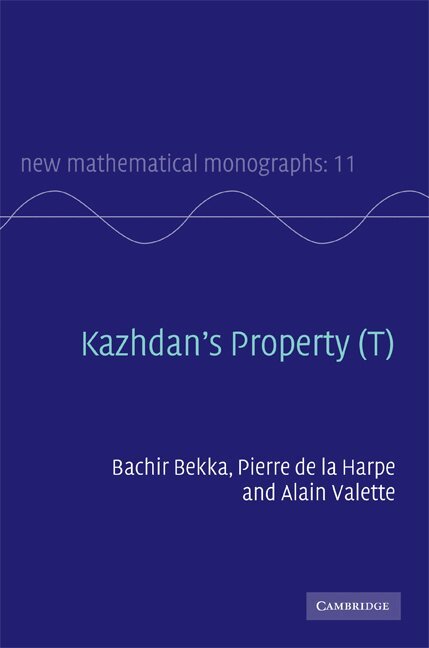
    Kazhdan's Property (T)

    AvBachir Bekka,Pierre de la de la Harpe

    Inbunden, Engelska, 2008

    Del 11 i serien New Mathematical Monographs

    2 072 kr

    Beställningsvara. Skickas inom 10-15 vardagar. Fri frakt över 249 kr.

    Beskrivning

    Property (T) is a rigidity property for topological groups, first formulated by D. Kazhdan in the mid 1960's with the aim of demonstrating that a large class of lattices are finitely generated. Later developments have shown that Property (T) plays an important role in an amazingly large variety of subjects, including discrete subgroups of Lie groups, ergodic theory, random walks, operator algebras, combinatorics, and theoretical computer science. This monograph offers a comprehensive introduction to the theory. It describes the two most important points of view on Property (T): the first uses a unitary group representation approach, and the second a fixed point property for affine isometric actions. Via these the authors discuss a range of important examples and applications to several domains of mathematics. A detailed appendix provides a systematic exposition of parts of the theory of group representations that are used to formulate and develop Property (T).

    Produktinformation

    • Utgivningsdatum:2008-04-17
    • Mått:160 x 235 x 32 mm
    • Vikt:800 g
    • Format:Inbunden
    • Språk:Engelska
    • Serie:New Mathematical Monographs
    • Antal sidor:486
    • Förlag:Cambridge University Press
    • ISBN:9780521887205

    Utforska kategorier

    • Algebra inom Naturvetenskap och teknik
    • Topologi inom Naturvetenskap och teknik

    Mer om författaren

    Bachir Bekka is Professor of Mathematics at the Université de Rennes 1, France. Pierre de la Harpe is Professor of Mathematics at the Université de Genève, Switzerland. Alain Valette is Professor of Mathematics at the Université de Neuchâtel, Switzerland.

    Innehållsförteckning

    • Introduction; Part I. Kazhdan's Property (T): 1. Property (T); 2. Property (FH); 3. Reduced Cohomology; 4. Bounded generation; 5. A spectral criterion for Property (T); 6. Some applications of Property (T); 7. A short list of open questions; Part II. Background on Unitary Representations: A. Unitary group representations; B. Measures on homogeneous spaces; C. Functions of positive type; D. Representations of abelian groups; E. Induced representations; F. Weak containment and Fell topology; G. Amenability; Appendix; Bibliography; List of symbols; Index.