• Fri frakt över 249 kr
  • •
  • Snabba leveranser
  • •
  • Billiga böcker
Kundservice

Du är på sajten för privatpersoner.

Företag, bibliotek eller offentlig verksamhet?

Du handlar på classic.bokus.com, där alla dina funktioner finns intakta.
Till classic.bokus.com
Bokus logotyp. Gå till startsidan.
  • Erbjudanden
  • Nyheter
  • Student
  • Topplistor
  • Barn & ungdom
  • Bokus Play
  • E-böcker
  • Pocketböcker
  • Spel & pussel

Må bättre, för mindre! Upp till 50% rabatt på hälsoböcker

Sidfot

Mina sidor

    Hjälp

    • Kundservice
    • Vanliga frågor och svar
    • Frakt och leverans
    • Retur vid ångerrätt
    • Reklamera vara
    • Betalning
    • Köpvillkor
    • Allmänna villkor
    • Information om webbplatsens tillgänglighet

    Om Bokus

    • Om oss
    • Pressrum
    • För studenter
    • För företag
    • För bibliotek och offentlig verksamhet
    • För leverantörer
    • Hållbarhet

    Populärt

    • Aktuella erbjudanden
    • Presentkort
    • Studentlitteratur
    • Nya böcker
    • Topplistor
    • Signerade böcker
    • Engelska böcker

    Inspiration

    • Boktips
    • BookTok
    • Populära bokserier
    • Barnbokskaraktärer
    • Populära författare
    Logotyp för Bokus
    Följ oss på Facebook (extern länk)Följ oss på Instagram (extern länk)Följ oss på YouTube (extern länk)Följ oss på TikTok (extern länk)
    bokus @ CookiesAnpassa cookiesIntegritetspolicyKöpvillkor
    Till Citymail hemsida (extern länk)Till Budbee hemsida (extern länk)Till Postnord hemsida (extern länk)Till Schenker hemsida (extern länk)Till Early Bird hemsida (extern länk)Till Walleys hemsida (extern länk)
    1. Filosofi och religion
    2. Filosofi
    3. Filosofiska discipliner

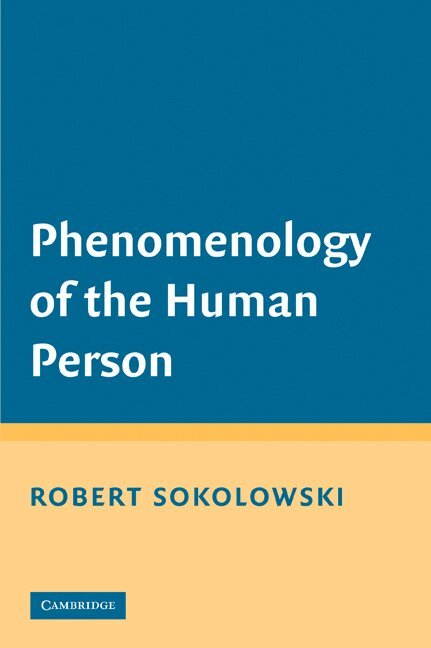
    Phenomenology of the Human Person

    AvRobert Sokolowski

    Inbunden, Engelska, 2008

    1 241 kr

    Beställningsvara. Skickas inom 10-15 vardagar. Fri frakt över 249 kr.

    Fler format och utgåvor

    Häftad

    405 kr

    Beskrivning

    In this book, Robert Sokolowski argues that being a person means to be involved with truth. He shows that human reason is established by syntactic composition in language, pictures, and actions and that we understand things when they are presented to us through syntax. Sokolowski highlights the role of the spoken word in human reason and examines the bodily and neurological basis for human experience. Drawing on Husserl and Aristotle, as well as Aquinas and Henry James, Sokolowski here employs phenomenology in a highly original way in order to clarify what we are as human agents.

    Produktinformation

    • Utgivningsdatum:2008-05-19
    • Mått:155 x 233 x 26 mm
    • Vikt:600 g
    • Format:Inbunden
    • Språk:Engelska
    • Antal sidor:360
    • Förlag:Cambridge University Press
    • ISBN:9780521888912

    Utforska kategorier

    • Filosofiska discipliner inom Filosofi och religion

    Mer om författaren

    Robert Sokolowski is the Elizabeth Breckenridge Caldwell Professor of Philosophy at The Catholic University of America. Twice awarded research fellowships from the National Endowment for the Humanities, he has also served as a consultant at the Los Alamos National Laboratory and gave the 26th J. Robert Oppenheimer Lecture there in 1996. He has also served as visiting professor at the Graduate Faculty of the New School University; the University of Texas, Austin; Villanova; and Yale University. Dr Sokolowski is the author of many books, including Introduction to Phenomenology, Moral Action, The God of Faith and Reason, Presence and Absence, and Husserlian Meditations.

    Recensioner i media

    "This rich metaphysical text is heavy indebted to Aristotle and Husserl, but at the same time refreshing only novel in its approach to such traditional philosophical topics as language, truth, knowledge, and selves...Though challenging at time, this work is not to be missed by those hungering for new insight into some of the most traditional issues in philosophy. Summing up: Recommended." - H. Storl, Choice

    Innehållsförteckning

    • Part I. The Form of Thinking: 1. Two ways of saying 'I'; 2. Further kinds of declaratives; 3. Linguistic syntax and human reason; 4. The person as the agent of syntax: predication; 5. Reason as public: quotation; 6. Grammatical signals and veracity; Part II. The Content of Thinking: 7. The content of what is said: essentials and accidentals; 8. Properties and accidents reveal what things are; 9. Knowing things in their absence: pictures, imagination, and words; 10. Mental representations; 11. What is a concept and how do we focus on it?; Part III. The Body and Human Action: 12. The body and the brain; 13. Active perception and declaratives; 14. Mental images and lenses; 15. Forms of wishing; 16. Declaring our wishes and choices; Part IV. Ancients and Moderns: 17. Aristotle; 18. Thomas Aquinas; 19. Conclusion, with Henry James.