• Fri frakt över 249 kr
  • •
  • Snabba leveranser
  • •
  • Billiga böcker
Kundservice

Du är på sajten för privatpersoner.

Företag, bibliotek eller offentlig verksamhet?

Du handlar på classic.bokus.com, där alla dina funktioner finns intakta.
Till classic.bokus.com
Bokus logotyp. Gå till startsidan.
  • Erbjudanden
  • Nyheter
  • Student
  • Topplistor
  • Barn & ungdom
  • Bokus Play
  • E-böcker
  • Pocketböcker
  • Spel & pussel

10% rabatt på allt med kod: NYSTART10 →

Sidfot

Mina sidor

    Hjälp

    • Kundservice
    • Vanliga frågor och svar
    • Frakt och leverans
    • Retur vid ångerrätt
    • Reklamera vara
    • Betalning
    • Köpvillkor
    • Allmänna villkor
    • Information om webbplatsens tillgänglighet

    Om Bokus

    • Om oss
    • Pressrum
    • För studenter
    • För företag
    • För bibliotek och offentlig verksamhet
    • För leverantörer
    • Hållbarhet

    Populärt

    • Aktuella erbjudanden
    • Presentkort
    • Studentlitteratur
    • Nya böcker
    • Topplistor
    • Signerade böcker
    • Engelska böcker

    Inspiration

    • Boktips
    • BookTok
    • Populära bokserier
    • Barnbokskaraktärer
    • Populära författare
    Logotyp för Bokus
    Följ oss på Facebook (extern länk)Följ oss på Instagram (extern länk)Följ oss på YouTube (extern länk)Följ oss på TikTok (extern länk)
    bokus @ CookiesAnpassa cookiesIntegritetspolicyKöpvillkor
    Till Citymail hemsida (extern länk)Till Budbee hemsida (extern länk)Till Postnord hemsida (extern länk)Till Schenker hemsida (extern länk)Till Early Bird hemsida (extern länk)Till Walleys hemsida (extern länk)
    1. Samhälle och politik
    2. Sociologi och antropologi
    3. Sociologi

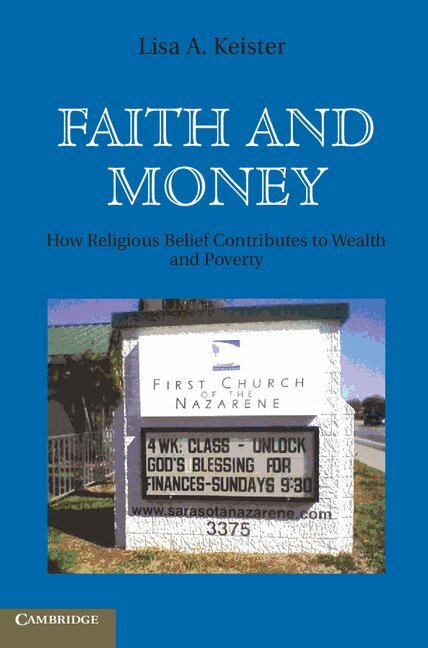
    Faith and Money

    How Religion Contributes to Wealth and Poverty

    AvLisa A. Keister

    Inbunden, Engelska, 2011

    865 kr

    Beställningsvara. Skickas inom 10-15 vardagar. Fri frakt över 249 kr.

    Fler format och utgåvor

    Häftad

    379 kr

    Beskrivning

    For those who own it, wealth can have extraordinary advantages. High levels of wealth can enhance educational attainment, create occupational opportunities, generate social influence and provide a buffer against financial emergencies. Even a small amount of savings can improve security, mitigate the effects of job loss and other financial setbacks and improve well-being dramatically. Although the benefits of wealth are significant, they are not enjoyed uniformly throughout the United States. In the United States, because religion is an important part of cultural orientation, religious beliefs should affect material well-being. This book explores the way religious orientations and beliefs affect Americans' incomes, savings and net worth.

    Produktinformation

    • Utgivningsdatum:2011-09-05
    • Mått:158 x 235 x 19 mm
    • Vikt:470 g
    • Format:Inbunden
    • Språk:Engelska
    • Antal sidor:254
    • Förlag:Cambridge University Press
    • ISBN:9780521896511

    Utforska kategorier

    • Sociologi inom Samhälle och politik

    Mer om författaren

    Lisa A. Keister is a professor of sociology and the Director of the Markets and Management Program at Duke University. She conducts research on wealth inequality, asset accumulation and the causes of each. She is the author of Getting Rich: America's New Rich and How They Got There (Cambridge University Press 2005) and Wealth in America (Cambridge University Press 2000). Her research on Chinese corporations and the country's economic transition appeared in her book Chinese Business Groups (2000) as well as various articles.

    Recensioner i media

    'This book is engagingly written with evidence to substantiate each claim. Undergraduate and graduate students will find [it] very insightful, as well as policy makers who are interested in gaining an understanding of not only the economic parity, but also the religious implications of the differentiation in wealth ownership.' Elijah Obinna, Religion

    Innehållsförteckning

    • 1. Religion and wealth; 2. Family and human capital processes; 3. Works, occupation, and income; 4. Wealth I: new worth and real assets; 5. Wealth II: financial assets, liabilities, and multivariate models; 6. Upward mobility and assimilation; 7. Notable achievement; 8. A truly complex relationship; 9. Conclusion: how much is enough?