• Fri frakt över 249 kr
  • •
  • Snabba leveranser
  • •
  • Billiga böcker
Kundservice

Du är på sajten för privatpersoner.

Företag, bibliotek eller offentlig verksamhet?

Du handlar på classic.bokus.com, där alla dina funktioner finns intakta.
Till classic.bokus.com
Bokus logotyp. Gå till startsidan.
  • Erbjudanden
  • Nyheter
  • Student
  • Topplistor
  • Barn & ungdom
  • Bokus Play
  • E-böcker
  • Pocketböcker
  • Spel & pussel

10% rabatt på allt med kod: NYSTART10 →

Sidfot

Mina sidor

    Hjälp

    • Kundservice
    • Vanliga frågor och svar
    • Frakt och leverans
    • Retur vid ångerrätt
    • Reklamera vara
    • Betalning
    • Köpvillkor
    • Allmänna villkor
    • Information om webbplatsens tillgänglighet

    Om Bokus

    • Om oss
    • Pressrum
    • För studenter
    • För företag
    • För bibliotek och offentlig verksamhet
    • För leverantörer
    • Hållbarhet

    Populärt

    • Aktuella erbjudanden
    • Presentkort
    • Studentlitteratur
    • Nya böcker
    • Topplistor
    • Signerade böcker
    • Engelska böcker

    Inspiration

    • Boktips
    • BookTok
    • Populära bokserier
    • Barnbokskaraktärer
    • Populära författare
    Logotyp för Bokus
    Följ oss på Facebook (extern länk)Följ oss på Instagram (extern länk)Följ oss på YouTube (extern länk)Följ oss på TikTok (extern länk)
    bokus @ CookiesAnpassa cookiesIntegritetspolicyKöpvillkor
    Till Citymail hemsida (extern länk)Till Budbee hemsida (extern länk)Till Postnord hemsida (extern länk)Till Schenker hemsida (extern länk)Till Early Bird hemsida (extern länk)Till Walleys hemsida (extern länk)
    1. Data och IT
    2. Systemvetenskap och AI
    3. Artificiell intelligens

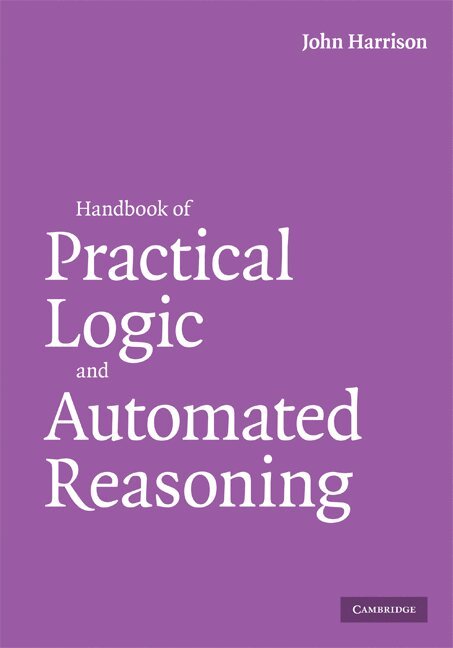
    Handbook of Practical Logic and Automated Reasoning

    AvJohn Harrison

    Inbunden, Engelska, 2009

    1 927 kr

    Beställningsvara. Skickas inom 10-15 vardagar. Fri frakt över 249 kr.

    Beskrivning

    The sheer complexity of computer systems has meant that automated reasoning, i.e. the ability of computers to perform logical inference, has become a vital component of program construction and of programming language design. This book meets the demand for a self-contained and broad-based account of the concepts, the machinery and the use of automated reasoning. The mathematical logic foundations are described in conjunction with practical application, all with the minimum of prerequisites. The approach is constructive, concrete and algorithmic: a key feature is that methods are described with reference to actual implementations (for which code is supplied) that readers can use, modify and experiment with. This book is ideally suited for those seeking a one-stop source for the general area of automated reasoning. It can be used as a reference, or as a place to learn the fundamentals, either in conjunction with advanced courses or for self study.

    Produktinformation

    • Utgivningsdatum:2009-03-12
    • Mått:174 x 255 x 37 mm
    • Vikt:1 390 g
    • Format:Inbunden
    • Språk:Engelska
    • Antal sidor:702
    • Förlag:Cambridge University Press
    • ISBN:9780521899574

    Utforska kategorier

    • Artificiell intelligens inom Data och IT

    Mer om författaren

    John Harrison is a Principal Engineer at the Intel Corporation in Portland, Oregon. He specialises in formal verification, automated theorem proving, floating-point arithmetic and mathematical algorithms.

    Recensioner i media

    'Contemporary research in computer science has produced an abundance of formal methods designed to enable hardware and software systems to reason correctly, and to enable us to reason better about these systems. Indeed, the explosion of research and specialised techniques can make it hard for students and newcomers to enter the field. John Harrison's Handbook of Practical Logic and Automated Reasoning is a significant addition to the expository literature on the subject, and will serve as a valuable resource for beginners and experts alike.' Theory and Practice of Logic Programming

    Innehållsförteckning

    • Preface; Ideological orientation; Acknowledgements; How to read this book; 1. Introduction; 2. Propositional logic; 3. First-order logic; 4. Equality; 5. Decidable problems; 6. Interactive theorem proving; 7. Limitations; Appendix 1. Mathematical background; Appendix 2. OCaml made light of; Appendix 3. Parsing and printing of formulas; References; Index.