• Fri frakt över 249 kr
  • •
  • Snabba leveranser
  • •
  • Billiga böcker
Kundservice

Du är på sajten för privatpersoner.

Företag, bibliotek eller offentlig verksamhet?

Du handlar på classic.bokus.com, där alla dina funktioner finns intakta.
Till classic.bokus.com
Bokus logotyp. Gå till startsidan.
  • Erbjudanden
  • Nyheter
  • Student
  • Topplistor
  • Barn & ungdom
  • Bokus Play
  • E-böcker
  • Pocketböcker
  • Spel & pussel

10% rabatt på allt med kod: NYSTART10 →

Sidfot

Mina sidor

    Hjälp

    • Kundservice
    • Vanliga frågor och svar
    • Frakt och leverans
    • Retur vid ångerrätt
    • Reklamera vara
    • Betalning
    • Köpvillkor
    • Allmänna villkor
    • Information om webbplatsens tillgänglighet

    Om Bokus

    • Om oss
    • Pressrum
    • För studenter
    • För företag
    • För bibliotek och offentlig verksamhet
    • För leverantörer
    • Hållbarhet

    Populärt

    • Aktuella erbjudanden
    • Presentkort
    • Studentlitteratur
    • Nya böcker
    • Topplistor
    • Signerade böcker
    • Engelska böcker

    Inspiration

    • Boktips
    • BookTok
    • Populära bokserier
    • Barnbokskaraktärer
    • Populära författare
    Logotyp för Bokus
    Följ oss på Facebook (extern länk)Följ oss på Instagram (extern länk)Följ oss på YouTube (extern länk)Följ oss på TikTok (extern länk)
    bokus @ CookiesAnpassa cookiesIntegritetspolicyKöpvillkor
    Till Citymail hemsida (extern länk)Till Budbee hemsida (extern länk)Till Postnord hemsida (extern länk)Till Schenker hemsida (extern länk)Till Early Bird hemsida (extern länk)Till Walleys hemsida (extern länk)
    1. Språk och ordböcker
    2. Språkvetenskap och lingvistik

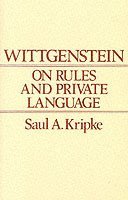
    Wittgenstein on Rules and Private Language

    An Elementary Exposition

    AvSaul A. Kripke

    Häftad, Engelska, 1984

    379 kr

    Skickas . Fri frakt över 249 kr.

    Beskrivning

    In this book Saul Kripke brings his powerful philosophical intelligence to bear on Wittgenstein's analysis of the notion of following a rule.

    Produktinformation

    • Utgivningsdatum:1984-01-05
    • Mått:137 x 213 x 10 mm
    • Vikt:227 g
    • Format:Häftad
    • Språk:Engelska
    • Antal sidor:160
    • Förlag:John Wiley and Sons Ltd
    • ISBN:9780631135210

    Utforska kategorier

    • Språkvetenskap och lingvistik inom Språk och ordböcker
    • Filosofiska discipliner inom Filosofi och religion

    Mer om författaren

    Born in Bay Shore, New York, the son of a rabbi (Myer Samuel) and a writer (Dorothy Karp), Saul Kripke demonstrated his genius to his startled parents when he was only 3 years old. He not only drew the logical consequences of ordinary beliefs, but also solved intricate problems in mathematics. As a child prodigy, he was presented by his father to distinguished mathematicians and philosophers, who were overwhelmed by his talents. His father introduced him at the age of 15 to a group of eminent mathematicians, headed by Haskell B. Curry. From his debut grew his first published article, "A Completeness Theorem in Modal Logic," which appeared in the Journal of Symbolic Logic. Kripke's boyhood genius did not flicker out in the 1960s, when he studied at Harvard, Oxford, Princeton and Rockefeller University or, more accurately, when he worked independently at these institutions and had occasional contact with his surroundings. His academic training was unique. He ascended directly to full professorships, without ever earning a doctorate. In fact, his highest academic degree was a B.A. from Harvard University, which he received in 1962. Kripke never earned a doctorate, because no academician could be found to teach him. Consequently, the universities let him alone and admitted him to their faculties when he said he was ready. Slow to publish his lectures, Kripke nonetheless released a few articles, which he published exclusively in technical journals of philosophy and mathematics. So far his work has extended the boundaries of the most abstruse field of analytic philosophy, modal logic. He is esteemed for having invented the quantitative formulations of modality and for having opened up the ontological territory of possible worlds. At the age of 36, he was appointed James McCosh Professor of Philosophy at Princeton University. Kripke's awards include a Fulbright Fellowship (1962), Guggenheim Fellowship (1968), and a Fellowship from the American Council of Learned Societies (1981). His work, esoteric as it may seem to a public acquainted with such "social" philosophers as John Dewey or Jean-Paul Sartre, has created new fields in mathematical set theory and modal logic, which will generate Ph.D. theses for years to come.

    Recensioner i media

    "Saul Kripke has thought uncommonly hard about the central argument of Wittgenstein's Philosophical Investigations and produces an uncommonly clear and vivid account of that argument ... clearly and compellingly presented ... an exemplary piece of exposition." Times Literary Supplement "A detailed examination of what is clearly a central theme in Wittgenstein's writings." Times Higher Education Supplement "Kripke does bring a whole range of things into focus in a striking and provocative way ... What Kripke has achieved, I think, is the first successful translation of what Wittgenstein was saying into the idiom of the contemporary Anglo-American mainstream in philosophy ... full of excellent things." (Australasian Journal of Philosophy) "Saul Kripke has thought uncommonly hard about the central argument of Wittgenstein's Philosophical Investigations and produces an uncommonly clear and vivid account of that argument ... clearly and compellingly presented ... an exemplary piece of exposition." (Times Literary Supplement)"A detailed examination of what is clearly a central theme in Wittgenstein's writings." (Times Higher Education Supplement)

    Innehållsförteckning

    • Preface. Introductory.The Wittgensteinian Paradox.The Solution and the 'Private Language' Argument.Postscript Wittgenstein and Other Minds.Index.