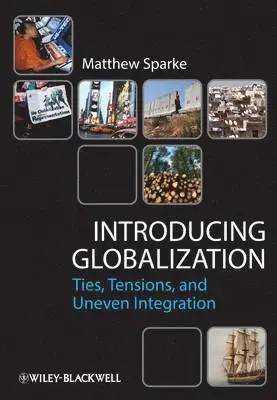
Inbunden, Engelska, 2013
Introducing Globalization
Ties, Tensions, and Uneven Integration
1226 kr
Beställningsvara. Skickas inom 7-10 vardagar. Fri frakt över 249 kr.
Fler format och utgåvor
Beskrivning
Produktinformation
- Utgivningsdatum: 2013-01-11
- Mått: 179 x 254 x 29 mm
- Vikt: 921 g
- Format: Inbunden
- Språk: Engelska
- Antal sidor: 512
- Förlag: John Wiley and Sons Ltd
- ISBN: 9780631231288
Utforska kategorier
Mer om författaren
Matthew Sparke is Professor of Geography and International Studies at the University of Washington, where he also serves as the Director of the undergraduate program in Global Health. He has authored over 60 scholarly publications, including the book In the Space of Theory (2005), but he is also dedicated to teaching about globalization as well as writing about it. He has multiple awards for his work as a teacher, including the lifetime Distinguished Teaching award from the University of Washington.
Recensioner i media
“Sparke models inquiry into taken-for-granted concepts or events through rich understanding and questioning. More importantly, he reframes spatial theory as the starting point of social studies conversations about globalization. Rather than accept the inevitability of globalization, he depicts the inevitability of inequity. He examines how inequities become actualized in lives through geopolitical and geoeconomic infrastructure. He encourages us to reconsider the relationships between disciplines, contending that disciplined inquiry enables simplistic understanding. He allows geography and spatial theory to be a way of understanding the world, a lens that resonates across the social studies. The book importantly segments a variety of explanatory moments to allow readers without a strong economics background to understand economic principles. It is a lack of economic understanding that makes global policy discussions unintelligible to the general public. In the process, he ultimately constructs the globally minded citizen. While his brand of global thinking (and citizenship) has a problematic Western perspective, it also utilizes a critical lens that requires awareness of these contradictions and their implications for ourselves and others. The spatial thinking highlighted throughout this review relies on thinking across the disciplines to attend to how, where, and why places are constructed independently and interdependently across scales and time. Rather than assuming that places are knowable, rejecting the three myths encourages questions about what has been made invisible, how new places come to exist, the kinds of interactions that occur therein, and how they reify and amend cultural and other discourses.” (Theory & Research in Social Education, 19 February 2015)
Betyg & recensioner
0 recensioner
Inga recensioner tillgängliga.