• Fri frakt över 249 kr
  • •
  • Snabba leveranser
  • •
  • Billiga böcker
Kundservice

Du är på sajten för privatpersoner.

Företag, bibliotek eller offentlig verksamhet?

Du handlar på classic.bokus.com, där alla dina funktioner finns intakta.
Till classic.bokus.com
Bokus logotyp. Gå till startsidan.
  • Erbjudanden
  • Student
  • Topplistor
  • Barn & ungdom
  • Bokus Play
  • E-böcker
  • Ljudböcker
  • Pocketböcker
  • Spel och pussel

5% studentrabatt – använd koden KURSBOK27 →

Sidfot

Mina sidor

    Hjälp

    • Kundservice
    • Vanliga frågor och svar
    • Frakt och leverans
    • Retur vid ångerrätt
    • Reklamera vara
    • Betalning
    • Köpvillkor
    • Allmänna villkor
    • Information om webbplatsens tillgänglighet

    Om Bokus

    • Om oss
    • Pressrum
    • För studenter
    • För företag
    • För bibliotek och offentlig verksamhet
    • För leverantörer
    • Hållbarhet

    Populärt

    • Aktuella erbjudanden
    • Presentkort
    • Studentlitteratur
    • Nya böcker
    • Topplistor
    • Signerade böcker
    • Engelska böcker

    Inspiration

    • Boktips
    • BookTok
    • Barnbokskaraktärer
    • Populära författare
    Logotyp för Bokus
    Följ oss på Facebook (extern länk)Följ oss på Instagram (extern länk)Följ oss på YouTube (extern länk)Följ oss på TikTok (extern länk)
    bokus @ CookiesAnpassa cookiesIntegritetspolicyKöpvillkor
    Till Citymail hemsida (extern länk)Till Budbee hemsida (extern länk)Till Postnord hemsida (extern länk)Till Schenker hemsida (extern länk)Till Early Bird hemsida (extern länk)Till Walleys hemsida (extern länk)
    1. Språk och ordböcker
    2. Språkvetenskap och lingvistik

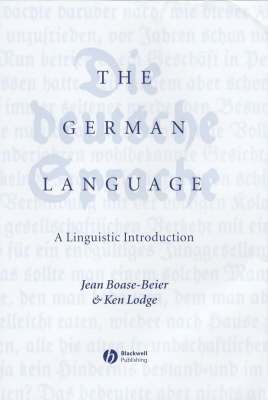
    German Language

    A Linguistic Introduction

    AvJean Boase-Beier,Ken R. Lodge

    Inbunden, Engelska, 2002

    1 234 kr

    Tillfälligt slut

    Fler format och utgåvor

    Häftad

    638 kr

    Beskrivning

    The German Language introduces students of German to a linguistic way of looking at the language.Written from a Chomksyan perspective, this volume covers the basic structural components of the German language: syntax, morphology, phonetics, phonology, and the lexicon. Explores the linguistic structure of German from current theoretical perspectives.Written from a Chomksyan perspective, this volume covers the basic structural components of the German language: syntax, morphology, phonetics, phonology, and the lexicon.Serves as a valuable resource for students of German language and literature and for linguists with little or no background in the language.Includes exercises, definitions of key terms, and suggestions for further reading.

    Produktinformation

    • Utgivningsdatum:2002-11-28
    • Mått:175 x 254 x 26 mm
    • Vikt:635 g
    • Format:Inbunden
    • Språk:Engelska
    • Antal sidor:272
    • Förlag:John Wiley and Sons Ltd
    • ISBN:9780631231387

    Utforska kategorier

    • Språkvetenskap och lingvistik inom Språk och ordböcker

    Mer om författaren

    Jean Boase-Beier is Senior Lecturer in German, Linguistics and Translation Studies in the School of Language, Linguistics and Translation Studies of the University of East Anglia, where she runs the MA course in literary translation. She is author of Poetic Compounds: The Principles of Poetic Language in Modern English Poetry (1987) as well as many articles on morphology and translation. She is also editor of The Practices of Literary Translation (with M. Holman, 1999).Ken Lodge is Senior Lecturer in Linguistics and Phonetics at the School of Language, Linguistics and Translation Studies of the University of East Anglia. He is author of Studies in the Phonology of Colloquial English (1984), as well as numerous articles on phonology.

    Recensioner i media

    "The linguistics field should have volumes like this for all of the world's languages, or at least the world's major languages. The authors... have penned a comprehensive account of German phonetics, phonology, morphology, syntax, lexis, stylistics, dialectology, and the historical background - in short, the makings for an interesting and solid course in German linguistics." Multilingua"I think this book succeeds at what must be a near impossible task: to introduce beginning students to the structure of German and to linguistic analysis at the same time, and to do both in a reader-friendly way that doesn't compromise on academic seriousness. This is a book, then, which students, teachers and even researchers of German linguistics will welcome and from which undergraduate courses will benefit hugely." Heinz Giegerich, Professor of English Linguistics, University of Edinburgh "The challenge in designing a successful language course is to integrate enough general linguistic ideas to be able to describe the features of the language insightfully, while also illustrating the classical linguistic problems of the language concerned. This book succeeds in these aims, and deserves to find a place on the reading lists for all courses in German linguistics." Times Higher Education Supplement

    Innehållsförteckning

    • Preface. Abbreviations.1. Introduction:.1.1. What Is The German Language?.1.2. A Linguistic Description.1.3. The Grammar And Grammatical Knowledge.1.4. Other Linguistic Knowledge.1.5. Further Reading.2. Syntax:.2.1. The Concept Of Syntax.2.2. Phrase Structures Of German.2.3. Case In German.2.4. The Position Of The German Verb.2.5. Syntactic Processes.2.6. Further Reading.Exercises.3. Morphology:.3.1. Morphemes And Morphology.3.2. Morphology And Word-Formation.3.2.1. Inflection.3.2.2. Derivation.3.2.3. Compounding.3.2.4. Conversion.3.2.5. Other Morphological Processes.3.3. The Relationship Between Morphology And Phonology.3.4. Productivity.3.5. Borrowings From Other Languages.3.6. The Relationship Between Morphology And Syntax.3.7. Further Reading.Exercises.4. Phonetics:.4.1. Introduction.4.2. Air-Stream Type.4.3. State Of The Glottis.4.4. State Of The Velum.4.5. Oral Articulators.4.6. Manner.4.7. Lip Position.4.8. Vocoid Articulations.4.9. Place Of Articulation.4.10. Resonance.4.11. Voice Onset Time.4.12. The Transcription Of German And English.4.13. Further Reading.Exercises.5. Phonology:.5.1. Preliminaries.5.2. Syllable Structure.5.3. The Obstruents.5.4. Affricates.5.5. Nasals.5.6. Other Consonants.5.7. Vowels.5.8. Connected Speech.5.8.1. Assimilation.5.8.2. Lenition.5.8.3. Shortening.5.8.4. Deletion.5.9. Further Reading.Exercises.6. Lexis:.6.1. The Lexicon And The Nature Of Lexical Entries.6.2. Thematic Structure.6.3. Categories Of Lexical Items.6.4. The Meaning Of Lexical Items.6.5. The Nature Of Lexical Items.6.6. Relations Among Lexical Items.6.7. Sense Relations.6.8. Further Reading.Exercises.7. Stylistics:.7.1. Stylistics And The Style Of Text.7.2. Style And Deviation.7.3. Stylistic Principles.7.4. Metaphor.7.5. Repetition.7.6. Iconicity.7.7. Compression.7.8. Ambiguity.7.9. Cohesion.7.10. Style And Choice.7.11. Further Reading.Exercises.8. Historical Background:.8.1. Preliminaries.8.2. Phonology.8.3. Umlaut.8.4. Morphology.8.5. Syntactic Changes.8.6. Lexical And Semantic Changes.8.7. External Influences.8.8. Further Reading.Exercises.9. Contemporary Variation:.9.1. Preliminaries.9.2. Variation By Use.9.3. Variation By User.9.3.1. Regional Accents.9.3.2. Morphological And Syntactic Variation.9.3.3. Lexical Variation.9.4. Further Reading.Exercises.References.Index.