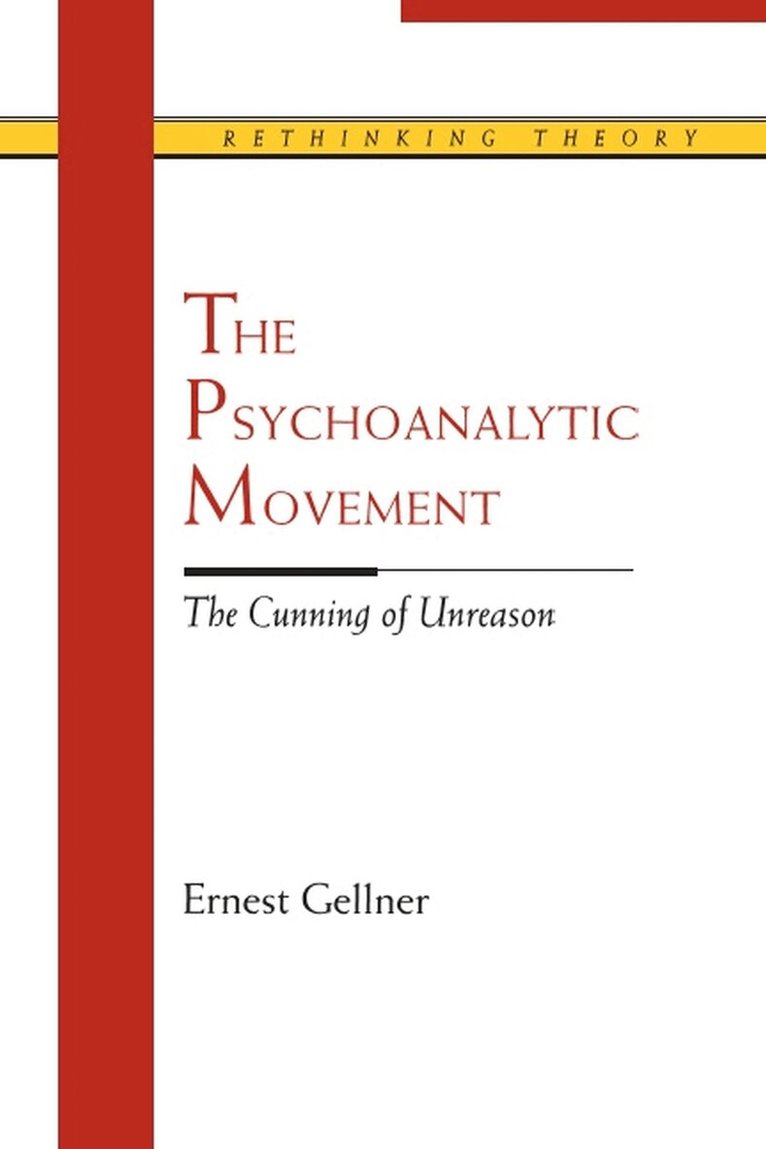
Psychoanalytic Movement
The Cunning of Unreason
562 kr
Beställningsvara. Skickas inom 5-8 vardagar. Fri frakt över 249 kr.
Du är på sajten för privatpersoner.
562 kr
Beställningsvara. Skickas inom 5-8 vardagar. Fri frakt över 249 kr.
Ernest Gellner was born in Paris in 1925, and was educated in Prague and England. He was professor of philosophy and sociology at the London School of Economics from 1949 to 1984. In 1984 he became the William Wyse Professor of Social Anthropology at the University of Cambridge. He is the author of Nations and Nationalism (Blackwell Publishers, 1983), Anthropology and Politics (Blackwell Publishers, 1996), and Encounters with Nationalism (Blackwell Publishers, 1995). Dr Gellner died in 1995.
‘The Psychoanalytic Movement was recognized as a classic upon its publication. José Brunner's new introduction places the argument within the context of “the Freud wars”, making it clear that the book was as concerned to explain the fabulous success of psychoanalysis as to debunk its pretensions. This may be Gellner's greatest book, containing as it does a general view of the history of philosophy and the character of modernity.’ John A. Hall, McGill University Previous praise for The Psychoanalytic Movement: ‘A marvel… This is a brilliantly written book, every page sparkling with intelligence, style and substance. Gellner provides a welcome and literate overview of the latest philosophic controversy about the logical status of psychoanalytic propositions. Its every page instructs and enlivens and represents a tribute to humane intelligence.’ New Statesman ‘In a stylish, witty and deceptively readable book, Gellner exposes the secular religious nature of the psychoanalytic enterprise. He admits that a compelling, charismatic belief must possess more than merely the promise of succour in a plague and links with the background convictions of the age.’ Nature ‘This is the first determined effort to account for a very odd historical and sociological phenomenon in realistic and meaningful terms…and it makes very good sense. Gellner is incisive, agreeable to read and often witty.’ Institute of Psychiatry Journal
Du är på sajten för privatpersoner.
562 kr
Beställningsvara. Skickas inom 5-8 vardagar. Fri frakt över 249 kr.
Ernest Gellner was born in Paris in 1925, and was educated in Prague and England. He was professor of philosophy and sociology at the London School of Economics from 1949 to 1984. In 1984 he became the William Wyse Professor of Social Anthropology at the University of Cambridge. He is the author of Nations and Nationalism (Blackwell Publishers, 1983), Anthropology and Politics (Blackwell Publishers, 1996), and Encounters with Nationalism (Blackwell Publishers, 1995). Dr Gellner died in 1995.
‘The Psychoanalytic Movement was recognized as a classic upon its publication. José Brunner's new introduction places the argument within the context of “the Freud wars”, making it clear that the book was as concerned to explain the fabulous success of psychoanalysis as to debunk its pretensions. This may be Gellner's greatest book, containing as it does a general view of the history of philosophy and the character of modernity.’ John A. Hall, McGill University Previous praise for The Psychoanalytic Movement: ‘A marvel… This is a brilliantly written book, every page sparkling with intelligence, style and substance. Gellner provides a welcome and literate overview of the latest philosophic controversy about the logical status of psychoanalytic propositions. Its every page instructs and enlivens and represents a tribute to humane intelligence.’ New Statesman ‘In a stylish, witty and deceptively readable book, Gellner exposes the secular religious nature of the psychoanalytic enterprise. He admits that a compelling, charismatic belief must possess more than merely the promise of succour in a plague and links with the background convictions of the age.’ Nature ‘This is the first determined effort to account for a very odd historical and sociological phenomenon in realistic and meaningful terms…and it makes very good sense. Gellner is incisive, agreeable to read and often witty.’ Institute of Psychiatry Journal