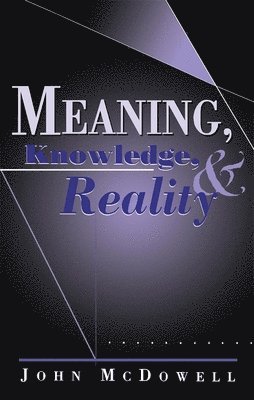
Meaning, Knowledge, and Reality
456 kr
Beställningsvara. Skickas inom 5-8 vardagar. Fri frakt över 249 kr.
Du är på sajten för privatpersoner.
456 kr
Beställningsvara. Skickas inom 5-8 vardagar. Fri frakt över 249 kr.
John McDowell is University Professor of Philosophy at the University of Pittsburgh.
In a characteristic passage...[McDowell] is discussing knowledge, but the passage could stand at the head of almost any of the immensely influential essays collected in these two volumes. Reading them together, one is struck by how much they have in common, despite the breadth of issues that they address, ranging from ethics to metaphysics, the theory of knowledge, mind and language. Time and again, McDowell aims to dissolve a philosophical problem by showing that it rests on a false assumption... What form do McDowell’s exorcisms take? They vary, of course, to suit the nature of the problem addressed. But there is a typical McDowellian move, which consists of the rejection of an approach that is so pervasive in contemporary philosophical thinking as to seem inescapable. This approach involves treating such phenomena as perception, knowledge, memory and the content of thought as composite: as consisting of different factors that can obtain independently. And part of the reason why this approach can seem so inescapable is that it starts with reflections that are not more than common sense.
Stanley Cavell, Cora Diamond, John McDowell, Ian Hacking, Cary Wolfe
Häftad, 2009
492 kr
Pierre-Laurent Chatain, John McDowell, Cedric Mousset, Paul Allan Schott
Häftad, 2009
451 kr
Du är på sajten för privatpersoner.
456 kr
Beställningsvara. Skickas inom 5-8 vardagar. Fri frakt över 249 kr.
John McDowell is University Professor of Philosophy at the University of Pittsburgh.
In a characteristic passage...[McDowell] is discussing knowledge, but the passage could stand at the head of almost any of the immensely influential essays collected in these two volumes. Reading them together, one is struck by how much they have in common, despite the breadth of issues that they address, ranging from ethics to metaphysics, the theory of knowledge, mind and language. Time and again, McDowell aims to dissolve a philosophical problem by showing that it rests on a false assumption... What form do McDowell’s exorcisms take? They vary, of course, to suit the nature of the problem addressed. But there is a typical McDowellian move, which consists of the rejection of an approach that is so pervasive in contemporary philosophical thinking as to seem inescapable. This approach involves treating such phenomena as perception, knowledge, memory and the content of thought as composite: as consisting of different factors that can obtain independently. And part of the reason why this approach can seem so inescapable is that it starts with reflections that are not more than common sense.
Stanley Cavell, Cora Diamond, John McDowell, Ian Hacking, Cary Wolfe
Häftad, 2009
492 kr
Pierre-Laurent Chatain, John McDowell, Cedric Mousset, Paul Allan Schott
Häftad, 2009
451 kr
Du är på sajten för privatpersoner.
456 kr
Beställningsvara. Skickas inom 5-8 vardagar. Fri frakt över 249 kr.
John McDowell is University Professor of Philosophy at the University of Pittsburgh.
In a characteristic passage...[McDowell] is discussing knowledge, but the passage could stand at the head of almost any of the immensely influential essays collected in these two volumes. Reading them together, one is struck by how much they have in common, despite the breadth of issues that they address, ranging from ethics to metaphysics, the theory of knowledge, mind and language. Time and again, McDowell aims to dissolve a philosophical problem by showing that it rests on a false assumption... What form do McDowell’s exorcisms take? They vary, of course, to suit the nature of the problem addressed. But there is a typical McDowellian move, which consists of the rejection of an approach that is so pervasive in contemporary philosophical thinking as to seem inescapable. This approach involves treating such phenomena as perception, knowledge, memory and the content of thought as composite: as consisting of different factors that can obtain independently. And part of the reason why this approach can seem so inescapable is that it starts with reflections that are not more than common sense.
Stanley Cavell, Cora Diamond, John McDowell, Ian Hacking, Cary Wolfe
Häftad, 2009
492 kr
Pierre-Laurent Chatain, John McDowell, Cedric Mousset, Paul Allan Schott
Häftad, 2009
451 kr