• Fri frakt över 249 kr
  • •
  • Snabba leveranser
  • •
  • Billiga böcker
Kundservice

Du är på sajten för privatpersoner.

Företag, bibliotek eller offentlig verksamhet?

Du handlar på classic.bokus.com, där alla dina funktioner finns intakta.
Till classic.bokus.com
Bokus logotyp. Gå till startsidan.
  • Erbjudanden
  • Nyheter
  • Student
  • Topplistor
  • Barn & ungdom
  • Bokus Play
  • E-böcker
  • Pocketböcker
  • Spel & pussel

10% rabatt på allt med kod: NYSTART10 →

Sidfot

Mina sidor

    Hjälp

    • Kundservice
    • Vanliga frågor och svar
    • Frakt och leverans
    • Retur vid ångerrätt
    • Reklamera vara
    • Betalning
    • Köpvillkor
    • Allmänna villkor
    • Information om webbplatsens tillgänglighet

    Om Bokus

    • Om oss
    • Pressrum
    • För studenter
    • För företag
    • För bibliotek och offentlig verksamhet
    • För leverantörer
    • Hållbarhet

    Populärt

    • Aktuella erbjudanden
    • Presentkort
    • Studentlitteratur
    • Nya böcker
    • Topplistor
    • Signerade böcker
    • Engelska böcker

    Inspiration

    • Boktips
    • BookTok
    • Populära bokserier
    • Barnbokskaraktärer
    • Populära författare
    Logotyp för Bokus
    Följ oss på Facebook (extern länk)Följ oss på Instagram (extern länk)Följ oss på YouTube (extern länk)Följ oss på TikTok (extern länk)
    bokus @ CookiesAnpassa cookiesIntegritetspolicyKöpvillkor
    Till Citymail hemsida (extern länk)Till Budbee hemsida (extern länk)Till Postnord hemsida (extern länk)Till Schenker hemsida (extern länk)Till Early Bird hemsida (extern länk)Till Walleys hemsida (extern länk)
    1. Samhälle och politik
    2. Politik och statsskick
    3. Centralt styre och förvaltning

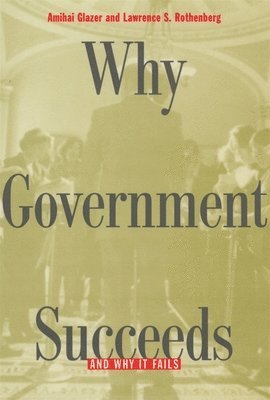
    Why Government Succeeds and Why It Fails

    AvAmihai Glazer,Lawrence S. Rothenberg

    Häftad, Engelska, 2005

    523 kr

    Beställningsvara. Skickas inom 3-6 vardagar. Fri frakt över 249 kr.

    Beskrivning

    This book looks beyond politics to show how the ability of the U.S. government to implement policies is strongly affected by various economic constraints. These include the credibility of the policies, the ability of government to commit to them, the extent to which firms and consumers rationally anticipate their effects, whether the success of a policy further encourages firms and individuals to behave in intended ways, and whether the behavior of such actors can be sustained without continued government intervention.The authors apply these concepts to four areas of policy: macroeconomic policies to promote employment and economic growth, redistributive policies to benefit the poor and the elderly, production policies to provide goods and services, and regulatory policies to guide the behavior of firms and individuals. In doing so they provide plausible explanations of many puzzling phenomena—for example, why government has been successful in reducing cigarette smoking, but has failed to get people to install and maintain emission-control devices in their cars.This book recasts debates about public policy, avoiding conventional “pro-government” or “anti-government” positions; rather, it helps to predict when public policy will succeed.

    Produktinformation

    • Utgivningsdatum:2005-02-15
    • Mått:143 x 225 x 15 mm
    • Vikt:363 g
    • Format:Häftad
    • Språk:Engelska
    • Antal sidor:224
    • Förlag:Harvard University Press
    • ISBN:9780674015890
    • Utmärkelser:Nominated for William H. Riker Book Award 2002

    Utforska kategorier

    • Centralt styre och förvaltning inom Samhälle och politik

    Mer om författaren

    Amihai Glazer is Professor of Economics at the University of California, Irvine. Lawrence S. Rothenberg is Max McGraw Distinguished Professor of Management & the Environment and Co-Director of the Ford Motor Company Center for Global Citizenship at the Kellogg School of Management, Northwestern University.

    Recensioner i media

    In their bold effort to explain why government succeeds (and why it fails), Amihai Glazer and Lawrence Rothenberg again prompt us to examine the relationship between politics and policy, this time by setting the ‘political machinations’ of politicians and interest groups to the side in order to ask: How do economic conditions impact the success or failure of a public policy? …More specifically, they argue that an analysis of public policy based upon four economic constraints—credibility, rational expectations, crowding out or in, and multiple equilibria—will help reveal the kinds of problems that government is most likely able to solve, and why.

    Innehållsförteckning

    • Acknowledgments Introduction: Public Policy-Limits and Possibilities How Economics Interacts with Politics Structure of Analysis Conceptual Apparatus: Economic Constraints What Makes Problems Soluble? 1. Macroeconomics: Can Government Control the Economy? Managing the Economy: Partisan Incentives and Political Cycles Monetary Policy and Rational Expectations Fiscal Policy-Is It Just Crowding Out? Exhortation: Persuasion and the Art of Equilibrium Selection Spending, Taxes, and Expectations: Budget Deficits as Policy Instruments Can Government Control the Economy? 2. Redistribution: A Success Story? Economic Constraints and Redistribution Uncertainty and Redistribution: Data Government Commitment to Future Redistribution Implications for Redistribution Effectiveness of Redistributive Policy Why Not Taxes? Conclusions: Redistributive Possibilities 3. When Can Government Regulate? The Scope of Regulation Regulating Firms: Possibilities and Pitfalls Regulating Consumer Behavior Conditions for Regulatory Success 4. Producing Goods and Services: Getting the Right Mix What Is Production? Crowding Out Private Provision Credibility as an Obstacle to Inducing Production Credibility as an Obstacle to Restricting Production Production Is Difficult 5. Economic Constraints and Political Institutions Divided Government and the Politics of Gridlock Federalism and the Devolution of Authority Political and Policy Reform What Do Politicians Know? Institutional Design and Policy Effectiveness 6. Final Thoughts What Can Government Do? Five Lessons Conclusions: The Burden of Government Notes References Index