• Fri frakt över 249 kr
  • •
  • Snabba leveranser
  • •
  • Billiga böcker
Kundservice

Du är på sajten för privatpersoner.

Företag, bibliotek eller offentlig verksamhet?

Du handlar på classic.bokus.com, där alla dina funktioner finns intakta.
Till classic.bokus.com
Bokus logotyp. Gå till startsidan.
  • Erbjudanden
  • Student
  • Topplistor
  • Barn & ungdom
  • Bokus Play
  • E-böcker
  • Ljudböcker
  • Pocketböcker
  • Spel & pussel

10% rabatt på allt med kod NYSTART10 →

Sidfot

Mina sidor

    Hjälp

    • Kundservice
    • Vanliga frågor och svar
    • Frakt och leverans
    • Retur vid ångerrätt
    • Reklamera vara
    • Betalning
    • Köpvillkor
    • Allmänna villkor
    • Information om webbplatsens tillgänglighet

    Om Bokus

    • Om oss
    • Pressrum
    • För studenter
    • För företag
    • För bibliotek och offentlig verksamhet
    • För leverantörer
    • Hållbarhet

    Populärt

    • Aktuella erbjudanden
    • Presentkort
    • Studentlitteratur
    • Nya böcker
    • Topplistor
    • Signerade böcker
    • Engelska böcker

    Inspiration

    • Boktips
    • BookTok
    • Populära bokserier
    • Barnbokskaraktärer
    • Populära författare
    Logotyp för Bokus
    Följ oss på Facebook (extern länk)Följ oss på Instagram (extern länk)Följ oss på YouTube (extern länk)Följ oss på TikTok (extern länk)
    bokus @ CookiesAnpassa cookiesIntegritetspolicyKöpvillkor
    Till Citymail hemsida (extern länk)Till Budbee hemsida (extern länk)Till Postnord hemsida (extern länk)Till Schenker hemsida (extern länk)Till Early Bird hemsida (extern länk)Till Walleys hemsida (extern länk)
    1. Filosofi och religion
    2. Filosofi
    3. Filosofiska discipliner

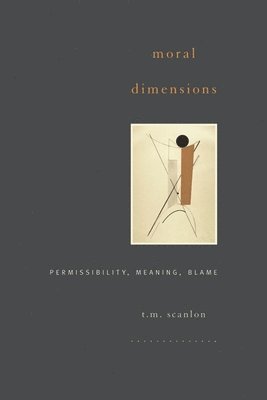
    Moral Dimensions

    Permissibility, Meaning, Blame

    AvT. M. Scanlon

    Häftad, Engelska, 2010

    267 kr

    Beställningsvara. Skickas inom 5-8 vardagar. Fri frakt över 249 kr.

    Beskrivning

    In a clear and elegant style, T. M. Scanlon reframes current philosophical debates as he explores the moral permissibility of an action. Permissibility may seem to depend on the agent’s reasons for performing an action. For example, there seems to be an important moral difference between tactical bombing and a campaign by terrorists—even if the same number of non-combatants are killed—and this difference may seem to lie in the agents’ respective aims. However, Scanlon argues that the apparent dependence of permissibility on the agent’s reasons in such cases is merely a failure to distinguish between two kinds of moral assessment: assessment of the permissibility of an action and assessment of the way an agent decided what to do. Distinguishing between these two forms of assessment leads Scanlon to an important distinction between the permissibility of an action and its meaning: the significance for others of the agent’s willingness to act in this way. An action’s meaning depends on the agent’s reasons for performing it in a way that its permissibility does not. Blame, he argues, is a response to the meaning of an action rather than its permissibility. This analysis leads to a novel account of the conditions of moral responsibility and to important conclusions about the ethics of blame.

    Produktinformation

    • Utgivningsdatum:2010-09-30
    • Mått:141 x 211 x 16 mm
    • Vikt:331 g
    • Format:Häftad
    • Språk:Engelska
    • Antal sidor:264
    • Förlag:Harvard University Press
    • ISBN:9780674057456

    Utforska kategorier

    • Filosofiska discipliner inom Filosofi och religion

    Mer om författaren

    T. M. Scanlon is Alford Professor of Natural Religion, Moral Philosophy, and Civil Polity, Emeritus, at Harvard University.

    Recensioner i media

    Scanlon offers a detailed account of a new analysis of key distinctions in theoretical ethics. These distinctions have very real consequences in a wide variety of practical issues, including debates regarding justified acts of war, the effort to justify terror or campaigns against terror, and seemingly intractable debates in biomedical ethics. Scanlon examines the permissibility of actions and the evaluations of actors, with a new account of both the initial--and as he sees it, illusory--attraction of the "doctrine of double effect." He argues that the illusion stems from confusion between two types of moral judgment, which apply principles in what Scanlon terms either "critical" or "deliberative" uses. Scanlon uses this difference to make an important new distinction between the permissibility of actions and their meaning, and to develop accounts of blame (linked to the meaning of an action) and moral responsibility that bear close attention.

    Innehållsförteckning

    • * Preface * Introduction * The Illusory Appeal of Double Effect * The Significance of Intent * Means and Ends * Blame * Notes * Bibliography * Index