• Fri frakt över 249 kr
  • •
  • Snabba leveranser
  • •
  • Billiga böcker
Kundservice

Du är på sajten för privatpersoner.

Företag, bibliotek eller offentlig verksamhet?

Du handlar på classic.bokus.com, där alla dina funktioner finns intakta.
Till classic.bokus.com
Bokus logotyp. Gå till startsidan.
  • Erbjudanden
  • Nyheter
  • Student
  • Topplistor
  • Barn & ungdom
  • Bokus Play
  • E-böcker
  • Pocketböcker
  • Spel & pussel

Må bättre, för mindre! Upp till 50% rabatt på hälsoböcker

Sidfot

Mina sidor

    Hjälp

    • Kundservice
    • Vanliga frågor och svar
    • Frakt och leverans
    • Retur vid ångerrätt
    • Reklamera vara
    • Betalning
    • Köpvillkor
    • Allmänna villkor
    • Information om webbplatsens tillgänglighet

    Om Bokus

    • Om oss
    • Pressrum
    • För studenter
    • För företag
    • För bibliotek och offentlig verksamhet
    • För leverantörer
    • Hållbarhet

    Populärt

    • Aktuella erbjudanden
    • Presentkort
    • Studentlitteratur
    • Nya böcker
    • Topplistor
    • Signerade böcker
    • Engelska böcker

    Inspiration

    • Boktips
    • BookTok
    • Populära bokserier
    • Barnbokskaraktärer
    • Populära författare
    Logotyp för Bokus
    Följ oss på Facebook (extern länk)Följ oss på Instagram (extern länk)Följ oss på YouTube (extern länk)Följ oss på TikTok (extern länk)
    bokus @ CookiesAnpassa cookiesIntegritetspolicyKöpvillkor
    Till Citymail hemsida (extern länk)Till Budbee hemsida (extern länk)Till Postnord hemsida (extern länk)Till Schenker hemsida (extern länk)Till Early Bird hemsida (extern länk)Till Walleys hemsida (extern länk)
    1. Filosofi och religion
    2. Filosofi
    3. Filosofiska discipliner

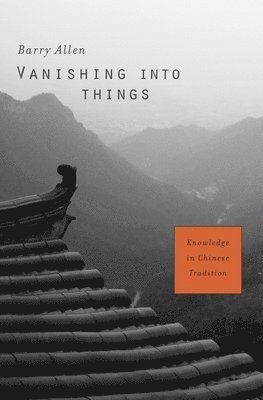
    Vanishing into Things

    Knowledge in Chinese Tradition

    AvBarry Allen

    Inbunden, Engelska, 2015

    522 kr

    Beställningsvara. Skickas inom 10-15 vardagar. Fri frakt över 249 kr.

    Beskrivning

    Vanishing into Things explores the concept of knowledge in Chinese thought over two millennia, from Confucius to Wang Yangming (ca. 1500 CE), and compares the different philosophical imperatives that have driven Chinese and Western thought. Challenging the hyperspecialized epistemology of modern philosophy in the West, Barry Allen urges his readers toward an ethical appreciation of why knowledge is worth pursuing.Western philosophers have long maintained that true knowledge is the best knowledge. Chinese thinkers, by contrast, have emphasized not the essence of knowing but the purpose. Ideas of truth play no part in their understanding of what the best knowledge is: knowledge is not deduced from principles or reducible to a theory. Rather, in Chinese tradition knowledge is expressed through wu wei, literally “not doing”—a response to circumstances that is at once effortless and effective. This type of knowledge perceives the evolution of circumstances from an early point, when its course can still be changed, provided one has the wisdom to grasp the opportunity.Allen guides readers through the major Confucian and Daoist thinkers including Kongzi, Mengzi, Xunzi, Laozi, and Zhuangzi, examining their influence on medieval Neoconfucianism and Chan (Zen) Buddhism, as well as the theme of knowledge in China’s art of war literature. The sophisticated and consistent concept of knowledge elucidated here will be of relevance to contemporary Western and Eastern philosophers alike.

    Produktinformation

    • Utgivningsdatum:2015-04-07
    • Mått:156 x 235 x 29 mm
    • Vikt:586 g
    • Format:Inbunden
    • Språk:Engelska
    • Antal sidor:304
    • Förlag:Harvard University Press
    • ISBN:9780674335912
    • Utmärkelser:Nominated for Joseph Levenson Book Prize 2017

    Utforska kategorier

    • Filosofiska discipliner inom Filosofi och religion

    Mer om författaren

    Barry Allen is Professor of Philosophy at McMaster University.

    Recensioner i media

    What makes his book particularly valuable in my opinion is that [Allen] argues well that we must now go beyond merely learning about the Chinese, to accepting that we can learn much from them, especially, but not confined to the relation between knowledge and its uses or misuses… After reading this book, it will, I believe, be difficult for anyone to not see epistemology in a somewhat different light, perhaps to review their ontological assumptions, and to not want to rethink the field of ethics as well if hoping to achieve a global reach… Readers will not only learn much about Chinese thought from this book, but will see important elements of their own intellectual heritage in a different way. Allen hopes this will lead to making philosophy as truly global in the future as it has mistakenly been thought to be in the past. In sum, a splendid book, a pleasure to read. Philosophy as a discipline is better for having it.