• Fri frakt över 249 kr
  • •
  • Snabba leveranser
  • •
  • Billiga böcker
Kundservice

Du är på sajten för privatpersoner.

Företag, bibliotek eller offentlig verksamhet?

Du handlar på classic.bokus.com, där alla dina funktioner finns intakta.
Till classic.bokus.com
Bokus logotyp. Gå till startsidan.
  • Erbjudanden
  • Student
  • Topplistor
  • Barn & ungdom
  • Bokus Play
  • E-böcker
  • Ljudböcker
  • Pocketböcker
  • Spel & pussel

Upp till 25% på utvalda nyheter →

Sidfot

Mina sidor

    Hjälp

    • Kundservice
    • Vanliga frågor och svar
    • Frakt och leverans
    • Retur vid ångerrätt
    • Reklamera vara
    • Betalning
    • Köpvillkor
    • Allmänna villkor
    • Information om webbplatsens tillgänglighet

    Om Bokus

    • Om oss
    • Pressrum
    • För studenter
    • För företag
    • För bibliotek och offentlig verksamhet
    • För leverantörer
    • Hållbarhet

    Populärt

    • Aktuella erbjudanden
    • Presentkort
    • Studentlitteratur
    • Nya böcker
    • Topplistor
    • Signerade böcker
    • Engelska böcker

    Inspiration

    • Boktips
    • BookTok
    • Populära bokserier
    • Barnbokskaraktärer
    • Populära författare
    Logotyp för Bokus
    Följ oss på Facebook (extern länk)Följ oss på Instagram (extern länk)Följ oss på YouTube (extern länk)Följ oss på TikTok (extern länk)
    bokus @ CookiesAnpassa cookiesIntegritetspolicyKöpvillkor
    Till Citymail hemsida (extern länk)Till Budbee hemsida (extern länk)Till Postnord hemsida (extern länk)Till Schenker hemsida (extern länk)Till Early Bird hemsida (extern länk)Till Walleys hemsida (extern länk)
    1. Ekonomi och Ledarskap
    2. Nationalekonomi

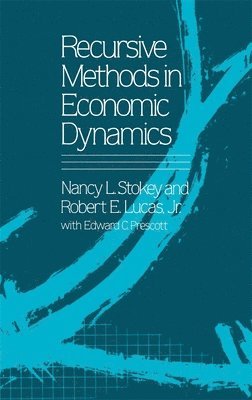
    Recursive Methods in Economic Dynamics

    AvNancy L. Stokey,Robert E. Lucas Jr.

    Inbunden, Engelska, 1989

    1 023 kr

    Beställningsvara. Skickas inom 10-15 vardagar. Fri frakt över 249 kr.

    Beskrivning

    Three eminent economists provide in this book a rigorous, self-contained treatment of modern economic dynamics. Nancy L. Stokey, Robert E. Lucas, Jr., and Edward C. Prescott develop the basic methods of recursive analysis and emphasize the many areas where they can usefully be applied.After presenting an overview of the recursive approach, the authors develop economic applications for deterministic dynamic programming and the stability theory of first-order difference equations. They then treat stochastic dynamic programming and the convergence theory of discrete-time Markov processes, illustrating each with additional economic applications. They also derive a strong law of large numbers for Markov processes. Finally, they present the two fundamental theorems of welfare economics and show how to apply the methods developed earlier to general equilibrium systems.The authors go on to apply their methods to many areas of economics. Models of firm and industry investment, household consumption behavior, long-run growth, capital accumulation, job search, job matching, inventory behavior, asset pricing, and money demand are among those they use to show how predictions can be made about individual and social behavior. Researchers and graduate students in many areas of economics, both theoretical and applied, will find this book essential.

    Produktinformation

    • Utgivningsdatum:1989-10-10
    • Mått:156 x 235 x 44 mm
    • Vikt:962 g
    • Format:Inbunden
    • Språk:Engelska
    • Antal sidor:608
    • Förlag:Harvard University Press
    • ISBN:9780674750968

    Utforska kategorier

    • Nationalekonomi inom Ekonomi och Ledarskap

    Mer om författaren

    Nancy L. Stokey is Frederick Henry Prince Distinguished Service Professor of Economics at the University of Chicago. Robert E. Lucas, Jr., is John Dewey Distinguished Service Professor of Economics at the University of Chicago. In 1995, he was awarded the Nobel Prize in Economics. Edward C. Prescott is Regents’ Professor and Professor of Economics at Arizona State University and Senior Monetary Advisor to the Federal Reserve Bank of Minneapolis.

    Recensioner i media

    The book is a tour de force. The authors present a unified approach to the techniques and applications of recursive economic theory. The presentations of discrete-time dynamic programming and of Markov processes are authoritative. There is a wide-ranging series of examples drawn from all branches of the discipline, but with special emphasis on macroeconomics. In the short run, the book will be a vital reference in any advanced course in macroeconomic theory. In the long run, it may help to remove the traditional boundaries between microeconomic theory and macroeconomic theory.

    Innehållsförteckning

    • I. THE RECURSIVE APPROACH 1. Introduction 2. An Overview 2.1 A Deterministic Model of Optimal Growth 2.2 A Stochastic Model of Optimal Growth 2.3 Competitive Equilibrium Growth 2.4 Conclusions and Plans II. DETERMINISTIC MODELS 3. Mathematical Preliminaries 3.1 Metric Spaces and Normed Vector Spaces 3.2 The Contraction Mapping Theorem 3.3 The Theorem of the Maximum 4. Dynamic Programming under Certainty 4.1 The Principle of Optimality 4.2 Bounded Returns 4.3 Constant Returns to Scale 4.4 Unbounded Returns 4.5 Euler Equations 5. Applications of Dynamic Programming under Certainty 5.1 The One-Sector Model of Optimal Growth 5.2 A "Cake-Eating" Problem 5.3 Optimal Growth with Linear Utility 5.4 Growth with Technical Progress 5.5 A Tree-Cutting Problem 5.6 Learning by Doing 5.7 Human Capital Accumulation 5.8 Growth with Human Capital 5.9 Investment with Convex Costs 5.10 Investment with Constant Returns 5.11 Recursive Preferences 5.12 Theory of the Consumer with Recursive Preferences 5.13 A Pareto Problem with Recursive Preferences 5.14 An (s, S) Inventory Problem 5.15 The Inventory Problem in Continuous Time 5.16 A Seller with Unknown Demand 5.17 A Consumption-Savings Problem 6. Deterministic Dynamics 6.1 One-Dimensional Examples 6.2 Global Stability: Liapounov Functions 6.3 Linear Systems and Linear Approximations 6.4 Euler Equations 6.5 Applications III. STOCHASTIC MODELS 7. Measure Theory and Integration 7.1 Measurable Spaces 7.2 Measures 7.3 Measurable Functions 7.4 Integration 7.5 Product Spaces 7.6 The Monotone Class Lemma