• Fri frakt över 249 kr
  • •
  • Snabba leveranser
  • •
  • Billiga böcker
Kundservice

Du är på sajten för privatpersoner.

Företag, bibliotek eller offentlig verksamhet?

Du handlar på classic.bokus.com, där alla dina funktioner finns intakta.
Till classic.bokus.com
Bokus logotyp. Gå till startsidan.
  • Erbjudanden
  • Nyheter
  • Student
  • Topplistor
  • Barn & ungdom
  • Bokus Play
  • E-böcker
  • Pocketböcker
  • Spel & pussel

10% studentrabatt med kod TERM26

Sidfot

Mina sidor

    Hjälp

    • Kundservice
    • Vanliga frågor och svar
    • Frakt och leverans
    • Retur vid ångerrätt
    • Reklamera vara
    • Betalning
    • Köpvillkor
    • Allmänna villkor
    • Information om webbplatsens tillgänglighet

    Om Bokus

    • Om oss
    • Pressrum
    • För studenter
    • För företag
    • För bibliotek och offentlig verksamhet
    • För leverantörer
    • Hållbarhet

    Populärt

    • Aktuella erbjudanden
    • Presentkort
    • Studentlitteratur
    • Nya böcker
    • Topplistor
    • Signerade böcker
    • Engelska böcker

    Inspiration

    • Boktips
    • BookTok
    • Populära bokserier
    • Barnbokskaraktärer
    • Populära författare
    Logotyp för Bokus
    Följ oss på Facebook (extern länk)Följ oss på Instagram (extern länk)Följ oss på YouTube (extern länk)Följ oss på TikTok (extern länk)
    bokus @ CookiesAnpassa cookiesIntegritetspolicyKöpvillkor
    Till Citymail hemsida (extern länk)Till Budbee hemsida (extern länk)Till Postnord hemsida (extern länk)Till Schenker hemsida (extern länk)Till Early Bird hemsida (extern länk)Till Walleys hemsida (extern länk)
    1. Samhälle och politik
    2. Politik och statsskick
    3. Centralt styre och förvaltning

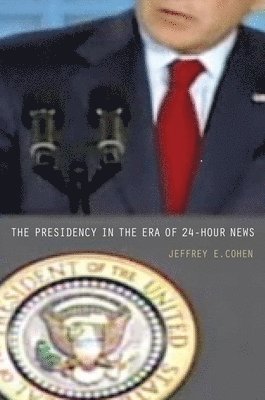
    Presidency in the Era of 24-Hour News

    AvJeffrey E. Cohen

    Häftad, Engelska, 2008

    415 kr

    Beställningsvara. Skickas inom 5-8 vardagar. Fri frakt över 249 kr.

    Fler format och utgåvor

    E-bok

    580 kr

    Beskrivning

    The Presidency in the Era of 24-Hour News examines how changes in the news media since the golden age of television--when three major networks held a near monopoly on the news people saw in the United States--have altered the way presidents communicate with the public and garner popular support. How did Bill Clinton manage to maintain high approval ratings during the Monica Lewinsky scandal? Why has the Iraq war mired George Bush in the lowest approval ratings of his presidency? Jeffrey Cohen reveals how the decline of government regulation and the growth of Internet and cable news outlets have made news organizations more competitive, resulting in decreased coverage of the president in the traditional news media and an increasingly negative tone in the coverage that does occur. He traces the dwindling of public trust in the news and shows how people pay less attention to it than they once did. Cohen argues that the news media's influence over public opinion has decreased considerably as a result, and so has the president's ability to influence the public through the news media. This has prompted a sea change in presidential leadership style.Engaging the public less to mobilize broad support, presidents increasingly cultivate special-interest groups that often already back the White House's agenda. This book carries far-reaching implications for the future of presidential governance and American democracy in the era of new media.

    Produktinformation

    • Utgivningsdatum:2008-03-23
    • Mått:152 x 235 x 15 mm
    • Vikt:390 g
    • Format:Häftad
    • Språk:Engelska
    • Antal sidor:288
    • Förlag:Princeton University Press
    • ISBN:9780691137179

    Utforska kategorier

    • Centralt styre och förvaltning inom Samhälle och politik

    Mer om författaren

    Jeffrey E. Cohen is professor of political science at Fordham University. He is the author of "Presidential Responsiveness and Public Policy-Making".

    Recensioner i media

    "Cohen has constructed a revised and refined version of the 'presidential news system' (the president, the news media, and the mass public) paradigm. He argues that as the 'golden age of television' evolved into the age of the new media in the late 1970s and early 1980s, a growing disconnect between the news and presidential support (approval) became apparent. Thoroughly grounded in political communication theory, this book is an excellent read on changes in presidential governance."--W. K. Hall, Choice "Theoretically, the book provides an important contribution... Methodologically, it ... enables the reader to gain a broad overview of basic literature and research collated in a single book... The book is a good resource."--Pinar Sayan, In-Spire Journal of Law, Politics, and Societies "This is an audacious attempt to provide an empirically based interpretation of the impact of a changing media environment on the power of the American presidency. In just over 200 pages Cohen develops a complex and multifaceted argument that should be widely read by students of American politics and of the interface between the media and politics more broadly."--Robin Brown, Political Studies Review "The Presidency in the Era of 24-Hour News stands as a welcome addition to the literature, particularly appropriate for assignment to upper-division courses on the presidency. Furthermore, Cohen's book belongs in an elite class of public presidency scholarship from this decade ... that merit mandatory inclusion on graduate presidential politics seminar syllabi."--Justin S. Vaughn, Political Science Quarterly "[I]f Cohen does not find empirical resolution to the puzzles of the presidential news system, he does the next best thing by skillfully illuminating important targets of inquiry for future research. For this he is to be commended, and The Presidency in the Era of 24-Hour News deserves a wide audience."--Glenn W Richardson, Presidential Studies Quarterly

    Innehållsförteckning

    • List of Illustrations vii List of Tables ix Preface xi Acknowledgments xiii CHAPTER 1: The Growing Disconnect between Presidential News Coverage and Public Opinion 1 CHAPTER 2: The Presidential News System during the Golden Age of Presidential Television 18 CHAPTER 3: The New Media Age and the Decline in Presidential News 49 CHAPTER 4: Change in Presidential News over the Long Haul: The New York Times Historical Series, 1857-1998 71 CHAPTER 5: The Increasing Negativity in Presidential News in the Age of New Media 89 CHAPTER 6: Sources of Negativity in Presidential News during the Age of New Media 107 CHAPTER 7: The Declining Audience for News and the New Media Age 135 CHAPTER 8: Declining Trust in the News Media and the New Media Age 160 CHAPTER 9: The Implications of the New Media on the Presidential News System and Presidential Leadership 175 CHAPTER 10: Conclusions: The New Media, the Presidency, and American Politics 201 Notes 209 Bibliography 233 Index 251