• Fri frakt över 249 kr
  • •
  • Snabba leveranser
  • •
  • Billiga böcker
Kundservice

Du är på sajten för privatpersoner.

Företag, bibliotek eller offentlig verksamhet?

Du handlar på classic.bokus.com, där alla dina funktioner finns intakta.
Till classic.bokus.com
Bokus logotyp. Gå till startsidan.
  • Erbjudanden
  • Nyheter
  • Student
  • Topplistor
  • Barn & ungdom
  • Bokus Play
  • E-böcker
  • Pocketböcker
  • Spel & pussel

10% rabatt på allt med kod: NYSTART10 →

Sidfot

Mina sidor

    Hjälp

    • Kundservice
    • Vanliga frågor och svar
    • Frakt och leverans
    • Retur vid ångerrätt
    • Reklamera vara
    • Betalning
    • Köpvillkor
    • Allmänna villkor
    • Information om webbplatsens tillgänglighet

    Om Bokus

    • Om oss
    • Pressrum
    • För studenter
    • För företag
    • För bibliotek och offentlig verksamhet
    • För leverantörer
    • Hållbarhet

    Populärt

    • Aktuella erbjudanden
    • Presentkort
    • Studentlitteratur
    • Nya böcker
    • Topplistor
    • Signerade böcker
    • Engelska böcker

    Inspiration

    • Boktips
    • BookTok
    • Populära bokserier
    • Barnbokskaraktärer
    • Populära författare
    Logotyp för Bokus
    Följ oss på Facebook (extern länk)Följ oss på Instagram (extern länk)Följ oss på YouTube (extern länk)Följ oss på TikTok (extern länk)
    bokus @ CookiesAnpassa cookiesIntegritetspolicyKöpvillkor
    Till Citymail hemsida (extern länk)Till Budbee hemsida (extern länk)Till Postnord hemsida (extern länk)Till Schenker hemsida (extern länk)Till Early Bird hemsida (extern länk)Till Walleys hemsida (extern länk)
    1. Filosofi och religion
    2. Filosofi
    3. Filosofiska discipliner

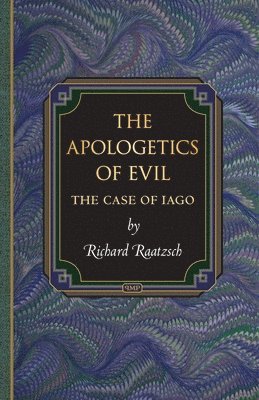
    Apologetics of Evil

    The Case of Iago

    AvRichard Raatzsch

    Inbunden, Engelska, 2009

    Del i serien Princeton Monographs in Philosophy

    458 kr

    Beställningsvara. Skickas inom 5-8 vardagar. Fri frakt över 249 kr.

    Fler format och utgåvor

    E-bok

    636 kr

    Beskrivning

    This book is a concise philosophical meditation on Iago and the nature of evil, through the exploration of the enduring puzzle found in Shakespeare's Othello. What drives Iago to orchestrate Othello's downfall? Instead of treating Iago's lack of motive as the play's greatest weakness, The Apologetics of Evil shows how this absence of motive is the play's greatest strength. Richard Raatzsch determines that Iago does not seek a particular end or revenge for a discrete wrong; instead, Iago is governed by a passion for intriguing in itself. Raatzsch explains that this passion is a pathological version of ordinary human behavior and that Iago lacks the ability to acknowledge others; what matters most to him is the difference between himself and the rest of the world. The book opens with a portrait of Iago, and considers the nature and moral significance of the evil that he represents. Raatzsch addresses the boundaries dividing normality and pathology, conceptualizing evil as a pathological form of the good or ordinary. Seen this way, evil is conceptually dependent on the ordinary, and Iago, as a form of moral monster, is a kind of nonbeing.Therefore, his actions might be understood and defended, even if they cannot be justified. In a brief epilogue, Raatzsch argues that literature's presentation of what is monstrous or virtuous can constitute an understanding of these concepts, not merely illustrate them.

    Produktinformation

    • Utgivningsdatum:2009-07-26
    • Mått:140 x 216 x 16 mm
    • Vikt:295 g
    • Format:Inbunden
    • Språk:Engelska
    • Serie:Princeton Monographs in Philosophy
    • Antal sidor:128
    • Förlag:Princeton University Press
    • ISBN:9780691137339
    • Översättare:Ladislaus Löb, Ladislaus Lob

    Utforska kategorier

    • Filosofiska discipliner inom Filosofi och religion
    • Litteraturvetenskap inom Skönlitteratur

    Mer om författaren

    Richard Raatzsch holds the chair for practical philosophy at the European Business School in Wiesbaden, Germany.

    Recensioner i media

    "What is evil? What are its forms? How is it motivated? These are questions of the greatest human significance and Raatzsch's treatment of them is sensitive, imaginative, and broadly based. This book brings together different lines of argument from epistemology, moral philosophy, and philosophy of mind in a highly compact and supercharged, yet fully comprehensible form. The result packs an enormous intellectual punch."—Raymond Geuss, University of Cambridge

    Innehållsförteckning

    • Introduction 1 Chapter One: The Concept of Iago 11 1.1 The Origin of the Concept 11 1.2 Acting without a Motive? 14 1.3 Iago's Mode of Being and the Idea of a Panopticon 30 Chapter Two: Apologia for Iago 77 2.1 Defense, Justification, and Understanding 77 2.2 Defending Iago 91 2.3 Why Iago Perishes, and What His Downfall Means 103 Acknowledgments 109 Index 111