• Fri frakt över 249 kr
  • •
  • Snabba leveranser
  • •
  • Billiga böcker
Kundservice

Du är på sajten för privatpersoner.

Företag, bibliotek eller offentlig verksamhet?

Du handlar på classic.bokus.com, där alla dina funktioner finns intakta.
Till classic.bokus.com
Bokus logotyp. Gå till startsidan.
  • Erbjudanden
  • Nyheter
  • Student
  • Topplistor
  • Barn & ungdom
  • Bokus Play
  • E-böcker
  • Pocketböcker
  • Spel & pussel

10% rabatt på allt med kod: NYSTART10 →

Sidfot

Mina sidor

    Hjälp

    • Kundservice
    • Vanliga frågor och svar
    • Frakt och leverans
    • Retur vid ångerrätt
    • Reklamera vara
    • Betalning
    • Köpvillkor
    • Allmänna villkor
    • Information om webbplatsens tillgänglighet

    Om Bokus

    • Om oss
    • Pressrum
    • För studenter
    • För företag
    • För bibliotek och offentlig verksamhet
    • För leverantörer
    • Hållbarhet

    Populärt

    • Aktuella erbjudanden
    • Presentkort
    • Studentlitteratur
    • Nya böcker
    • Topplistor
    • Signerade böcker
    • Engelska böcker

    Inspiration

    • Boktips
    • BookTok
    • Populära bokserier
    • Barnbokskaraktärer
    • Populära författare
    Logotyp för Bokus
    Följ oss på Facebook (extern länk)Följ oss på Instagram (extern länk)Följ oss på YouTube (extern länk)Följ oss på TikTok (extern länk)
    bokus @ CookiesAnpassa cookiesIntegritetspolicyKöpvillkor
    Till Citymail hemsida (extern länk)Till Budbee hemsida (extern länk)Till Postnord hemsida (extern länk)Till Schenker hemsida (extern länk)Till Early Bird hemsida (extern länk)Till Walleys hemsida (extern länk)
    1. Kultur
    2. Arkitektur

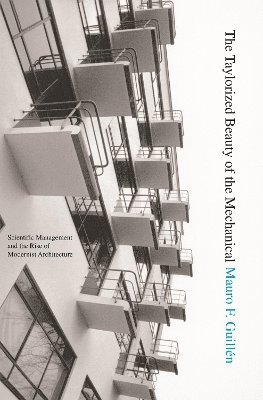
    Taylorized Beauty of the Mechanical

    Scientific Management and the Rise of Modernist Architecture

    AvMauro F. Guillén

    Häftad, Engelska, 2008

    Del i serien Princeton Studies in Cultural Sociology

    428 kr

    Beställningsvara. Skickas inom 5-8 vardagar. Fri frakt över 249 kr.

    Fler format och utgåvor

    E-bok

    598 kr

    Beskrivning

    The dream of scientific management was a rationalized machine world where life would approach the perfection of an assembly line. But since its early twentieth-century peak this dream has come to seem a dehumanizing nightmare. Henry Ford's assembly lines turned out a quarter of a million cars in 1914, but all of them were black. Forgotten has been the unparalleled new aesthetic beauty once seen in the ideas of Ford and scientific management pioneer Frederick Winslow Taylor. In The Taylorized Beauty of the Mechanical, Mauro Guillen recovers this history and retells the story of the emergence of modernist architecture as a romance with the ideas of scientific management--one that permanently reshaped the profession of architecture. Modernist architecture's pioneers, Guillen shows, found in scientific management the promise of a new, functional, machine-like--and beautiful--architecture, and the prospect of a new role for the architect as technical professional and social reformer. Taylor and Ford had a signal influence on Bauhaus founder Walter Gropius and on Le Corbusier and his Towards a New Architecture, the most important manifesto of modernist architecture.Architects were so enamored with the ideas of scientific management that they adopted them even when there was no functional advantage to do so. Not a traditional architectural history but rather a sociological study of the profession of architecture during its early modernist period, The Taylorized Beauty of the Mechanical provides a new understanding of the degree to which modernist architecture emerged from a tradition of engineering and industrial management.

    Produktinformation

    • Utgivningsdatum:2008-10-26
    • Mått:152 x 235 x 15 mm
    • Vikt:318 g
    • Format:Häftad
    • Språk:Engelska
    • Serie:Princeton Studies in Cultural Sociology
    • Antal sidor:208
    • Förlag:Princeton University Press
    • ISBN:9780691138473

    Utforska kategorier

    • Arkitektur inom Kultur
    • Sociologi inom Samhälle och politik

    Mer om författaren

    Mauro F. Guillen is director of the Lauder Institute and the Dr. Felix Zandman Professor of International Management and Sociology at the Wharton School of the University of Pennsylvania. He is the author of T"The Limits of Convergence: Globalization and Organizational Change in Argentina, South Korea, and Spain" (Princeton), "The Rise of Spanish Multinationals", and the coauthor of "Building a Global Bank" (Princeton).

    Recensioner i media

    "The Taylorized Beauty of the Mechanical is an ambitious work. Mauro Guillen draws from an abundance of sources, both contemporary and recent, to support his hypothesis that there was a connection between the rise of scientific management and the development of modernist architecture... Guillen has written an excellent comparative study that will appeal both to business historians and to architectural and design historians."--Per H. Hansen, Business History Review "Guillen ... offers a unique and bold explanation of the differential development of modern architecture internationally... Guillen's analysis of modern architecture is impressive and inventive. If his answers are not definitive, he certainly asks the right questions and, consequently, greatly advances the sociological study of architecture."--David Gartman, American Journal of Sociology "Mauro F. Guillen contributes to the scholarship on architectural Modernism with an interesting twist with approaching the architectural history literature from a joint managerial and sociological viewpoint... [T]his survey will be of interest to specialists and non-specialists alike."--Guillaume Evrard, European Legacy

    Innehållsförteckning

    • List of Plates vii List of Tables and Figures ix Preface xi Chapter One: Organization, Modernism, and Architecture 1 Chapter Two: The Taylorized Beauty of the Mechanical 15 Chapter Three: What Caused Modernist Architecture? 33 Chapter Four: Industrialization, Technology, and the State: Britain, France, Germany 45 Chapter Five: Backwardness and Revolution: Italy, Russia, Spain 68 Chapter Six: Modernism without Modernity: Mexico, Brazil, Argentina 91 Chapter Seven: Sponsorship, Professionalization, and Modernist Architecture 108 Chapter Eight: The Enduring Promise of Modernist Architecture 137 Appendix: Leading Architects 149 Illustration Credits for Plates 157 References 159 Index 179