• Fri frakt över 249 kr
  • •
  • Snabba leveranser
  • •
  • Billiga böcker
Kundservice

Du är på sajten för privatpersoner.

Företag, bibliotek eller offentlig verksamhet?

Du handlar på classic.bokus.com, där alla dina funktioner finns intakta.
Till classic.bokus.com
Bokus logotyp. Gå till startsidan.
  • Erbjudanden
  • Nyheter
  • Student
  • Topplistor
  • Barn & ungdom
  • Bokus Play
  • E-böcker
  • Pocketböcker
  • Spel & pussel

10% rabatt på allt med kod NYSTART10 →

Sidfot

Mina sidor

    Hjälp

    • Kundservice
    • Vanliga frågor och svar
    • Frakt och leverans
    • Retur vid ångerrätt
    • Reklamera vara
    • Betalning
    • Köpvillkor
    • Allmänna villkor
    • Information om webbplatsens tillgänglighet

    Om Bokus

    • Om oss
    • Pressrum
    • För studenter
    • För företag
    • För bibliotek och offentlig verksamhet
    • För leverantörer
    • Hållbarhet

    Populärt

    • Aktuella erbjudanden
    • Presentkort
    • Studentlitteratur
    • Nya böcker
    • Topplistor
    • Signerade böcker
    • Engelska böcker

    Inspiration

    • Boktips
    • BookTok
    • Populära bokserier
    • Barnbokskaraktärer
    • Populära författare
    Logotyp för Bokus
    Följ oss på Facebook (extern länk)Följ oss på Instagram (extern länk)Följ oss på YouTube (extern länk)Följ oss på TikTok (extern länk)
    bokus @ CookiesAnpassa cookiesIntegritetspolicyKöpvillkor
    Till Citymail hemsida (extern länk)Till Budbee hemsida (extern länk)Till Postnord hemsida (extern länk)Till Schenker hemsida (extern länk)Till Early Bird hemsida (extern länk)Till Walleys hemsida (extern länk)
    1. Juridik
    2. Särskilda rättsområden
    3. Rättsordning

    Citizens, Courts, and Confirmations

    Positivity Theory and the Judgments of the American People

    AvJames L. Gibson,Gregory A. Caldeira

    Häftad, Engelska, 2009

    366 kr

    Beställningsvara. Skickas inom 5-8 vardagar. Fri frakt över 249 kr.

    Beskrivning

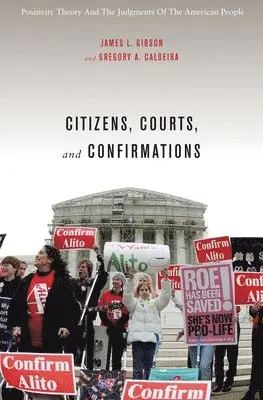
    In recent years the American public has witnessed several hard-fought battles over nominees to the U.S. Supreme Court. In these heated confirmation fights, candidates' legal and political philosophies have been subject to intense scrutiny and debate. Citizens, Courts, and Confirmations examines one such fight--over the nomination of Samuel Alito--to discover how and why people formed opinions about the nominee, and to determine how the confirmation process shaped perceptions of the Supreme Court's legitimacy. Drawing on a nationally representative survey, James Gibson and Gregory Caldeira use the Alito confirmation fight as a window into public attitudes about the nation's highest court. They find that Americans know far more about the Supreme Court than many realize, that the Court enjoys a great deal of legitimacy among the American people, that attitudes toward the Court as an institution generally do not suffer from partisan or ideological polarization, and that public knowledge enhances the legitimacy accorded the Court.Yet the authors demonstrate that partisan and ideological infighting that treats the Court as just another political institution undermines the considerable public support the institution currently enjoys, and that politicized confirmation battles pose a grave threat to the basic legitimacy of the Supreme Court.

    Produktinformation

    • Utgivningsdatum:2009-06-15
    • Mått:152 x 235 x 15 mm
    • Vikt:340 g
    • Format:Häftad
    • Språk:Engelska
    • Antal sidor:240
    • Förlag:Princeton University Press
    • ISBN:9780691139883

    Utforska kategorier

    • Rättsordning inom Juridik
    • Politisk aktivism inom Samhälle och politik

    Mer om författaren

    James L. Gibson is the Sidney W. Souers Professor of Government at Washington University in St. Louis. His books include "Overcoming Apartheid: Can Truth Reconcile a Divided Nation?" Gregory A. Caldeira holds the Ann and Darrell Dreher Chair in Political Communication and Policy Thinking at Ohio State University.

    Recensioner i media

    "Citizens, Courts, and Confirmations is a significant contribution to the literature on judicial politics. Its findings are interesting and unique, and it provides a number of insights likely to prompt further studies of courts and the citizenry... Any scholar or citizen interested in the interrelations of courts and public opinion should read Citizens, Courts, and Confirmations, and it will surely find its way on to the syllabi of numerous graduate courses on judicial politics."--Richard L. Vining, Law and Politics Book Review "As a piece of research, Citizens is everything court scholars have come to expect from these two authors: its innovative methodology and provocative findings contribute significantly to the literature on public opinion and the judiciary... Like any good study, Citizens both advances the literature and serves as an impetus for future work."--Nicholas LaRowe, Journal of Politics "I found this book to be an excellent example of cutting edge research that can be highly useful in the classroom. [This book is an] excellent example of the best of current judicial politics research."--Mark C. Miller, Political Psychology

    Innehållsförteckning

    • List of Figures and Tables ix Preface xi CHAPTER ONE: Introduction: The Public and Supreme Court Nominations 1 Changes in Attitudes toward Judicial Institutions 4 The Theory of Positivity Bias 7 Outlining the Chapters That Follow 14 CHAPTER TWO: Knowing about Courts 17 Assessing Public Information about Law and Courts 19 Empirical Evidence of Mass Ignorance 20 Discussion and Concluding Comments 34 Appendix 2.A: Survey Design, The 2001 Survey 35 CHAPTER THREE: The Popular Legitimacy of the United States Supreme Court 36 Theories of Institutional Legitimacy 38 Measuring Institutional Legitimacy 44 Accounting for Individual-Level Variability in Institutional Loyalty 49 Discussion 61 CHAPTER FOUR: Institutional Loyalty, Positivity Bias, and the Alito Nomination 63 The Confirmation of Samuel Alito to the Supreme Court 66 The Positivity Theory Hypotheses 69 Assessments of the Confirmation Process 71 The Models 72 Determinants of Confirmation Preferences 85 Discussion and Concluding Comments 93 CHAPTER FIVE: A Dynamic Test of the Positivity Bias Hypothesis 96 Applying the Theory of Positivity Bias to Confirmations 97 Measuring Change in Attitudes toward the U.S. Supreme Court 98 The Model of Change in Institutional Support 103 Findings 110 Discussion and Concluding Comments 119 CHAPTER SIX: Concluding Thoughts, Theory, and Policy 121 Caveats, Puzzles, and Questions 125 APPENDIX A: Survey Design: The 2005 Survey 129 APPENDIX B: The Representativeness of the Panel Sample 131 APPENDIX C: The Supreme Court and the U.S. Presidential Election of 2000: Wounds, Self-Inflicted or Otherwise? 133 James L. Gibson, Gregory A. Caldeira, and Lester Kenyatta Spence The Theory of Institutional Legitimacy 135 Institutional Loyalty in the Aftermath of the Election 139 Views of the Court's Opinion in Bush v. Gore 144 Discussion and Concluding Comments 156 Appendix C.1: Survey Design 158 Appendix C.2: Measurement 159 References 163 Index 175