• Fri frakt över 249 kr
  • •
  • Snabba leveranser
  • •
  • Billiga böcker
Kundservice

Du är på sajten för privatpersoner.

Företag, bibliotek eller offentlig verksamhet?

Du handlar på classic.bokus.com, där alla dina funktioner finns intakta.
Till classic.bokus.com
Bokus logotyp. Gå till startsidan.
  • Erbjudanden
  • Nyheter
  • Student
  • Topplistor
  • Barn & ungdom
  • Bokus Play
  • E-böcker
  • Pocketböcker
  • Spel & pussel

10% rabatt på allt med kod NYSTART10 →

Sidfot

Mina sidor

    Hjälp

    • Kundservice
    • Vanliga frågor och svar
    • Frakt och leverans
    • Retur vid ångerrätt
    • Reklamera vara
    • Betalning
    • Köpvillkor
    • Allmänna villkor
    • Information om webbplatsens tillgänglighet

    Om Bokus

    • Om oss
    • Pressrum
    • För studenter
    • För företag
    • För bibliotek och offentlig verksamhet
    • För leverantörer
    • Hållbarhet

    Populärt

    • Aktuella erbjudanden
    • Presentkort
    • Studentlitteratur
    • Nya böcker
    • Topplistor
    • Signerade böcker
    • Engelska böcker

    Inspiration

    • Boktips
    • BookTok
    • Populära bokserier
    • Barnbokskaraktärer
    • Populära författare
    Logotyp för Bokus
    Följ oss på Facebook (extern länk)Följ oss på Instagram (extern länk)Följ oss på YouTube (extern länk)Följ oss på TikTok (extern länk)
    bokus @ CookiesAnpassa cookiesIntegritetspolicyKöpvillkor
    Till Citymail hemsida (extern länk)Till Budbee hemsida (extern länk)Till Postnord hemsida (extern länk)Till Schenker hemsida (extern länk)Till Early Bird hemsida (extern länk)Till Walleys hemsida (extern länk)
    1. Historia och arkeologi
    2. Historia
    3. Historia: särskilda händelser och ämnen
    4. Kalla krig och ombudskrig

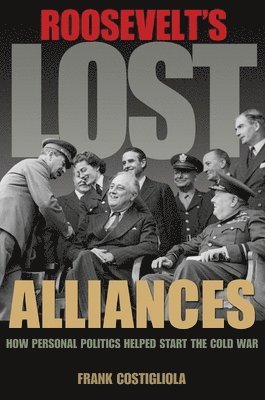
    Roosevelt's Lost Alliances

    How Personal Politics Helped Start the Cold War

    AvFrank Costigliola

    Häftad, Engelska, 2013

    258 kr

    Beställningsvara. Skickas inom 5-8 vardagar. Fri frakt över 249 kr.

    Fler format och utgåvor

    E-bok

    356 kr

    Beskrivning

    In the spring of 1945, as the Allied victory in Europe was approaching, the shape of the postwar world hinged on the personal politics and flawed personalities of Roosevelt, Churchill, and Stalin. Roosevelt's Lost Alliances captures this moment and shows how FDR crafted a winning coalition by overcoming the different habits, upbringings, sympathies, and past experiences of the three leaders. In particular, Roosevelt trained his famous charm on Stalin, lavishing respect on him, salving his insecurities, and rendering him more amenable to compromise on some matters. Yet, even as he pursued a lasting peace, FDR was alienating his own intimate circle of advisers and becoming dangerously isolated. After his death, postwar cooperation depended on Harry Truman, who, with very different sensibilities, heeded the embittered "Soviet experts" his predecessor had kept distant. A Grand Alliance was painstakingly built and carelessly lost. The Cold War was by no means inevitable.This landmark study brings to light key overlooked documents, such as the Yalta diary of Roosevelt's daughter Anna; the intimate letters of Roosevelt's de facto chief of staff, Missy LeHand; and the wiretap transcripts of estranged adviser Harry Hopkins. With a gripping narrative and subtle analysis, Roosevelt's Lost Alliances lays out a new approach to foreign relations history. Frank Costigliola highlights the interplay between national political interests and more contingent factors, such as the personalities of leaders and the culturally conditioned emotions forming their perceptions and driving their actions. Foreign relations flowed from personal politics--a lesson pertinent to historians, diplomats, and citizens alike.

    Produktinformation

    • Utgivningsdatum:2013-02-24
    • Mått:152 x 235 x 32 mm
    • Vikt:765 g
    • Format:Häftad
    • Språk:Engelska
    • Antal sidor:544
    • Förlag:Princeton University Press
    • ISBN:9780691157924
    • Utmärkelser:Commended for PROSE Awards: U.S. History 2012

    Utforska kategorier

    • Kalla krig och ombudskrig inom Historia och arkeologi
    • Internationella relationer inom Samhälle och politik

    Mer om författaren

    Frank Costigliola is professor of history at the University of Connecticut and former president of the Society for Historians of American Foreign Relations. He is the author of France and the United States and Awkward Dominion.

    Recensioner i media

    Winner of the 2013 Robert H. Ferrell Book Prize, Society for Historians of American Foreign Relations Honorable Mention for the 2012 Award for Best Professional/Scholarly Book in U.S. History, Association of American Publishers "The premise that 'the Cold War was not inevitable' launches this penetrating, personality-focused exploration of its WWII roots and the late 20th century conflict whose aftershocks are still being felt today. Costigliola (Awkward Dominion) is deft in his characterization of the Big Three: Churchill--boyish, flamboyant, and thrilled by armed conflict; Stalin--a piercingly intelligent former seminarian capable of merciless brutality for the sake of a cause; and FDR--the fulcrum, a blue-blooded trickster willing both to humor Churchill's nude effusiveness as a guest in the White House and win at Yalta the honest admiration of the insecure Stalin. With all the trappings of a dramatic HBO series (sex, intrigue, hierarchy, and global and historical resonance) Costigliola dutifully traces the reasons Roosevelt's vision of three (or four) world policemen committed to global stability failed to win out in the post-war near-term."--Publishers Weekly "Even with 60 years of writing on the Cold War's origins behind us, Roosevelt's Lost Alliances can boast of a novel thesis."--Jordan Michael Smith, BostonGlobe.com "This well-written work, based on extensive use of the private papers, personal correspondence, and published memoirs of the major participants, provides an interesting perspective on the wartime alliance and the origins of the Cold War, guaranteed to spark discussion."--Choice "In Roosevelt's Lost Alliances Costigliola deploys a finely tuned methodology to produce a learned and satisfying histoire totale of the inner workings of the Big Three wartime alliance and the reasons for its demise. He re-examines familiar material in the light of new questions and draws on previously ignored or under-utilized sources, of which the ones by women are especially important."--Michaela Hoenicke Moore, H-Diplo "As an exercise in wedge revisionism, Costigliola advances a powerful viewpoint, albeit one he might have couched with more shading and less certitude."--Newark Star-Ledger "This book offers a provocative psychological thesis on leadership and diplomacy that contributes to understanding the origins of the Cold War. It will appeal to scholars and general readers interested in the transition of the Allies from World War II to the Cold War. Highly recommended."--Library Journal (starred review) "Every so often appears a new publication that demonstrates the complexities of the historian's craft and reminds professionals that their scholarly pursuits--no matter how evenhanded, rational, or seemingly definitive--must ultimately land somewhere between art and science. So is the case with Frank Costigliola's engaging and thought-provoking new study of 'personal politics.'"--Steven M. George, 49th Parallel "Among its many contributions, Costigliola's impressive book reminds us that the emotional truths of the earlier Cold Warriors' positions will be forever undermined by the costs and scars of the conflict they helped to set in motion."--Hannah Gurman, American Historical Review "Costigliola's rich and incisive analysis will vastly deepen our understanding of the imponderables surrounding the perhaps most crucial phase of the twentieth century."--Klaus Schwabe, Diplomatic History "Costigliola's is a brave thesis, premised upon many years of fine scholarship, that will enrich our understanding of this crucial period of history. It will provoke much debate and deserves to be widely read."--Alan P. Dobson, Historian "Roosevelt's Lost Alliances is an important and well-written book. Not because it recounts familiar events, but because it is able to examine the main figures from a new perspective and, by doing so, can demonstrate how important personal views, cultural differences, and mutual misunderstanding were in the onset of the Cold War."--Eszterhazy Karoly College, Hungarian Journal of English and American Studies "Costigliola's insistence on exploring the private, human sides of public policy yields dividends. Utilising a wide range of new or underexploited archives, he brings out the personalities of the wartime Big Three."--David Reynolds, Diplomacy & Statecraft "Costigliola seeks to render a new, more Roosevelt-friendly judgment. Even those historians who will doubtless quibble with, or challenge, his conclusions will still find an enormous amount to enjoy and to stimulate them in this important book."--Steven Casey, War in History "This is a great read of war and politics at the very pinnacle of the Allied leadership pyramid that is both educational and surprising, engagingly crafted and well presented."--Blaine Taylor, Military Advisor

    Innehållsförteckning

    • Introduction 1 CHAPTER 1: A Portrait of the Allies as Young Men: Franklin, Winston, and Koba 21 CHAPTER 2: From Missy to Molotov: The Women and Men Who Sustained the Big Three 58 CHAPTER 3: The Personal Touch: Forming the Alliance, January-August 1941 97 CHAPTER 4: Transcending Differences: Eden Goes to Moscow and Churchill to Washington, December 1941 141 CHAPTER 5: Creating the "Family Circle": The Tortuous Path to Tehran, 1942-43 163 CHAPTER 6: "I've Worked It Out": Roosevelt's Plan to Win the Peace and Defy Death, 1944-45 205 CHAPTER 7: The Diplomacy of Trauma: Kennan and His Colleagues in Moscow, 1933-46 259 CHAPTER 8: Guns and Kisses in the Kremlin: Ambassadors Harriman and Clark Kerr Encounter Stalin, 1943-46 291 CHAPTER 9: "Roosevelt's Death Has Changed Everything": Truman's First Days, April-June 1945 312 CHAPTER 10: The Lost Alliance: Widespread Anxiety and Deepening Ideology, July 1945-March 1946 359 Conclusion and Epilogue 418 Acknowledgments 429 Bibliographical Note 433 Notes 437 Index 523