• Fri frakt över 249 kr
  • •
  • Snabba leveranser
  • •
  • Billiga böcker
Kundservice

Du är på sajten för privatpersoner.

Företag, bibliotek eller offentlig verksamhet?

Du handlar på classic.bokus.com, där alla dina funktioner finns intakta.
Till classic.bokus.com
Bokus logotyp. Gå till startsidan.
  • Erbjudanden
  • Nyheter
  • Student
  • Topplistor
  • Barn & ungdom
  • Bokus Play
  • E-böcker
  • Pocketböcker
  • Spel & pussel

10% rabatt på allt med kod: NYSTART10 →

Sidfot

Mina sidor

    Hjälp

    • Kundservice
    • Vanliga frågor och svar
    • Frakt och leverans
    • Retur vid ångerrätt
    • Reklamera vara
    • Betalning
    • Köpvillkor
    • Allmänna villkor
    • Information om webbplatsens tillgänglighet

    Om Bokus

    • Om oss
    • Pressrum
    • För studenter
    • För företag
    • För bibliotek och offentlig verksamhet
    • För leverantörer
    • Hållbarhet

    Populärt

    • Aktuella erbjudanden
    • Presentkort
    • Studentlitteratur
    • Nya böcker
    • Topplistor
    • Signerade böcker
    • Engelska böcker

    Inspiration

    • Boktips
    • BookTok
    • Populära bokserier
    • Barnbokskaraktärer
    • Populära författare
    Logotyp för Bokus
    Följ oss på Facebook (extern länk)Följ oss på Instagram (extern länk)Följ oss på YouTube (extern länk)Följ oss på TikTok (extern länk)
    bokus @ CookiesAnpassa cookiesIntegritetspolicyKöpvillkor
    Till Citymail hemsida (extern länk)Till Budbee hemsida (extern länk)Till Postnord hemsida (extern länk)Till Schenker hemsida (extern länk)Till Early Bird hemsida (extern länk)Till Walleys hemsida (extern länk)
    1. Naturvetenskap och teknik
    2. Matematik och naturvetenskap
    3. Fysik
    4. Tillämpad fysik

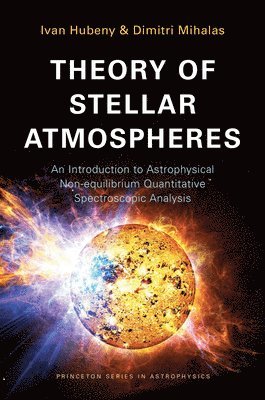
    Theory of Stellar Atmospheres

    An Introduction to Astrophysical Non-equilibrium Quantitative Spectroscopic Analysis

    AvIvan Hubeny,Dimitri Mihalas

    Häftad, Engelska, 2014

    Del i serien Princeton Series in Astrophysics

    986 kr

    Beställningsvara. Skickas inom 5-8 vardagar. Fri frakt över 249 kr.

    Beskrivning

    This book provides an in-depth and self-contained treatment of the latest advances achieved in quantitative spectroscopic analyses of the observable outer layers of stars and similar objects. Written by two leading researchers in the field, it presents a comprehensive account of both the physical foundations and numerical methods of such analyses. The book is ideal for astronomers who want to acquire deeper insight into the physical foundations of the theory of stellar atmospheres, or who want to learn about modern computational techniques for treating radiative transfer in non-equilibrium situations. It can also serve as a rigorous yet accessible introduction to the discipline for graduate students. * Provides a comprehensive, up-to-date account of the field* Covers computational methods as well as the underlying physics* Serves as an ideal reference book for researchers and a rigorous yet accessible textbook for graduate students* An online illustration package is available to professors at press.princeton.edu

    Produktinformation

    • Utgivningsdatum:2014-10-26
    • Mått:152 x 235 x 53 mm
    • Vikt:1 565 g
    • Format:Häftad
    • Språk:Engelska
    • Serie:Princeton Series in Astrophysics
    • Antal sidor:944
    • Förlag:Princeton University Press
    • ISBN:9780691163291

    Utforska kategorier

    • Tillämpad fysik inom Naturvetenskap och teknik
    • Analytisk kemi inom Naturvetenskap och teknik

    Mer om författaren

    Ivan Hubeny is a senior research scientist at the Steward Observatory and adjunct professor in the Department of Astronomy at the University of Arizona. Dimitri Mihalas (1939-2013) was an astrophysicist at the Los Alamos National Laboratory. His many books include Stellar Atmospheres and Foundations of Radiation Hydrodynamics.

    Recensioner i media

    "It is an excellent guide for anyone interested in radiation transport and spectral analyses in astrophysics."--Claudia-Veronika Meister, Zentralblatt MATH "A magisterial work that will surely be the definitive reference for many years to come."--Ian D. Howarth, The Observatory

    Innehållsförteckning

    • Preface xi Chapter 1. Why Study Stellar Atmospheres? 1 1.1 A Historical Precis 1 1.2 The Bottom Line 15 Chapter 2. Observational Foundations 20 2.1 What Is a Stellar Atmosphere? 20 2.2 Spectroscopy 23 2.3 Spectrophotometry 29 2.4 Photometry 32 2.5 Mass, Luminosity, and Radius 46 2.6 Interpretation of Color-Magnitude Diagrams 53 Chapter 3. Radiation 61 3.1 Specific Intensity 61 3.2 Mean Intensity and Energy Density 65 3.3 Radiation Flux 72 3.4 Radiation Pressure Tensor 75 3.5 * Transformation Properties of I, E, F, P 78 3.6 Quantum Theory of Radiation in Vacuum 80 Chapter 4. Statistical Mechanics of Matter and Radiation 86 4.1 Thermodynamic Equilibrium 86 4.2 Boltzmann Statistics 88 4.3 Thermal Radiation 98 4.4 Quantum Statistics 103 4.5 Local Thermodynamic Equilibrium 111 Chapter 5. Absorption and Emission of Radiation 113 5.1 Absorption and Thermal Emission 114 5.2 Detailed Balance 116 5.3 Bound-Bound Absorption Probability 121 5.4 Bound-Bound Emission Probability 130 5.5 Photoionization 136 5.6 Free-Free Transitions 137 Chapter 6. Continuum Scattering 144 6.1 Thomson Scattering: Classical Analysis 145 6.2 Thomson Scattering: Quantum Mechanical Analysis 150 6.3 * Rayleigh and Raman Scattering 153 6.4 Compton Scattering 159 6.5 Compton Scattering in the Early Universe 165 Chapter 7. Atomic and Molecular Absorption Cross Sections 170 7.1 Hydrogen and Hydrogenic Ions 171 7.2 Multi-Electron Atoms 192 7.3 Molecules 208 Chapter 8. Spectral Line Broadening 228 8.1 Natural Damping Profile 228 8.2 Doppler Broadening: Voigt Function 231 8.3 Semiclassical Impact Theory 233 8.4 Statistical Theory: Quasi-Static Approximation 241 8.5 * Quantum Theory of Line Broadening 248 8.6 Applications 258 Chapter 9. Kinetic Equilibrium Equations 262 9.1 LTE versus Non-LTE 262 9.2 General Formulation 264 9.3 Transition Rates 267 9.4 Level Dissolution and Occupation Probabilities 278 9.5 Complete Rate Equations 282 Chapter 10. Scattering of Radiation in Spectral Lines 290 10.1 Semiclassical (Weisskopf-Woolley) Picture 291 10.2 * Quantum Mechanical Derivation of Redistribution Functions 301 10.3 Basic Redistribution Functions 308 10.4 More Complex Redistribution Functions 321 10.5 Emission Coefficient 327 Chapter 11. Radiative Transfer Equation 334 11.1 Absorption, Emission, and Scattering Coefficients 334 11.2 Formulation 339 11.3 Moments of the Transfer Equation 347 11.4 Time-Independent, Static, Planar Atmospheres 352 11.5 Schwarzschild-Milne Equations 361 11.6 Second-Order Form of the Transfer Equation 367 11.7 Discretization 370 11.8 Probabilistic Interpretation 373 11.9 Diffusion Limit 374 Chapter 12. Direct Solution of the Transfer Equation 378 12.1 The Problem of Scattering 379 12.2 Feautrier's Method 387 12.3 Rybicki's Method 397 12.4 Formal Solution 400 12.5 Variable Eddington Factors 418 Chapter 13. Iterative Solution of the Transfer Equation 421 13.1 Accelerated Lambda Iteration: A Heuristic View 421 13.2 Iteration Methods and Convergence Properties 425 13.3 Accelerated Lambda Iteration (ALI) 434 13.4 Acceleration of Convergence 440 13.5 Astrophysical Implementation 443 Chapter 14. NLTE Two-Level and Multi-Level Atoms 448 14.1 Formulation 448 14.2 Two-Level Atom 457 14.3 Approximate Solutions 471 14.4 Equivalent-Two-Level-Atom Approach 482 14.5 Numerical Solution of the Multi-level Atom Problem 488 14.6 Physical Interpretation 505 Chapter 15. Radiative Transfer with Partial Redistribution 511 15.1 Formulation 511 15.2 Simple Heuristic Model 515 15.3 Approximate Solutions 519 15.4 Exact Solutions 524 15.5 Multi-level Atoms 533 15.6 Applications 539 Chapter 16. Structural Equations 546 16.1 Equations of Hydrodynamics 546 16.2 1D Flow 554 16.3 1D Steady Flow 555 16.4 StaticAtmospheres 557 16.5 Convection 558 16.6 Stellar Interiors 565 Chapter 17. LTE Model Atmospheres 569 17.1 Gray Atmosphere 569 17.2 Equation of State 588 17.3 Non-Gray LTE Radiative-Equilibrium Models 593 17.4 Models with Convection 604 17.5 LTE Spectral Line Formation 606 17.6 Line Blanketing 620 17.7 Models with External Irradiation 627 17.8 Available Modeling Codes and Grids 631 Chapter 18. Non-LTE Model Atmospheres 633 18.1 Overview of Basic Equations 633 18.2 Complete Linearization 645 18.3 Overview of Possible Iterative Methods 660 18.4 Application of ALI and Related Methods 667 18.5 NLTE Metal Line Blanketing 676 18.6 Applications: Modeling Codes and Grids 684 Chapter 19. Extended and Expanding Atmospheres 691 19.1 Extended Atmospheres 691 19.2 Moving Atmospheres: Observer's-Frame Formulation 705 19.3 Moving Atmospheres: Comoving-Frame Formulation 713 19.4 Moving Atmospheres: Mixed-Frame Formulation 736 19.5 Sobolev Approximation 743 19.6 NLTE Line Formation 754 Chapter 20. Stellar Winds 764 20.1 Qualitative Picture 765 20.2 Thermally DrivenWinds 766 20.3 Radiation-Driven Winds 772 20.4 Global Model Atmospheres 800 Appendix A. Relativistic Particles 815 A.1 Kinematics and Dynamics of Point Particles 815 A.2 Relativistic Kinetic Theory 822 Appendix B. Photons 829 B.1 Lorentz Transformation of the Photon Four-Momentum 829 B.2 Photon Distribution Function 830 B.3 Thomas Transformations 831 Glossary of Symbols 833 Bibliography 849 Index 915