• Fri frakt över 249 kr
  • •
  • Snabba leveranser
  • •
  • Billiga böcker
Kundservice

Du är på sajten för privatpersoner.

Företag, bibliotek eller offentlig verksamhet?

Du handlar på classic.bokus.com, där alla dina funktioner finns intakta.
Till classic.bokus.com
Bokus logotyp. Gå till startsidan.
  • Erbjudanden
  • Nyheter
  • Student
  • Topplistor
  • Barn & ungdom
  • Bokus Play
  • E-böcker
  • Pocketböcker
  • Spel & pussel

10% studentrabatt med kod TERM26

Sidfot

Mina sidor

    Hjälp

    • Kundservice
    • Vanliga frågor och svar
    • Frakt och leverans
    • Retur vid ångerrätt
    • Reklamera vara
    • Betalning
    • Köpvillkor
    • Allmänna villkor
    • Information om webbplatsens tillgänglighet

    Om Bokus

    • Om oss
    • Pressrum
    • För studenter
    • För företag
    • För bibliotek och offentlig verksamhet
    • För leverantörer
    • Hållbarhet

    Populärt

    • Aktuella erbjudanden
    • Presentkort
    • Studentlitteratur
    • Nya böcker
    • Topplistor
    • Signerade böcker
    • Engelska böcker

    Inspiration

    • Boktips
    • BookTok
    • Populära bokserier
    • Barnbokskaraktärer
    • Populära författare
    Logotyp för Bokus
    Följ oss på Facebook (extern länk)Följ oss på Instagram (extern länk)Följ oss på YouTube (extern länk)Följ oss på TikTok (extern länk)
    bokus @ CookiesAnpassa cookiesIntegritetspolicyKöpvillkor
    Till Citymail hemsida (extern länk)Till Budbee hemsida (extern länk)Till Postnord hemsida (extern länk)Till Schenker hemsida (extern länk)Till Early Bird hemsida (extern länk)Till Walleys hemsida (extern länk)
    1. Skönlitteratur
    2. Romaner
    3. Klassiska romaner/Klassiker

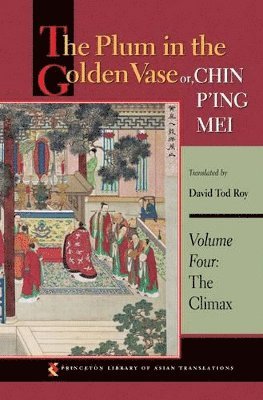
    Plum in the Golden Vase or, Chin P'ing Mei, Volume Four

    The Climax

    AvDavid Tod Roy

    Häftad, Engelska, 2015

    Del i serien Princeton Library of Asian Translations

    533 kr

    Beställningsvara. Skickas inom 5-8 vardagar. Fri frakt över 249 kr.

    Beskrivning

    This is the fourth and penultimate volume in David Roy's celebrated translation of one of the most famous and important novels in Chinese literature. The Plum in the Golden Vase or, Chin P'ing Mei is an anonymous sixteenth-century work that focuses on the domestic life of Hsi-men Ch'ing, a corrupt, upwardly mobile merchant in a provincial town, who maintains a harem of six wives and concubines. The novel, known primarily for its erotic realism, is also a landmark in the development of the narrative art form--not only from a specifically Chinese perspective but in a world-historical context. This complete and annotated translation aims to faithfully represent and elucidate all the rhetorical features of the original in its most authentic form and thereby enable the Western reader to appreciate this Chinese masterpiece at its true worth.

    Produktinformation

    • Utgivningsdatum:2015-10-06
    • Mått:155 x 234 x 56 mm
    • Vikt:1 430 g
    • Format:Häftad
    • Språk:Engelska
    • Serie:Princeton Library of Asian Translations
    • Antal sidor:1 030
    • Förlag:Princeton University Press
    • ISBN:9780691169828
    • Översättare:David Tod Roy

    Utforska kategorier

    • Klassiska romaner/Klassiker inom Skönlitteratur
    • Skönlitteratur i översättning inom Skönlitteratur

    Mer om författaren

    David Tod Roy (1933-2016) was professor emeritus of Chinese literature at the University of Chicago. His monumental five-volume translation of the Chin P'ing Mei was completed in 2013.

    Recensioner i media

    "[A] book of manners for the debauched. Its readers in the late Ming period likely hid it under their bedcovers."--Amy Tan, New York Times Book Review Praise for the previous volumes: "[I]t is time to remind ourselves that The Plum in the Golden Vase is not just about sex, whether the numerous descriptions of sexual acts throughout the novel be viewed as titillating, harshly realistic, or, in Mr. Roy's words, intended 'to express in the most powerful metaphor available to him the author's contempt for the sort of persons who indulge in them.' The novel is a sprawling panorama of life and times in urban China, allegedly set safely in the Sung dynasty, but transparently contemporary to the author's late sixteenth-century world, as scores of internal references demonstrate. The eight hundred or so men, women, and children who appear in the book cover a breath-taking variety of human types, and encompass pretty much every imaginable mood and genre--from sadism to tenderness, from light humor to philosophical musings, from acute social commentary to outrageous satire."--Jonathan Spence, New York Review of Books Praise for previous volumes: "Reading Roy's translation is a remarkable experience."--Robert Chatain, Chicago Tribune Review of Books "Both the fourth volume of The Plum and the previous three volumes are top-notch English translation of traditional Chinese fiction. Roy's superb translation skills preserve the subtleties in the original Chinese novel. English-speaking readers can, for the first time, appreciate one of the masterpieces of Chinese fiction in its entirety, thanks to Roy's diligent and careful work. Most important of all, The Plum represents the culmination of Roy's life-long devotion to research on fin Ping Mei and demonstrates Roy's encyclopedic knowledge of Jin Ping Mei scholarship. Reading The Plum can help scholars understand the research that has been conducted on this novel and help them develop new directions for future research. I wholeheartedly recommend The Plum to anyone interested in Chinese literature, culture, and history, and look forward to the publication of the final volume of Roy's translation."--Junjie Luo, Chinese Literature "This volume, a masterwork of translation of language, culture, social values, and literary intent provides students of linguistics, philosophy, psychology, anthropology, sociology, economics, and history, as well as those willing to invest time in a long but highly entertaining tale with an invaluable opportunity to gain insight into sixteenth-century society outside imperial court circles during the Ming era."--Ilicia J. Sprey, Sixteenth Century Journal Praise for previous volumes: "Clearly David Roy is the greatest scholar-translator in the field of premodern vernacular Chinese fiction... The puns and various other kinds of word plays that abound in the Chin P'ing Mei are so difficult to translate that I can't help 'slapping the table in amazement' each time I see evidence of Roy's masterful rendition of them... I recommend this book, in the strongest possible terms, to anyone interested in the novel form in general, in Chinese literature in particular, or in the translation of Chinese literature."--Shuhui Yang, Chinese Literature: Essays, Articles, and Reviews

    Innehållsförteckning

    • LIST OF ILLUSTRATIONS ix ACKNOWLEDGMENTS xi CAST OF CHARACTERS xiii CHAPTER 61: Han Tao-kuo Prepares an Entertainment for Hsi-men Ch'ing; Li P'ing-erh Painfully Observes the Double Yang Festival 1 CHAPTER 62: Taoist Master P'an Performs an Exorcism on the Lantern Altar; Hsi-men Ch'ing Laments Egregiously on Behalf of Li P'ing-erh 44 CHAPTER 63: Friends and Relatives Offer Funeral Oblations at a Memorial Feast; Hsi-men Ch'ing Is Reminded of Li P'ing-erh While Watching a Drama 83 CHAPTER 64: Yu-hsiao Kneels in Making an Appeal to P'an Chin-lien; Officers of the Guard Sacrifi ce to a Rich Man's Spouse 104 CHAPTER 65: Abbot Wu Meets the Funeral Procession and Eulogizes the Portrait; Censor Sung Imposes on a Local Magnate to Entertain Eunuch Huang 121 CHAPTER 66: Majordomo Chai Sends a Letter with a Consolatory Contribution; Perfect Man Huang Conducts a Rite for the Salvation of the Dead 153 CHAPTER 67: Hsi-men Ch'ing Appreciates the Snow While in His Studio; Li P'ing-erh Describes Her Intimate Feelings in a Dream 174 CHAPTER 68: Cheng Ai-yueh Flaunts Her Beauty and Discloses a Secret; Tai-an Perseveres Assiduously in Seeking Out Auntie Wen 211 CHAPTER 69: Auntie Wen Communicates Hsi-men Ch'ing's Wishes to Lady Lin; Wang Ts'ai Falls for a Trick and Invites His Own Humiliation 244 CHAPTER 70: Hsi-men Ch'ing's Successful Efforts Procure Him a Promotion; Assembled Offi cials Report before Defender-in-chief Chu Mien 277 CHAPTER 71: Li P'ing-erh Appears in a Dream in Battalion Commander Ho's House; The Judicial Commissioners Present Their Memorials at the Audience 306 CHAPTER 72: Wang the Third Kowtows to Hsi-men Ch'ing as His Adopted Father; Ying Po-chueh Intercedes to Alleviate the Grievance of Li Ming 342 CHAPTER 73: P'an Chin-lien Is Irked by the Song "I Remember Her Flute-playing"; Big Sister Yu Sings "Getting through the Five Watches of the Night" 384 CHAPTER 74: Censor Sung Ch'iao-nien Solicits the Eight Immortals Tripod; Wu Yueh-niang Listens to the Precious Scroll on Woman Huang 420 CHAPTER 75: Ch'un-mei Vilely Abuses Second Sister Shen; Yu-hsiao Spills the Beans to P'an Chin-lien 456 CHAPTER 76: Meng Yu-lou Assuages Yueh-niang's Wrath; Hsi-men Ch'ing Repudiates Licentiate Wen 503 CHAPTER 77: Hsi-men Ch'ing Slogs through the Snow to Visit Cheng Ai-yueh; Pen the Fourth's Wife Sits by the Window Waiting for a Tryst 544 CHAPTER 78: Hsi-men Ch'ing Ventures upon a Second Engagement with Lady Lin; Wu Yueh-niang Invites Ho Yung-shou's Wife to View the Lanterns 579 CHAPTER 79: Hsi-men Ch'ing in His Sexual Indulgence Incurs an Illness; Wu Yueh-niang Bears a Child upon the Death of Her Husband 627 CHAPTER 80: Ch'en Ching-chi Resorts to Pilfering Jade and Purloining Perfume; Li Chiao-erh Makes Off with the Silver and Returns to the Brothel 668 NOTES 689 BIBLIOGRAPHY 855 INDEX 895 Roy.