• Fri frakt över 249 kr
  • •
  • Snabba leveranser
  • •
  • Billiga böcker
Kundservice

Du är på sajten för privatpersoner.

Företag, bibliotek eller offentlig verksamhet?

Du handlar på classic.bokus.com, där alla dina funktioner finns intakta.
Till classic.bokus.com
Bokus logotyp. Gå till startsidan.
  • Erbjudanden
  • Nyheter
  • Student
  • Topplistor
  • Barn & ungdom
  • Bokus Play
  • E-böcker
  • Pocketböcker
  • Spel & pussel

10% studentrabatt med kod TERM26

Sidfot

Mina sidor

    Hjälp

    • Kundservice
    • Vanliga frågor och svar
    • Frakt och leverans
    • Retur vid ångerrätt
    • Reklamera vara
    • Betalning
    • Köpvillkor
    • Allmänna villkor
    • Information om webbplatsens tillgänglighet

    Om Bokus

    • Om oss
    • Pressrum
    • För studenter
    • För företag
    • För bibliotek och offentlig verksamhet
    • För leverantörer
    • Hållbarhet

    Populärt

    • Aktuella erbjudanden
    • Presentkort
    • Studentlitteratur
    • Nya böcker
    • Topplistor
    • Signerade böcker
    • Engelska böcker

    Inspiration

    • Boktips
    • BookTok
    • Populära bokserier
    • Barnbokskaraktärer
    • Populära författare
    Logotyp för Bokus
    Följ oss på Facebook (extern länk)Följ oss på Instagram (extern länk)Följ oss på YouTube (extern länk)Följ oss på TikTok (extern länk)
    bokus @ CookiesAnpassa cookiesIntegritetspolicyKöpvillkor
    Till Citymail hemsida (extern länk)Till Budbee hemsida (extern länk)Till Postnord hemsida (extern länk)Till Schenker hemsida (extern länk)Till Early Bird hemsida (extern länk)Till Walleys hemsida (extern länk)
    1. Naturvetenskap och teknik
    2. Matematik och naturvetenskap
    3. Matematik
    4. Talteori

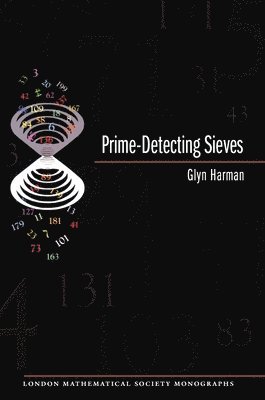
    Prime-Detecting Sieves (LMS-33)

    AvGlyn Harman

    Häftad, Engelska, 2020

    Del i serien London Mathematical Society Monographs

    807 kr

    Beställningsvara. Skickas inom 5-8 vardagar. Fri frakt över 249 kr.

    Fler format och utgåvor

    Inbunden

    1 191 kr

    E-bok

    1 133 kr

    Beskrivning

    This book seeks to describe the rapid development in recent decades of sieve methods able to detect prime numbers. The subject began with Eratosthenes in antiquity, took on new shape with Legendre's form of the sieve, was substantially reworked by Ivan M. Vinogradov and Yuri V. Linnik, but came into its own with Robert C. Vaughan and important contributions from others, notably Roger Heath-Brown and Henryk Iwaniec. Prime-Detecting Sieves breaks new ground by bringing together several different types of problems that have been tackled with modern sieve methods and by discussing the ideas common to each, in particular the use of Type I and Type II information.No other book has undertaken such a systematic treatment of prime-detecting sieves. Among the many topics Glyn Harman covers are primes in short intervals, the greatest prime factor of the sequence of shifted primes, Goldbach numbers in short intervals, the distribution of Gaussian primes, and the recent work of John Friedlander and Iwaniec on primes that are a sum of a square and a fourth power, and Heath-Brown's work on primes represented as a cube plus twice a cube. This book contains much that is accessible to beginning graduate students, yet also provides insights that will benefit established researchers.

    Produktinformation

    • Utgivningsdatum:2020-05-26
    • Mått:156 x 235 x 23 mm
    • Vikt:295 g
    • Format:Häftad
    • Språk:Engelska
    • Serie:London Mathematical Society Monographs
    • Antal sidor:384
    • Förlag:Princeton University Press
    • ISBN:9780691202990

    Utforska kategorier

    • Talteori inom Naturvetenskap och teknik

    Mer om författaren

    Glyn Harman is professor of pure mathematics at the University of London, Royal Holloway. He is the author of Metric Number Theory, the coeditor of Sieve Methods, Exponential Sums, and their Applications in Number Theory, and the corecipient of the Hardy-Ramanujan award for his work on primes in short intervals.

    Recensioner i media

    "This book provides a very nice introduction to a very active and important area of research. Several chapters include discussion of the limitations of the given methods; this is an unusual feature but a very useful one to readers. There is also helpful discussion of historical developments of the given methods. This a valuable book, both for researchers and for advanced graduate students in analytic number theory."---S. W Graham, Mathematical Reviews