• Fri frakt över 249 kr
  • •
  • Snabba leveranser
  • •
  • Billiga böcker
Kundservice

Du är på sajten för privatpersoner.

Företag, bibliotek eller offentlig verksamhet?

Du handlar på classic.bokus.com, där alla dina funktioner finns intakta.
Till classic.bokus.com
Bokus logotyp. Gå till startsidan.
  • Erbjudanden
  • Nyheter
  • Student
  • Topplistor
  • Barn & ungdom
  • Bokus Play
  • E-böcker
  • Pocketböcker
  • Spel & pussel

10% studentrabatt med kod TERM26

Sidfot

Mina sidor

    Hjälp

    • Kundservice
    • Vanliga frågor och svar
    • Frakt och leverans
    • Retur vid ångerrätt
    • Reklamera vara
    • Betalning
    • Köpvillkor
    • Allmänna villkor
    • Information om webbplatsens tillgänglighet

    Om Bokus

    • Om oss
    • Pressrum
    • För studenter
    • För företag
    • För bibliotek och offentlig verksamhet
    • För leverantörer
    • Hållbarhet

    Populärt

    • Aktuella erbjudanden
    • Presentkort
    • Studentlitteratur
    • Nya böcker
    • Topplistor
    • Signerade böcker
    • Engelska böcker

    Inspiration

    • Boktips
    • BookTok
    • Populära bokserier
    • Barnbokskaraktärer
    • Populära författare
    Logotyp för Bokus
    Följ oss på Facebook (extern länk)Följ oss på Instagram (extern länk)Följ oss på YouTube (extern länk)Följ oss på TikTok (extern länk)
    bokus @ CookiesAnpassa cookiesIntegritetspolicyKöpvillkor
    Till Citymail hemsida (extern länk)Till Budbee hemsida (extern länk)Till Postnord hemsida (extern länk)Till Schenker hemsida (extern länk)Till Early Bird hemsida (extern länk)Till Walleys hemsida (extern länk)
    1. Medicin
    2. Medicin: allmänt
    3. Medicinsk utrustning och medicinska tekniker

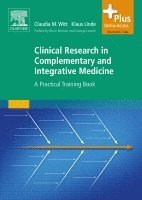
    Clinical Research in Complementary and Integrative Medicine

    A Practical Training Book

    AvClaudia M. Witt,Klaus Linde

    Häftad, Engelska, 2011

    584 kr

    Beställningsvara. Skickas inom 5-8 vardagar. Fri frakt över 249 kr.

    Beskrivning

    Sie wollen eine Studie in durchführen und wissen nicht ganz genau, wie?Kein Problem! Clinical Research zeigt Ihnen alle Aspekte verständlich und nachvollziehbar. Sie erhalten einem umfassenden Überblick und praxistaugliche Anleitungen. Schritt für Schritt erarbeiten und üben Sie die Kriterien und - of course - all in english!Dieses Buch hat mehr!Mit dem Code im Buch haben Sie ab Aktivierung 12 Monate kostenlosen Online-Zugriff auf den Buchinhalt und die Abbildungen..** Angebot freibleibendThis practical training book: systematically introduces the key aspects of study design and basic statistics.helps you to develop, plan and execute your research project.combines established theoretical approaches with practical skills applicable to your own clinical study.is a step-by-step tutorial for a complete clinical study, which is illustrated in three case studies.includes additional training exercises, featuring different study conditions and environments, that will help you to practice and test your knowledge.Clinical Research in Complementary and Integrative Medicine - the best way to understand clinical research and to plan and perform your own study!Free online access:After activating the code inside this book you get free online access to the content and the illustrations for 12 months.

    Produktinformation

    • Utgivningsdatum:2011-09-01
    • Mått:170 x 240 x 13 mm
    • Vikt:1 g
    • Format:Häftad
    • Språk:Engelska
    • Antal sidor:208
    • Förlag:Elsevier Health Sciences
    • ISBN:9780702034763

    Utforska kategorier

    • Medicinsk utrustning och medicinska tekniker inom Medicin

    Innehållsförteckning

    • Contents1 Introduction 11.1 What do we mean by complementary medicine in this book? 11.2 The science behind clinical medicine 21.2.1 Major areas of research 21.2.2 Topics in clinical research 21.2.3 Evidence-based medicine 31.3 Why do we need research on complementary therapies? 31.4 Is research into complementary therapies special? 51.4.1 Why research into complementary therapies is somewhat different? 51.4.2 Strategic approaches to research into complementary medicine 61.4.3 Why it is difficult to realize strategic approaches? 61.5 Aims, target audience and structure of this book 7I Theory - Things you should know before embarking on a clinical study 92 Basic study design 112.1 When is a treatment effective? 112.1.1 Why do we need control or comparison groups? 112.1.2 Types of controls and comparisons 122.1.3 Specific and non-specific effects 142.2 Bias - threats to internal validity 152.2.1 Prognostic and baseline differences between groups - why randomization is so desirable 152.2.2 Differences between groups after treatment has started - why blinding is so desirable 172.2.3 Attrition 172.2.4 Bias during analysis and reporting 182.3 Clinical studies and the real world - external validity 182.3.1 The need for balancing internal and external validity 182.3.2 Selection of study participants 202.3.3 Selection of study interventions 212.3.4 Selection of outcome measures 222.4 What study design for what purpose? 222.4.1 Studies without a control group 222.4.2 Studies with a non-randomized comparison group 252.4.3 Randomized trials 272.5 Establishing an evidence picture 313 Basic statistics 333.1 Why statistics? 333.2 Types of variables and their distribution 333.2.1 Categorical variables 333.2.2 Continuous variables 343.2.3 Categorical or continuous? 343.3 Summarizing your data 343.3.1 Calculating the mean and the median 353.3.2 The distribution of your data 353.3.3 Measuring variation within your study population 363.3.4 Measuring sampling variation 373.3.5 Standard deviation, standard error and confidence interval 383.4 Comparing two groups or two time points for one variable 383.4.1 Calculating summary measures for dichotomous variables 383.4.2 Calculating summary measures for continuous variables 393.4.3 Testing a hypothesis 403.4.4 Relevance of the p-value 41Contents3.4.5 Statistical tests for comparing means 423.4.6 Statistical tests for comparing proportions 423.4.7 Confidence intervals 423.4.8 Type I and type II errors 433.4.9 How to deal with multiple testing 433.5 Comparing more than two groups for one variable 443.5.1 Statistical models and tests for comparing more than two groups for one variable 443.6 Comparing two or more groups for more than one variable 453.6.1 Correcting for baseline differences 453.6.2 Logistic regression and statistical modelling 453.7 Analysis populations 463.8 Dealing with missing values 463.9 Interval hypotheses: equivalence/non-inferiority and superiority 47II Practice - Planning, managing, analyzing and publishing a clinical study 494 Planning 514.1 Formulating the research question 514.1.1 Why a clear research question is so crucial 514.1.2 Practical steps 514.1.3 Case studies 544.2 Study Protocol 564.2.1 What is a study protocol? 564.2.2 Develop your study protocol - step by step 564.3 Interventions and Controls 594.3.1 Theoretical background 594.3.2 Define your control and interventions 624.3.3 Case studies 644.4 Randomization 654.4.1 Individual and cluster randomization 654.4.2 Practical steps 664.4.3 Case studies 704.5 What to do if you do not randomize 714.5.1 Taking baseline differences into account 724.5.2 Matching - practical steps 724.5.3 Adjusting analyses for imbalances - practical steps 734.5.4 Case study 744.6 Blinding 744.6.1 Should you go for blinding? 744.6.2 Practical steps 764.6.3 Case studies 794.7 Study participants 814.7.1 Who should be included in your study? 814.7.2 Practical steps 814.7.3 Case studies 834.8 Outcome measurement 854.8.1 Theoretical background 854.8.2 Define your outcome measures and prepare your CRF 894.8.3 Case studies on outcomes 914.9 Sample size calculation 934.9.1 What does sample size calculation mean? 934.9.2 Practical steps 944.9.3 Case studies 1004.10 Ethics and regulatory aspects 1024.10.1 Theoretical background on ethics 1024.10.2 Getting approval from the IRB/Ethics Committee 1034.10.3 Regulatory aspects 1045 Study and data management 1055.1 Project management 1055.1.1 Phases of project management 1055.1.2 Taking notes 1055.2 Guidelines for clinical trials 1065.3 Study management 1075.3.1 Theoretical background 1085.3.2 Manage your study 1095.4 Data management 1135.4.1 Theoretical background 1135.4.2 Manage your data 1165.5 Case studies 1216 Data analysis 1236.1 Analysing your own data step by step 1236.1.1 Step 1: Define the analysis populations and the handling of missing values 1236.1.2 Step 2: Identify the different types of variable 1246.1.3 Step 3: Clarify what you can calculate from your data 1246.1.4 Step 4: Choose suitable statistical methods 1256.1.5 Step 5: Perform the statistical analysis 1266.1.6 Step 6: Decide how you will present your results 1276.1.7 Step 7: Interpret your results and draw your conclusions 1276.2 Case studies 1277 Publication 1337.1 General issues 1337.1.1 Why is publication so crucial? 1337.1.2 Basic things to keep in mind 1337.2 Early preparatory work 1347.2.1 Define your aims 1347.2.2 Deciding on authorship 1347.2.3 Selecting a journal 1357.2.4 Checking instructions for authors 1377.2.5 Checking general guidelines for reporting 1377.3 Writing the manuscript 1377.3.1 Results section 1387.3.2 Methods section 1387.3.3 Introduction 1397.3.4 Discussion 1397.3.5 Abstract 1407.3.6 References 1407.3.7 Additional statements 1407.3.8 Internal revision 1417.4 Getting your manuscript accepted 1417.4.1 Preparing the submission 1417.4.2 Submitting the manuscript 1427.4.3 What happens at the journal? 1427.4.4 Revision 1437.4.5 After rejection . 1437.5 After acceptance 1447.5.1 Proofreading 1447.5.2 Finally: Publication 1447.5.3 Dealing with mass media 144III Putting a clinical study into context 1458 Qualitative research 1478.1 Research question and examples 1478.2 Qualitative approaches 1488.2.1 Ethnography 1488.2.2 Field research 1488.2.3 Case studies 1498.3 Qualitative methods and types of data 1498.3.1 Interviews 1498.3.2 Observation 1498.3.3 Written documents or pictures 1508.4 Qualitative data analysis 1508.4.1 Content analysis 1508.4.2 Grounded theory 1508.5 Quality assurance in qualitative research 1518.6 Combining qualitative and quantitative research methods 1519 Economic studies 1539.1 Principles of economic analysis 1539.1.1 Costing 1539.1.2 Measuring the benefit 1549.2 Types of economic evaluations 1569.2.1 Cost of disease analysis 1569.2.2 Cost-benefit analysis 1579.2.3 Cost-effectiveness-analysis 1579.2.4 Cost-utility analysis 1579.2.5 Cost-minimization analysis 1589.3 Examples of economic analysis 1589.4 Critical appraisal 159Contents10 Single-case research 16310.1 Why case reports are not scientific 16310.2 Why single-case research is important? 16310.3 Assessing causality in single cases 16410.4 Experimental single-case studies 16410.4.1 General aspects 16410.4.2 Progressive approaches 16510.4.3 Repetitive approaches 16710.5 Observational single case studies 16810.5.1 Retrospective case studies 16810.5.2 Prospective case studies 16810.5.3 Semi-prospective case studies 16910.6 Cross-roads between research on single cases and groups of patients 16910.6.1 Best case series 16910.6.2 Multiple baseline studies 17010.6.3 Single-case studies embedded in studies of groups of patients 17010.6.4 Meta-analysis of single case studies 17011 A brief look at other study designs 17311.1 Cross-sectional studies/surveys 17311.2 Diagnostic studies 17511.3 Etiological and prognostic studies 177Appendix 181Index 187