• Fri frakt över 249 kr
  • •
  • Snabba leveranser
  • •
  • Billiga böcker
Kundservice

Du är på sajten för privatpersoner.

Företag, bibliotek eller offentlig verksamhet?

Du handlar på classic.bokus.com, där alla dina funktioner finns intakta.
Till classic.bokus.com
Bokus logotyp. Gå till startsidan.
  • Erbjudanden
  • Nyheter
  • Student
  • Topplistor
  • Barn & ungdom
  • Bokus Play
  • E-böcker
  • Pocketböcker
  • Spel & pussel

10% rabatt på allt med kod NYSTART10 →

Sidfot

Mina sidor

    Hjälp

    • Kundservice
    • Vanliga frågor och svar
    • Frakt och leverans
    • Retur vid ångerrätt
    • Reklamera vara
    • Betalning
    • Köpvillkor
    • Allmänna villkor
    • Information om webbplatsens tillgänglighet

    Om Bokus

    • Om oss
    • Pressrum
    • För studenter
    • För företag
    • För bibliotek och offentlig verksamhet
    • För leverantörer
    • Hållbarhet

    Populärt

    • Aktuella erbjudanden
    • Presentkort
    • Studentlitteratur
    • Nya böcker
    • Topplistor
    • Signerade böcker
    • Engelska böcker

    Inspiration

    • Boktips
    • BookTok
    • Populära bokserier
    • Barnbokskaraktärer
    • Populära författare
    Logotyp för Bokus
    Följ oss på Facebook (extern länk)Följ oss på Instagram (extern länk)Följ oss på YouTube (extern länk)Följ oss på TikTok (extern länk)
    bokus @ CookiesAnpassa cookiesIntegritetspolicyKöpvillkor
    Till Citymail hemsida (extern länk)Till Budbee hemsida (extern länk)Till Postnord hemsida (extern länk)Till Schenker hemsida (extern länk)Till Early Bird hemsida (extern länk)Till Walleys hemsida (extern länk)
    1. Skönlitteratur
    2. Litteraturvetenskap
    3. Litteraturvetenskap

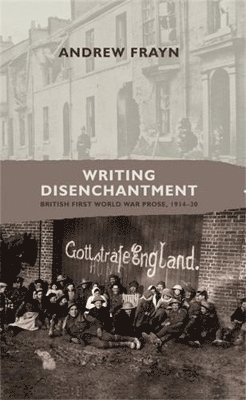
    Writing Disenchantment

    British First World War Prose, 1914–30

    AvAndrew Frayn

    Inbunden, Engelska, 2014

    1 254 kr

    Beställningsvara. Skickas inom 5-8 vardagar. Fri frakt över 249 kr.

    Beskrivning

    It has become axiomatic that First World War literature was disenchanted, or disillusioned, and returning combatants were unable to process or communicate that experience. In Writing disenchantment, Andrew Frayn argues that this was not just about the war: non-combatants were just as disenchanted as those who fought, and writers such as D. H. Lawrence and Virginia Woolf produced some of the sharpest criticisms. Its language already existed in contemporary sociological and historical accounts of the problems of mass culture and the modern city, whose structures contained the conflict and were strengthened during it. Archival material, sales data and reviews are used to chart disenchantment in a wide range of early twentieth-century war literature from novels about fears of invasion and pacifism, through the modernist novels of the 1920s to its dominance in the War Books Boom of 1928–30. This book will appeal to scholars and students of English literature, social and cultural history, and gender studies.

    Produktinformation

    • Utgivningsdatum:2014-09-30
    • Mått:138 x 216 x 25 mm
    • Vikt:452 g
    • Format:Inbunden
    • Språk:Engelska
    • Antal sidor:272
    • Förlag:Manchester University Press
    • ISBN:9780719089220

    Utforska kategorier

    • Litteraturvetenskap inom Skönlitteratur

    Mer om författaren

    Andrew Frayn is Lecturer in Twentieth-Century Literature and Culture at Edinburgh Napier University

    Recensioner i media

    'A nuanced, sophisticated book that advances its insights through careful readings of works both iconic and very nearly forgotten. The pairing of high modernist with mass-cultural novels is ingenious, and reveals the overarching coherence of British culture in the Great War.'Stephen Ross, University of Victoria‘Andrew Frayn's Writing Disenchantment is a signal achievement - an original, thoughtful book that forces us to think again about both the Great War's legacies, and the relationship between British society, culture, and economy in the widest possible sense. Keenly attentive to the politically charged nature of writing about war and its aftermath, and ranging across ostensibly discrete forms of 'mass' and 'modernist' writing, Frayn shows how disenchantment became a keynote in the formation of British modernities. Vital reading for literary critics and historians working on this period, Writing Disenchantment is also an excellent critical introduction to the contested memories of the Great War for undergraduate and postgraduate students.’Matt Houlbrook, Professor of Cultural History, University of Birmingham

    Innehållsförteckning

    • Introduction1. Patriotism, propaganda and pacifism, 1914–182. Hope to Disenchantment, 1919–223. Modernism, conflict and the Home Front, 1922–274. Sagas and series, 1924–285. Popular disenchantment: the war books boom, 1928–30ConclusionIndex