• Fri frakt över 249 kr
  • •
  • Snabba leveranser
  • •
  • Billiga böcker
Kundservice

Du är på sajten för privatpersoner.

Företag, bibliotek eller offentlig verksamhet?

Du handlar på classic.bokus.com, där alla dina funktioner finns intakta.
Till classic.bokus.com
Bokus logotyp. Gå till startsidan.
  • Erbjudanden
  • Nyheter
  • Student
  • Topplistor
  • Barn & ungdom
  • Bokus Play
  • E-böcker
  • Pocketböcker
  • Spel & pussel

10% rabatt på allt med kod: NYSTART10 →

Sidfot

Mina sidor

    Hjälp

    • Kundservice
    • Vanliga frågor och svar
    • Frakt och leverans
    • Retur vid ångerrätt
    • Reklamera vara
    • Betalning
    • Köpvillkor
    • Allmänna villkor
    • Information om webbplatsens tillgänglighet

    Om Bokus

    • Om oss
    • Pressrum
    • För studenter
    • För företag
    • För bibliotek och offentlig verksamhet
    • För leverantörer
    • Hållbarhet

    Populärt

    • Aktuella erbjudanden
    • Presentkort
    • Studentlitteratur
    • Nya böcker
    • Topplistor
    • Signerade böcker
    • Engelska böcker

    Inspiration

    • Boktips
    • BookTok
    • Populära bokserier
    • Barnbokskaraktärer
    • Populära författare
    Logotyp för Bokus
    Följ oss på Facebook (extern länk)Följ oss på Instagram (extern länk)Följ oss på YouTube (extern länk)Följ oss på TikTok (extern länk)
    bokus @ CookiesAnpassa cookiesIntegritetspolicyKöpvillkor
    Till Citymail hemsida (extern länk)Till Budbee hemsida (extern länk)Till Postnord hemsida (extern länk)Till Schenker hemsida (extern länk)Till Early Bird hemsida (extern länk)Till Walleys hemsida (extern länk)
    1. Skönlitteratur
    2. Litteraturvetenskap
    3. Litteraturvetenskap

    Night in French libertine fiction

    AvMarine Ganofsky

    Häftad, Engelska, 2018

    Del i serien Oxford University Studies in the Enlightenment

    1 860 kr

    Beställningsvara. Skickas inom 5-8 vardagar. Fri frakt över 249 kr.

    Beskrivning

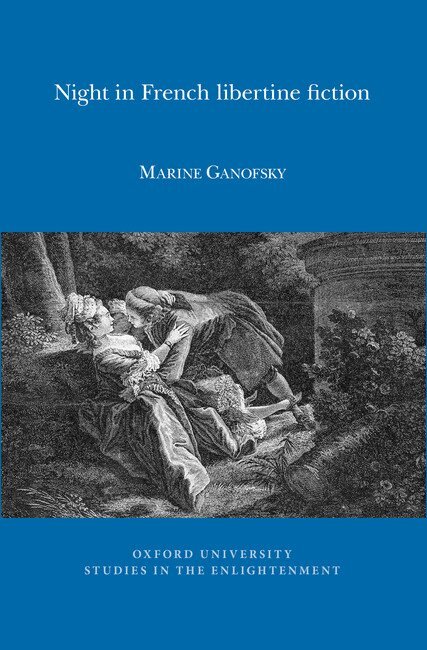
    In the age of Enlightenment the concept of night evolved from being a time of dread to a time for pleasure. Between the start of the Régence (1715-1723) and the French Revolution the nocturnal and the erotic became intrinsically connected: shadows and darkness were reconfigured as the object of the philosophes’ fascination, while night was increasingly experienced as the realm of the self. Nowhere is this paradigmatic shift better recorded than in French libertine literature of the long eighteenth century.Marine Ganofsky delves into the night scenes of libertine fiction to analyse how the idea of night was reimagined and represented by writers ranging from Crébillon to Sade. Her original analysis of erotic encounters in pornographic novels, gallant stories and sensual fairy tales reveals how they capture the period’s emancipation from superstitions and traditions. The nocturnal settings of these libertine narratives were the primary means of staging men and women’s hitherto hidden sexual encounters and innermost fantasies, and ultimately illustrate the conquest of night-time terrors in favour of social encounters and amorous intimacy.Libertine nocturnal scenes reflect above all the Enlightenment’s re-invention of shadows less as an obstacle than an incentive to discover the mysteries they harbour. Through her innovative research Marine Ganofsky presents the erotic nights of libertine fiction as a sign that the siècle des Lumières, free to enjoy the charms to be found in, or under, the cover of darkness, was also the siècle de la nuit.

    Produktinformation

    • Utgivningsdatum:2018-06-30
    • Mått:156 x 234 x 18 mm
    • Vikt:20 g
    • Format:Häftad
    • Språk:Engelska
    • Serie:Oxford University Studies in the Enlightenment
    • Antal sidor:292
    • Förlag:Voltaire Foundation
    • ISBN:9780729412155

    Utforska kategorier

    • Litteraturvetenskap inom Skönlitteratur

    Mer om författaren

    Marine Ganofsky est maître de conférences en littérature française à l’Université de St Andrews. Ses recherches portent sur le dix-huitième siècle et sa quête de bonheur qu’elle étudie depuis la perspective de la littérature, de l’esthétique, de la philosophie et de l’histoire socio-culturelle. Son premier livre explore le sujet des nuits libertines et elle travaille actuellement sur le concept d’illusion au siècle des Lumières.Marine Ganofsky is a lecturer in French literature at the University of St Andrews. Her research focuses on the eighteenth century and its quest for happiness. She approaches the topic through the lens of literature, aesthetics, philosophy and socio-cultural history. Her first book looked at libertine nights and she is now working on the concept of illusion in the Age of Enlightenment.

    Recensioner i media

    'With an engaging narrative arc, Night in French Libertine Fiction shows how the playful dichotomy between celebrating the limits imposed by the night and using the night to transgress social or moral limits (as detailed in chapters two through six) is destroyed by the Sadean extension of the logic of libertinism.'Craig Koslofsky, H-France

    Innehållsförteckning

    • Introductioni. Libertine fiction: a nocturnal genre?ii. Libertine nocturnesiii. The ‘Nocturnal Order’ of libertine nightsiv. The eroticisation of the nocturnalv. The nocturnalisation of eroticismvi. Chapter outline1. Enlightening the night: a cultural and historical perspective on eighteenth-century nightsi. Intellectual enlightenmentii. Material enlightenment2. The nocturnal aesthetics of libertine fictioni. Libertine writing, pornography and obscurityii. The embellishing obscurity of Crébillon’s oriental talesiii. The eroticism of demi-jours in Le Souper des petits-maîtres and Les Soupers de Daphnéiv. Voluptuous shadows in Thémidorev. Félicia and sublime obscurity3. Night as a hiding spacei. Night as a private space within communal living in Le Portier des chartreux and Mémoires de Suzonii. Night as an indulgent architectural space in La Petite Maisoniii. Night as an intimate body part in La Nuit merveilleuse4. Nocturnal illusions: dreams of sylph-like loversi. The dream: the sleep of reason produces sylphs in Le Sylpheii. The mistake: the genie Makis, or the mistaken lover in Angolaiii. The lie: Clitandre, or a sylph of no consequence in La Nuit et le momentiv. The illusion: Mirbelle, or the fleshless sylph in Les Malheurs de l’inconstance5. Nocturnal revelationsi. Damon’s Nyctelian initiation in Point de lendemainii. Laure’s nocturnal education in Le Rideau levéiii. Cécile’s nightly enlightenment in Les Liaisons dangereuses6. Queens of the night: women and their nocturnal mystery in Les Liaisons dangereusesi. The marquise de Merteuil’s nights, or the masquerade of femininityii. The présidente de Tourvel’s shadow, or the female mystery7. The end of libertine nights: Les Cent Vingt Journées de Sodomei. Sade’s Gothic and sublime nocturnes: within the dark night of the soulii. The Sadean nocturnal fortressiii. Sade versus the libertine clair-obscurEpilogue: beyond libertine nights – mornings and morrowsi. Morningsii. MorrowsBibliographyIndex