• Fri frakt över 249 kr
  • •
  • Snabba leveranser
  • •
  • Billiga böcker
Kundservice

Du är på sajten för privatpersoner.

Företag, bibliotek eller offentlig verksamhet?

Du handlar på classic.bokus.com, där alla dina funktioner finns intakta.
Till classic.bokus.com
Bokus logotyp. Gå till startsidan.
  • Erbjudanden
  • Nyheter
  • Student
  • Topplistor
  • Barn & ungdom
  • Bokus Play
  • E-böcker
  • Pocketböcker
  • Spel & pussel

Må bättre, för mindre! Upp till 50% rabatt på hälsoböcker

Sidfot

Mina sidor

    Hjälp

    • Kundservice
    • Vanliga frågor och svar
    • Frakt och leverans
    • Retur vid ångerrätt
    • Reklamera vara
    • Betalning
    • Köpvillkor
    • Allmänna villkor
    • Information om webbplatsens tillgänglighet

    Om Bokus

    • Om oss
    • Pressrum
    • För studenter
    • För företag
    • För bibliotek och offentlig verksamhet
    • För leverantörer
    • Hållbarhet

    Populärt

    • Aktuella erbjudanden
    • Presentkort
    • Studentlitteratur
    • Nya böcker
    • Topplistor
    • Signerade böcker
    • Engelska böcker

    Inspiration

    • Boktips
    • BookTok
    • Populära bokserier
    • Barnbokskaraktärer
    • Populära författare
    Logotyp för Bokus
    Följ oss på Facebook (extern länk)Följ oss på Instagram (extern länk)Följ oss på YouTube (extern länk)Följ oss på TikTok (extern länk)
    bokus @ CookiesAnpassa cookiesIntegritetspolicyKöpvillkor
    Till Citymail hemsida (extern länk)Till Budbee hemsida (extern länk)Till Postnord hemsida (extern länk)Till Schenker hemsida (extern länk)Till Early Bird hemsida (extern länk)Till Walleys hemsida (extern länk)
    1. Hälsa och familj
    2. Relationer
    3. Dejting & kärleksrelationer

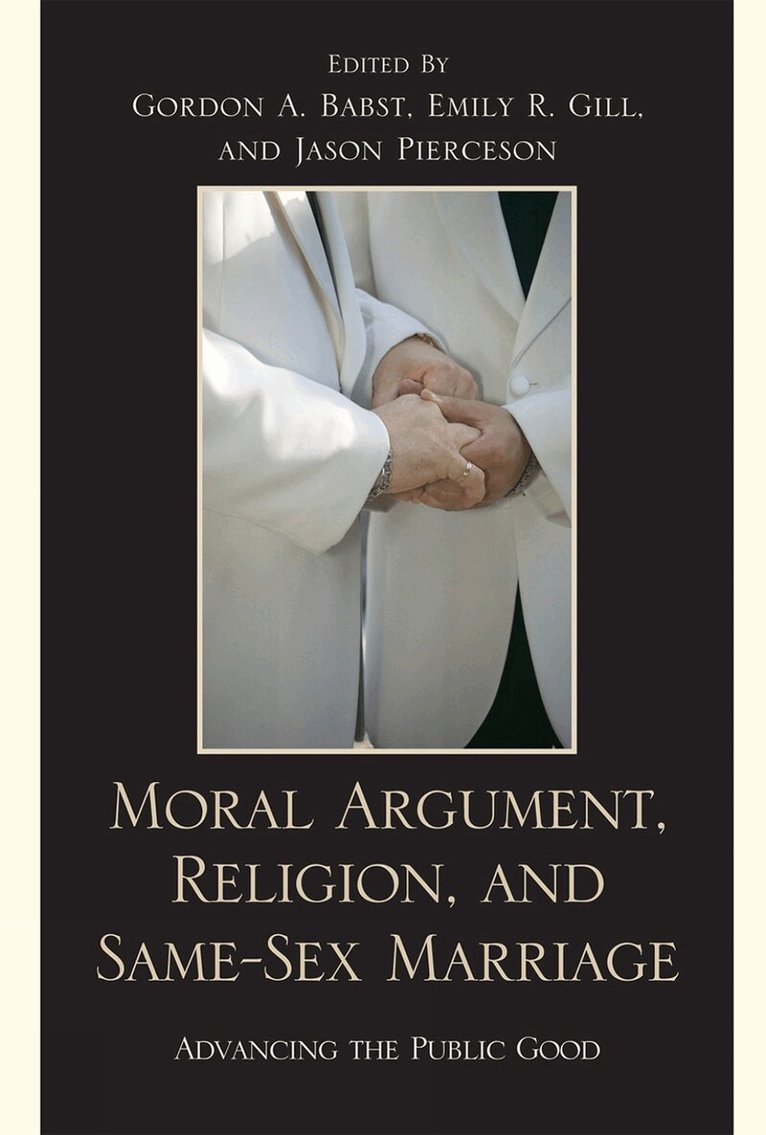
    Moral Argument, Religion, and Same-Sex Marriage

    Advancing the Public Good

    AvGordon A. Babst,Emily R. Gill

    Häftad, Engelska, 2009

    744 kr

    Beställningsvara. Skickas inom 10-15 vardagar. Fri frakt över 249 kr.

    Beskrivning

    The diverse expert contributors to this volume from the fields of politics and law use moral argumentation with respect to same-sex marriage, gay rights in general, and California's Prop 8. The arguments are advanced in terms of the nation's foundational political and legal principles, extending ethical argumentation to important contemporary public policy areas such as marriage, the separation of church and state, and the rearing of children.Several chapters also contest the perceived if not actual establishment in the law and public policy of heterosexist and religious bias that continues to work against full and meaningful inclusion of sexual minorities. This bias is ironically and improperly couched in the language of American political and religious values, and it misunderstands the nation's core principles, or willfully miscasts them as inapplicable to many Americans and their families. Nonetheless, this bias is pervasive in the nation's political discourse, working to deny an important right and the recognition of equality to many citizens. The main contribution ofMoral Argument, Religion, and Same-Sex Marriage is in its direct engagement with the political and legal arguments of the gay community's critics on their own moral and ethical terms. Along the way, important concepts in public discourse—such as governmental neutrality, the right to marry, and religious freedom—are presented and cast in the light of liberal-democratic theory.

    Produktinformation

    • Utgivningsdatum:2009-09-03
    • Mått:156 x 231 x 16 mm
    • Vikt:415 g
    • Format:Häftad
    • Språk:Engelska
    • Antal sidor:266
    • Förlag:Bloomsbury Publishing Plc
    • ISBN:9780739126509

    Utforska kategorier

    • Dejting & kärleksrelationer inom Hälsa och familj

    Mer om författaren

    Gordon A. Babst is associate professor of political science at Chapman University and author ofLiberal Constitutionalism, Marriage, and Sexual Orientation: A Contemporary Case for Dis-Establishment.Emily R. Gill is Caterpillar Professor of Political Science at Bradley University and author of Becoming Free: Autonomy and Diversity in the Liberal Polity.Jason A. Pierceson is associate professor of political studies and legal studies at University of Illinois at Springfield and author of Courts, Liberalism, and Rights: Gay Law and Politics in the United States and Canada.

    Recensioner i media

    Traditionally, proponents of gay and lesbian rights have ceded the turf of 'morality' to their opponents and have usually advocated the privatization of moral values. The essays in this fine collection engage social conservatives on their own terms in a variety of ways, and they demonstrate convincingly that recognition of same sex attraction and union can be defended vigorously on moral and ethical grounds. The contributors to this volume show that recognition of the legitimacy of same-sex unions is not simply a matter of morally neutral 'tolerance,' but that such unions can make positive contributions to the public interest. This volume represents an important contribution to political science and to the discourse of practical politics.

    Innehållsförteckning

    • Chapter 1 IntroductionPart 2 Part I. Same-Sex Marriage and PartnershipsChapter 3 Introduction to Part IChapter 4 Chapter 1. A Commentary on the Old Saw that Same-Sex Marriage Threatens CivilizationChapter 5 Chapter 2. Looking for Liberty and Defining Marriage in Three Same-Sex Marriage CasesChapter 6 Chapter 3. The Religion Clauses and Same-Sex MarriageChapter 7 Chapter 4. Against Neutrality in the Legal Recognition of Intimate RelationshipsPart 8 Part II. Same-Sex Attraction and Liberal Democratic TheoryChapter 9 Introduction to Part IIChapter 10 Chapter 5. Marriage Equality and the Morality of Liberalism: The California DecisionChapter 11 Chapter 6. Same-Sex Marriage and the American Political TraditionChapter 12 Chapter 7. The Special Status of Religion Under the First Amendment…and What it Means for Gay Rights and Anti-Discrimination LawsChapter 13 Chapter 8. Supporting Queer Youth: A New Vision of Child, Family, and StateChapter 14 Chapter 9. Consuming its own? Heteronormativity contra Human PluralityChapter 15 Conclusion