• Fri frakt över 249 kr
  • •
  • Snabba leveranser
  • •
  • Billiga böcker
Kundservice

Du är på sajten för privatpersoner.

Företag, bibliotek eller offentlig verksamhet?

Du handlar på classic.bokus.com, där alla dina funktioner finns intakta.
Till classic.bokus.com
Bokus logotyp. Gå till startsidan.
  • Erbjudanden
  • Nyheter
  • Student
  • Topplistor
  • Barn & ungdom
  • Bokus Play
  • E-böcker
  • Pocketböcker
  • Spel & pussel

10% rabatt på allt med kod NYSTART10 →

Sidfot

Mina sidor

    Hjälp

    • Kundservice
    • Vanliga frågor och svar
    • Frakt och leverans
    • Retur vid ångerrätt
    • Reklamera vara
    • Betalning
    • Köpvillkor
    • Allmänna villkor
    • Information om webbplatsens tillgänglighet

    Om Bokus

    • Om oss
    • Pressrum
    • För studenter
    • För företag
    • För bibliotek och offentlig verksamhet
    • För leverantörer
    • Hållbarhet

    Populärt

    • Aktuella erbjudanden
    • Presentkort
    • Studentlitteratur
    • Nya böcker
    • Topplistor
    • Signerade böcker
    • Engelska böcker

    Inspiration

    • Boktips
    • BookTok
    • Populära bokserier
    • Barnbokskaraktärer
    • Populära författare
    Logotyp för Bokus
    Följ oss på Facebook (extern länk)Följ oss på Instagram (extern länk)Följ oss på YouTube (extern länk)Följ oss på TikTok (extern länk)
    bokus @ CookiesAnpassa cookiesIntegritetspolicyKöpvillkor
    Till Citymail hemsida (extern länk)Till Budbee hemsida (extern länk)Till Postnord hemsida (extern länk)Till Schenker hemsida (extern länk)Till Early Bird hemsida (extern länk)Till Walleys hemsida (extern länk)
    1. Skönlitteratur
    2. Antologier

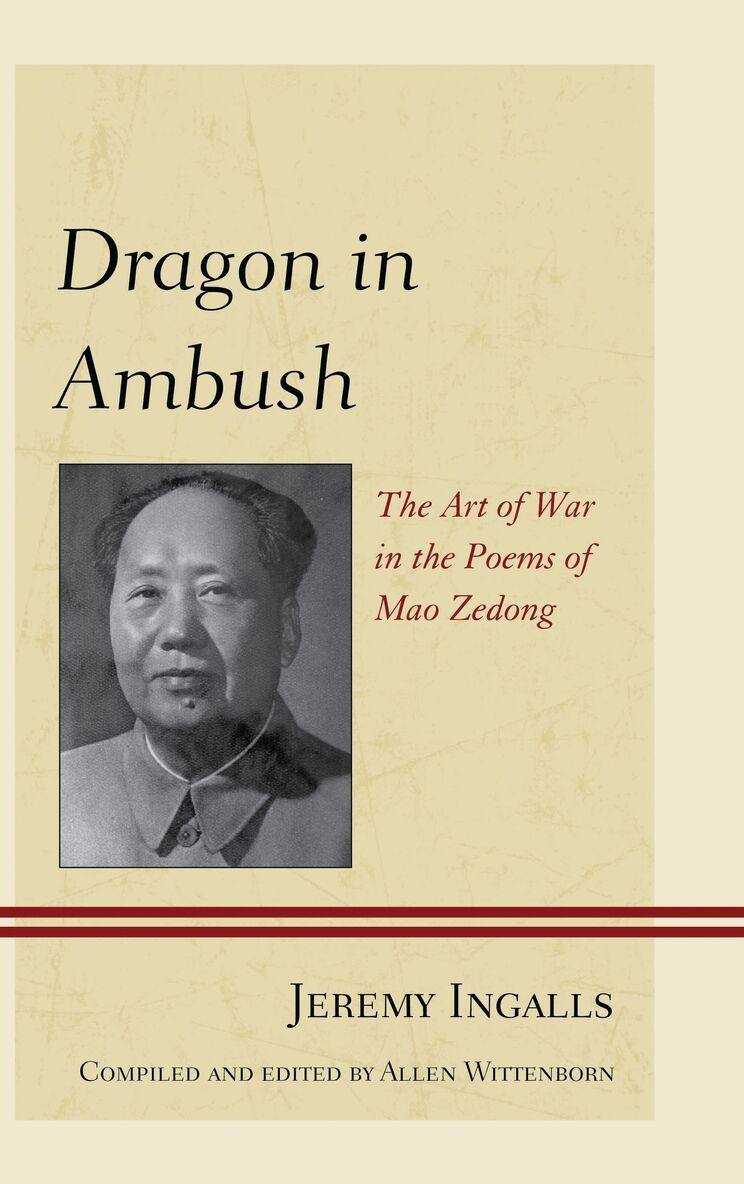
    Dragon in Ambush

    The Art of War in the Poems of Mao Zedong

    AvJeremy Ingalls,Allen Wittenborn

    Inbunden, Engelska, 2013

    1 764 kr

    Beställningsvara. Skickas inom 10-15 vardagar. Fri frakt över 249 kr.

    Beskrivning

    Dragon in Ambush by Jeremy Ingallsis a critique and new translation of the first twenty poems of Mao Zedong’s published poetry. This seminal work stands out from previous translations of Mao’s poems in seeing them as an expression of his core political beliefs, rather than for their poetic effect. Instead, Dr. Ingalls shows in consummate detail that Mao was careful and deliberate in employing imagery in his poetry to lay out procedures for political supremacy in which the central drive was his will to psychological domination. That is, domination of the minds of others is the unifying theme of Mao’s verse-sequence.The crux of Prof. Ingalls’ work lies in her focus on the symbolism in the poems. The poems are, in Mao’s use of them as a means of communication, meaningless on their surface. No image, however seemingly commonplace, is ever employed for merely lyrical or aesthetic description. Every image functions as a factor in an entirely political calculus. According to Dr. Ingalls, “When Mao mentions streams or mountains, suns or moons, clouds or winds or icicles, horses, elephants, snakes, tigers, leopards or bears, specifies kinds of trees or birds or fish, flies, brooms, mats or bridges, these and all his other images have, as their primary function, neither happenstance descriptions nor whimsical metaphor. They all have politically symbolic functions in Mao’s algebra of versified political discourse.”Furthermore, in her analysis, Prof. Ingalls downplays the significance of Marxism-Leninism in the Thought of Mao Zedong. She shows that throughout his career, Mao regarded Marxism-Leninism as a political convenience, not as a doctrine permanently essential to his master-plan. Just as Mao used the Nationalists of Chiang Kai-shek and Stalin’s Soviet Union as means to further his own political ambitions, so did he manipulate Marxist-Leninist ideology to hoodwink and attract, at home and abroad, professional revolutionaries to help do his bidding. Mao’s aims express, in their worldviews, an entirely Chinese tradition. In his poems Mao’s dialectics, his materialism, and his authoritarianism all take their points of reference from within the Chinese cultural order. Dragon in Ambush is a thoroughly unique and revolutionary approach to understanding the Mind of Mao Zedong.

    Produktinformation

    • Utgivningsdatum:2013-05-16
    • Mått:160 x 235 x 32 mm
    • Vikt:807 g
    • Format:Inbunden
    • Språk:Engelska
    • Antal sidor:420
    • Förlag:Bloomsbury Publishing Plc
    • ISBN:9780739177822

    Utforska kategorier

    • Antologier inom Skönlitteratur
    • Biografier inom Biografier
    • Litteraturvetenskap inom Skönlitteratur

    Mer om författaren

    Brief Biography of Author: Jeremy IngallsJeremy Ingalls was a well-known American poet, scholar, editor, and translator. She was born April 2, 1911, in Gloucester, Massachusetts, where she attended Tufts University earning a B.A. (1932) and an M.A. (1933). She was awarded an honorary Doctor of Literature and Letters (Litt.D.) from Tufts University in 1965. Dr. Ingalls carried out post-graduate studies at the Oriental Institute at the University of Chicago, 1945-47. Throughout the 1940s and 50s she taught at the University of Chicago, Western College in Oxford, Ohio, and at Rockford College, Illinois, where she was Resident Poet, Professor of Asian Studies, and eventually head of its English Department, 1953-60. She retired 1960 and moved to Tucson, Arizona to become a full-time writer and researcher. In 1941, she won the prestigious Yale Series of Younger Poets Prize for her book, The Metaphysical Sword. She received a Guggenheim Fellowship (1943-44), an American Academy of Arts and Letters grant (1944-45), a classical Chinese research fellowship from the Republic of China, Taiwan (1945-47), a Shelley Memorial Award for Poetry (1950), a Lola Ridge Memorial Award for Poetry (1951, 1952), and a Ford Foundation faculty fellowship (1952-53). Other honors included a Fulbright professorship (1957-58) in American literature at Kobe University, Japan, a Rockefeller Foundation lectureship in Kyoto, Japan (1958), a Steinman Foundation lecturer on poetry (1960), and an Asian Foundation delegate to the Republic of (South) Korea in 1964. Jeremy Ingalls died on March 16, 2000, in Tucson, Arizona.Brief Biography of Editor: Allen WittenbornAllen Wittenborn earned a Bachelor of Arts degree in Asian Languages and Literature at San Francisco State College (now University) in 1967 where he studied Chinese and Japanese, and a Master of Arts in International Relations at the University of Oregon in 1970. He received his PhD in Asian Studies at the University of Arizona in 1979. During the 1980s, he worked in the travel and tour industry, in China and Southeast Asia as a translator and interpreter. From 1989 to 2007 when he retired, he taught in the departments of History and Asian Studies at San Diego State University. His dissertation, a critique and translation of writings by the philosopher, Zhu Xi, was published as Further Reflections on Things at Hand by University Press of America in 1991. In addition to numerous journal and newspapers articles, Dr. published his first novel, Kokang, in 2012.

    Recensioner i media

    Carefully translating and analyzing Mao's first 20 published poems for their political expression, the late Ingalls (poet, scholar, editor, and translator) presents Mao's poetry as an extension of his political thought rather than simply a leisure activity. After all, within China, poems had a long history of playing a role as political gauges. Part 1 establishes the historical and literary background needed to understand Mao's poems and his desire to become China's next emperor. Part 2 provides a more detailed literary, ideological, and textural analysis of each poem through Ingalls's examination of the ideas and words that explain the 'paradox that [Mao] understands but which ... he does not expect all of his readers to perceive.' This is an exceptionally well-written text, with extensive analytical notes, a bibliography, and a glossary of characters used. Readers do not have to be familiar with Mao's poems, but to fully benefit from this work, readers must be familiar with Mao's other writings and the writings of his contemporaries, with Chinese literary tradition, and with Chinese history from ancient times through the 20th century. Summing Up: Recommended. Graduate students, researchers, faculty.

    Innehållsförteckning

    • PrefacePart 1: Recognizing the TerrainChapter 1: Methods of ApproachChapter 2: A Rationale for RuthlessnessPart 2: Mao’s Poems 1 – 20Section A: A Dragon Bides His Time, 1925-1929Poem 1 ChangshaPoem 2 Yellow Crane TowerPoem 3 JingangshanPoem 4 Chiang’s WarSection B: Hidden Dragon, 1929-1934Poem 5: Double YangPoem 6: New Year’s DayPoem 7: On the Road to GuangchangPoem 8: From Tingzhou toward ChangshaPoem 9: Eluding the First Major EncirclementPoem 10: Eluding the Second Major EncirclementPoem 11: DabodiPoem 12: HuichangSection C: Dragon in the Field, 1935-1949Poem 13: Loushan Barrier GatePoems 14, 15, 16: Mountain PoemsPoem 17: The Long MarchPoem 18: KunlunPoem 19: Six Turns’ MountainPoem 20: Snow