• Fri frakt över 249 kr
  • •
  • Snabba leveranser
  • •
  • Billiga böcker
Kundservice

Du är på sajten för privatpersoner.

Företag, bibliotek eller offentlig verksamhet?

Du handlar på classic.bokus.com, där alla dina funktioner finns intakta.
Till classic.bokus.com
Bokus logotyp. Gå till startsidan.
  • Erbjudanden
  • Nyheter
  • Student
  • Topplistor
  • Barn & ungdom
  • Bokus Play
  • E-böcker
  • Pocketböcker
  • Spel & pussel

10% rabatt på allt med kod: NYSTART10 →

Sidfot

Mina sidor

    Hjälp

    • Kundservice
    • Vanliga frågor och svar
    • Frakt och leverans
    • Retur vid ångerrätt
    • Reklamera vara
    • Betalning
    • Köpvillkor
    • Allmänna villkor
    • Information om webbplatsens tillgänglighet

    Om Bokus

    • Om oss
    • Pressrum
    • För studenter
    • För företag
    • För bibliotek och offentlig verksamhet
    • För leverantörer
    • Hållbarhet

    Populärt

    • Aktuella erbjudanden
    • Presentkort
    • Studentlitteratur
    • Nya böcker
    • Topplistor
    • Signerade böcker
    • Engelska böcker

    Inspiration

    • Boktips
    • BookTok
    • Populära bokserier
    • Barnbokskaraktärer
    • Populära författare
    Logotyp för Bokus
    Följ oss på Facebook (extern länk)Följ oss på Instagram (extern länk)Följ oss på YouTube (extern länk)Följ oss på TikTok (extern länk)
    bokus @ CookiesAnpassa cookiesIntegritetspolicyKöpvillkor
    Till Citymail hemsida (extern länk)Till Budbee hemsida (extern länk)Till Postnord hemsida (extern länk)Till Schenker hemsida (extern länk)Till Early Bird hemsida (extern länk)Till Walleys hemsida (extern länk)
    1. Filosofi och religion
    2. Filosofi
    3. Filosofiska discipliner

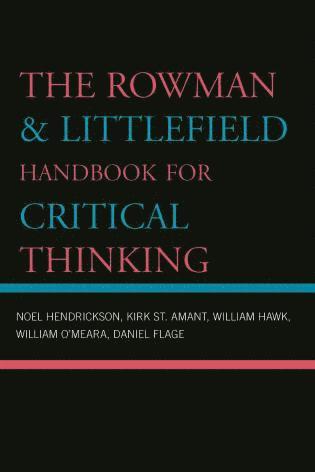
    Rowman & Littlefield Handbook for Critical Thinking

    AvNoel Hendrickson,Kirk Amant

    Häftad, Engelska, 2008

    Del i serien Elements of Philosophy

    368 kr

    Beställningsvara. Skickas inom 10-15 vardagar. Fri frakt över 249 kr.

    Beskrivning

    Just as The Elements of Style provides a quick and authoritative reference for writers, The Rowman & Littlefield Handbook for Critical Thinking provides a quick and authoritative reference for issues regarding reasoning. The Handbook provides clear and succinct discussions of the following issues:· Issues germane to clarifying sentences: ambiguity, vagueness, and propositional attitudes. ·General discussions of descriptions, explanations, and arguments.·Criteria for evaluating observational statements and testimony. ·Categorical syllogisms, including issues germane to both the Boolean and Aristotelian interpretations. ·A complete system of propositional logic and a brief discussion of the use of truth tables. ·Induction: generalization and particularization arguments, analogies, arguments to the best explanation, Mill's Methods, counterfactual reasoning, and making decisions under risk and uncertainty. ·A brief discussion of the principle formulas involved in calculating probabilities. ·An extended discussion of informal fallacies. ·An essay on the relationship between critical thinking and writing.

    Produktinformation

    • Utgivningsdatum:2008-02-08
    • Mått:155 x 230 x 12 mm
    • Vikt:261 g
    • Format:Häftad
    • Språk:Engelska
    • Serie:Elements of Philosophy
    • Antal sidor:168
    • Förlag:Bloomsbury Publishing Plc
    • ISBN:9780742559790

    Utforska kategorier

    • Filosofiska discipliner inom Filosofi och religion

    Mer om författaren

    Daniel E. Flage is professor of philosophy at James Madison University. His previous publications have been in critical thinking, logic, and history of modern philosophy.Noel Hendrickson is assistant professor of philosophy at James Madison University. He has previously published papers in analytic metaphysics and action theory. His current research focuses on counterfactual reasoning and reasoning methods in intelligence analysis.Kirk St. Amant is associate professor of technical communication and rhetoric at Texas Tech University. His previous publications have focused on intercultural communication, computer-mediated communication, and online education. William O'Meara is professor of philosophy at James Madison University. His previous publications include co-authoring the James Madison Test in Critical Thinking, editing an introductory reader in philosophy as well as writing articles in American Philosophy, Phenomenology, and Karl Marx.William J. Hawk is professor of philosophy and head of the department of philosophy and religion at James Madison University. His previous publications include articles in ethics and political philosophy specifically having to do with pacifism.

    Recensioner i media

    Recommended . . . for those who want quick access to the formal rules often associated with critical thinking.

    Innehållsförteckning

    • Part 1 IntroductionPart 2 Chapter 1: Word Hazards: Statements, Ambiguity, and VaguenessChapter 3 A Logical Digression: Propositional AttitudesPart 4 Chapter 2: Complex Passages: Descriptions, Explanations, and ArgumentsChapter 5 Odd wordsChapter 6 A Logical Digression: How not to distinguish induction from deduction, or why the valid/inductive distinction is betterPart 7 Chapter 3: Finding ArgumentsPart 8 Chapter 4: Grounding Statements in Fact: Observation, Testimony, and Other Arguments based upon CriteriaChapter 9 Criteria for evaluating observation statementsChapter 10 Criteria for evaluating testimonyPart 11 Chapter 5: Deduction: Categorical SyllogismsChapter 12 Conversion, Obversion, ContrapositionChapter 13 Categorical SyllogismsChapter 14 a. A Logical Digression: Venn DiagramsChapter 15 b. A Logical Digression: Conditional ValidityChapter 16 c. Odd WordsChapter 17 EnthymemesPart 18 Chapter 6: Arguments Based upon PropositionsChapter 19 Statement FormsChapter 20 a. A Logical Digression: Symbols and Truth Table DefinitionsChapter 21 Argument FormsChapter 22 a. Logical Digression: Truth Tables for Testing the Validity of ArgumentsChapter 23 b. Odd Words: Tautology, Contradiction, Contingent StatementChapter 24 Logical EquivalencesChapter 25 a. A Logical Digression: Demonstrating the Equivalences with Truth TablesPart 26 Chapter 7: Probability CalculationsChapter 27 Theories of ProbabilityChapter 28 a. Odd Words: Relative Frequency and Subjective TheoriesChapter 29 Rules of ProbabilityPart 30 Chapter 8: Generalizations and ParticularizationsChapter 31 Generalization ArgumentsChapter 32 a. A Logical Digression: Surveys and Opinion PollsChapter 33 Particularization ArgumentsPart 34 Chapter 9: Analogical ArgumentsChapter 35 Analogical ArgumentsChapter 36 a. A Logical Digression: Analogical Arguments vs. Generalization and Particularization ArgumentsPart 37 Chapter 10: Evaluating Hypotheses: Inference to Best ExplanationChapter 38 LikelihoodChapter 39 Explanatory PowerChapter 40 SimplicityChapter 41 NoveltyChapter 42 Appropriate Explanatory ContentChapter 43 Summary of Factors in Evaluating Explanatory InferencesChapter 44 Explanatory Inferences, Confirmation, Disconfirmation, and Bayes's TheoremPart 45 Chapter 11: Causal InferencesChapter 46 Mill's Methods of Causal InferenceChapter 47 Probabilistic Method of Causal InferenceChapter 48 Counterfactual Method of Causal InferencePart 49 Chapter 12: Counterfactual ReasoningChapter 50 Supporting Counterfactual ClaimsChapter 51 a. A Logical Digression: Counterfactual FallaciesPart 52 Chapter 13: Decisions Under RiskChapter 53 UtilityChapter 54 Decision-Making Under Risk With One FactorChapter 55 Decision-Making Under Risk With Multiple FactorsPart 56 Chapter 14: Decisions Under UncertaintyChapter 57 Universal Principles for Decisions Under UncertaintyChapter 58 Further Principles for Decisions Under Multilateral UncertaintyChapter 59 Further Principles for Decisions Under Unilateral UncertaintyPart 60 Chapter 15: Informal FallaciesChapter 61 Fallacies of AmbiguityChapter 62 Fallacies of RelevanceChapter 63 Fallacies of PresumptionChapter 64 Fallacies of Weak InductionPart 65 Chapter 16: Critical Writing: An Audience-Centered Approach to Critical ThinkingChapter 66 Examining Critical Writing: A Rhetorical ApproachChapter 67 Selecting the Appropriate ForumChapter 68 Establishing Presentation ObjectivesChapter 69 Establishing Initial CredibilityChapter 70 Screening Content for InclusionChapter 71 Considering Sources of InformationChapter 72 Identifying Content AreasChapter 73 Grouping Information for ReadersChapter 74 Organizing Information within the ForumChapter 75 Externalizing Ideas: A Final PerspectivePart 76 Bibliography