• Fri frakt över 249 kr
  • •
  • Snabba leveranser
  • •
  • Billiga böcker
Kundservice

Du är på sajten för privatpersoner.

Företag, bibliotek eller offentlig verksamhet?

Du handlar på classic.bokus.com, där alla dina funktioner finns intakta.
Till classic.bokus.com
Bokus logotyp. Gå till startsidan.
  • Erbjudanden
  • Nyheter
  • Student
  • Topplistor
  • Barn & ungdom
  • Bokus Play
  • E-böcker
  • Pocketböcker
  • Spel & pussel

10% rabatt på allt med kod NYSTART10 →

Sidfot

Mina sidor

    Hjälp

    • Kundservice
    • Vanliga frågor och svar
    • Frakt och leverans
    • Retur vid ångerrätt
    • Reklamera vara
    • Betalning
    • Köpvillkor
    • Allmänna villkor
    • Information om webbplatsens tillgänglighet

    Om Bokus

    • Om oss
    • Pressrum
    • För studenter
    • För företag
    • För bibliotek och offentlig verksamhet
    • För leverantörer
    • Hållbarhet

    Populärt

    • Aktuella erbjudanden
    • Presentkort
    • Studentlitteratur
    • Nya böcker
    • Topplistor
    • Signerade böcker
    • Engelska böcker

    Inspiration

    • Boktips
    • BookTok
    • Populära bokserier
    • Barnbokskaraktärer
    • Populära författare
    Logotyp för Bokus
    Följ oss på Facebook (extern länk)Följ oss på Instagram (extern länk)Följ oss på YouTube (extern länk)Följ oss på TikTok (extern länk)
    bokus @ CookiesAnpassa cookiesIntegritetspolicyKöpvillkor
    Till Citymail hemsida (extern länk)Till Budbee hemsida (extern länk)Till Postnord hemsida (extern länk)Till Schenker hemsida (extern länk)Till Early Bird hemsida (extern länk)Till Walleys hemsida (extern länk)
    1. Filosofi och religion
    2. Filosofi
    3. Filosofiska discipliner

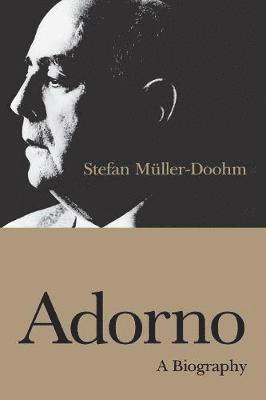
    Adorno

    A Biography

    AvStefan Müller-Doohm

    Häftad, Engelska, 2008

    309 kr

    Beställningsvara. Skickas inom 5-8 vardagar. Fri frakt över 249 kr.

    Beskrivning

    'Even the biographical individual is a social category', wrote Adorno. ‘It can only be defined in a living context together with others.’ In this major new biography, Stefan Müller-Doohm turns this maxim back on Adorno himself and provides a rich and comprehensive account of the life and work of one of the most brilliant minds of the twentieth century. This authoritative biography ranges across the whole of Adorno's life and career, from his childhood and student years to his years in emigration in the United States and his return to postwar Germany. At the same time, Muller-Doohm examines the full range of Adorno's writings on philosophy, sociology, literary theory, music theory and cultural criticism. Drawing on an array of sources from Adorno's personal correspondence with Horkheimer, Benjamin, Berg, Marcuse, Kracauer and Mann to interviews, notes and both published and unpublished writings, Muller-Doohm situates Adorno's contributions in the context of his times and provides a rich and balanced appraisal of his significance in the 20th Century as a whole.Müller-Doohm's clear prose succeeds in making accessible some of the most complex areas of Adorno's thought. This outstanding biography will be the standard work on Adorno for years to come.

    Produktinformation

    • Utgivningsdatum:2008-12-19
    • Mått:152 x 229 x 51 mm
    • Vikt:1 071 g
    • Format:Häftad
    • Språk:Engelska
    • Antal sidor:648
    • Förlag:John Wiley and Sons Ltd
    • ISBN:9780745631097
    • Översättare:Rodney Livingstone

    Utforska kategorier

    • Filosofiska discipliner inom Filosofi och religion

    Mer om författaren

    Stefan Müller-Doohm isProfessor of Sociology at Oldenburg University, Germany.

    Recensioner i media

    "Although Adorno died in 1969, we have had to wait more than thirty years for a biography ... Stefan Müller-Doohm’s is the most detailed and probably the best. (It has been exceptionally well translated, too.)"Times Literary Supplement "Stands as a very informative account of Adorno’s life, which has much to offer casual readers of Adorno and those with a thorough interest in his work [and] ties a narrative description of Adorno’s life to a sensitive understanding of his thought, and of the consistency of his reflection across the different disciplinary boundaries that it traversed ... This book does all the things a biography should."Times Higher Education Supplement"Exhaustively researched and presented with exemplary balance, Müller-Doohm’s re-creation of Adorno’s 'damaged life' is fully worthy of its demanding subject. No future student of one of the twentieth century’s most influential thinkers will be able to ignore this remarkable achievement in intellectual biography."Martin Jay, University of California, Berkeley

    Innehållsförteckning

    • List of Figures viiiList of Plates ixPreface xiiAcknowledgements xivIllustration Acknowledgements xviPart I Origins: Family, Childhood and Youth: School and University in Frankfurt am Main Family Inheritance: A Picture of Contrasts 31 Adorno’s Corsican Grandfather: Jean François, alias Giovanni Francesco 5• Fencing master Calvelli-Adorno in the Frankfurt suburb of Bockenheim 82 Wiesengrund: The Jewish Heritage of his Father’s Romantic Name 13• A generous father and two musical mothers 153 Between Oberrad and Amorbach 25• School experiences of a precocious youth 32• Arousing philosophical interests in the musical soul: Kracauer’s influence on Adorno 374 Éducation sentimentale 52• First love and a number of affairs 55Part II A Change of Scene: Between Frankfurt, Vienna and Berlin: A Profusion of Intellectual Interests Commuting between Philosophy and Music 675 Against the Stream: The City of Frankfurt and its University 69• First meeting with Max Horkheimer in the seminar on gestalt psychology 746 A Man with Philosophical Qualities in the World of Viennese Music: The Danube Metropolis 82• Apprenticeship with his master and teacher 837 In Search of a Career 95• Between philosophy and music: no parting of the ways 1008 Music Criticism and Compositional Practice 110• Theorizing the twelve-tone method: Adorno’s debate with Krenek 1159 Towards a Theory of Aesthetics 119• Rather more than a beginner’s foray into philosophy 12510 A Second Anomaly in Frankfurt: The Institute of Social Research 132• Two inaugural lectures 134• A Privatdozent in the shadow of Walter Benjamin 145• The Zeitschrift für Sozialforschung and Adorno’s ideological critique of music 150• In league with Horkheimer against a second school of sociology under the same roof 155• The opera project: The Treasure of Indian Joe 159Part III Emigration Years: An Intellectual in a Foreign Land A Twofold Exile: Intellectual Homelessness as Personal Fate 16911 The ‘Coordination’ of the National Socialist Nation and Adorno’s Reluctant Emigration 173• Hibernating with dignity? 18112 Between Academic and Authentic Concerns: From Philosophy Lecturer to Advanced Student in Oxford 187• Sticks and carrots 194• An abiding distaste: jazz as a tolerated excess 198• Setbacks . . . 203• . . . and personal losses 20713 Writing Letters as an Aid to Philosophical Self-Clarification: Debates with Benjamin, Sohn-Rethel and Kracauer 214• A double relationship: Gretel and Max 22614 Learning by Doing: Adorno’s Path to Social Research 242• In the Institute of Social Research on Morningside Heights 255• Between two stools once again: a long road from New York to Los Angeles 26715 Happiness in Misfortune: Adorno’s Years in California 273• Messages in a bottle, or, How to create enlightenment about the Enlightenment 278• Merits of social research: studies in the authoritarian personality 288• Moral feelings in immoral times 298• The Privy Councillor: Adorno and Thomas Mann 311Part IV Thinking the Unconditional and Enduring the Conditional The Explosive Power of Saying No 32516 Change of Scene: Surveying the Ruins 328• Playing an active role in postwar Germany? 336• Back to America: horoscope analysis and TV research 348• Letting the cat out of the bag: Kafka, Beckett, Hölderlin 35317 Gaining Recognition for Critical Theory: Adorno’s Activities in the Late 1950s and Early 1960s 366• In the stream, but swimming against the tide 374• Speaking of the rope while in the country of the hangman 380• The crisis of the subject: self-preservation without a self 387• The purpose of life: understanding the language of music 392• Right living? Places, people, friendships 39818 Eating Bread: A Theory Devoured by Thought 412• The dispute about positivism: Via discourse to the Frankfurt School 421• Against German stuffiness 430• The fat child 433• What kind of a society do we live in? Adorno’s analysis of the present 44119 With his Back to the Wall 448• Patricide deferred 457• The futility of defending a theory as practice 460• Moments of happiness, despite everything 465• The divided nature of art 470• Death 474Epilogue: Thinking Against Oneself 481Notes 492References and Bibliography 615Index 645