• Fri frakt över 249 kr
  • •
  • Snabba leveranser
  • •
  • Billiga böcker
Kundservice

Du är på sajten för privatpersoner.

Företag, bibliotek eller offentlig verksamhet?

Du handlar på classic.bokus.com, där alla dina funktioner finns intakta.
Till classic.bokus.com
Bokus logotyp. Gå till startsidan.
  • Erbjudanden
  • Nyheter
  • Student
  • Topplistor
  • Barn & ungdom
  • Bokus Play
  • E-böcker
  • Pocketböcker
  • Spel & pussel

10% rabatt på allt med kod: NYSTART10 →

Sidfot

Mina sidor

    Hjälp

    • Kundservice
    • Vanliga frågor och svar
    • Frakt och leverans
    • Retur vid ångerrätt
    • Reklamera vara
    • Betalning
    • Köpvillkor
    • Allmänna villkor
    • Information om webbplatsens tillgänglighet

    Om Bokus

    • Om oss
    • Pressrum
    • För studenter
    • För företag
    • För bibliotek och offentlig verksamhet
    • För leverantörer
    • Hållbarhet

    Populärt

    • Aktuella erbjudanden
    • Presentkort
    • Studentlitteratur
    • Nya böcker
    • Topplistor
    • Signerade böcker
    • Engelska böcker

    Inspiration

    • Boktips
    • BookTok
    • Populära bokserier
    • Barnbokskaraktärer
    • Populära författare
    Logotyp för Bokus
    Följ oss på Facebook (extern länk)Följ oss på Instagram (extern länk)Följ oss på YouTube (extern länk)Följ oss på TikTok (extern länk)
    bokus @ CookiesAnpassa cookiesIntegritetspolicyKöpvillkor
    Till Citymail hemsida (extern länk)Till Budbee hemsida (extern länk)Till Postnord hemsida (extern länk)Till Schenker hemsida (extern länk)Till Early Bird hemsida (extern länk)Till Walleys hemsida (extern länk)
    1. Ekonomi och Ledarskap
    2. Nationalekonomi
    3. Ekonomisk politik

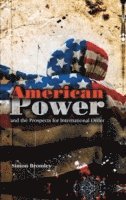
    American Power and the Prospects for International Order

    AvSimon Bromley

    Inbunden, Engelska, 2008

    742 kr

    Beställningsvara. Skickas inom 5-8 vardagar. Fri frakt över 249 kr.

    Fler format och utgåvor

    Häftad

    267 kr

    E-bok

    309 kr

    Beskrivning

    The turn of the century has seen the US greatly enhance its military supremacy across the world. It has also played a key role in shaping the international economic order. More recently, however, its world-wide economic domination has started to diminish as other regions and countries have become globally important players. Simon Bromley brings a fresh perspective to these issues, arguing that it is as yet unclear whether the US will be capable of rising to the challenges posed by the new world order. He carefully examines the intricacies of these debates including the American ideology of a liberal international order and the relation of this to the Bush doctrine; US power in the transatlantic arena and US-European integration in relation to the EU and NATO; and the geo-politics of oil. He looks at a range of challenges to US dominance, including the weakening of the dollar; the rapid growth and industrialization of Asia; and the strengths and weaknesses of Bush's foreign policy.This book is set to spark debate amongst students and scholars of international politics, as well as appealing to anyone interested in the changing shape of the international order.

    Produktinformation

    • Utgivningsdatum:2008-07-04
    • Mått:158 x 236 x 23 mm
    • Vikt:490 g
    • Format:Inbunden
    • Språk:Engelska
    • Antal sidor:288
    • Förlag:John Wiley and Sons Ltd
    • ISBN:9780745642383

    Utforska kategorier

    • Ekonomisk politik inom Ekonomi och Ledarskap
    • Internationella relationer inom Samhälle och politik

    Mer om författaren

    Simon Bromley is Senior Lecturer in Politics and International Studies at the Open University.

    Recensioner i media

    "A well-researched, multifaceted and insightful analysis of the sources and challenges to US supremacy. Particularly impressive is the way in which Bromley is able to explain complex economic theory in relatively easily understood terms, and at times to bridge the gap between economic and security based analyses of US power and international order in general." Australian Journal of Political Science "Walt Rostow's theory of modernization, in Bromley's view, supplemented the requirement of containing Soviet military power with the need to 'create forms of coordinated economic interdependence, based on the replication of the American model of capitalism in the rest of the capitalist world, from which many states could derive positive benefit'. Bromley elucidates this argument in an excellent first chapter and goes on to demonstrate how the neo-conservative foreign policy agenda both builds on this foundation and departs from it."Political Studies Quarterly"This is a good book and should be recommended in particular to those who think they already know everything about American foreign relations."Times Higher Education"Simon Bromley is one of the most knowledgeable, astute and sober analysts of the role of oil in the making of the American empire. This new book confirms this amidst a broader examination of the American strategy and ideology from the post-war era up to today."Leo Panitch, York University, Toronto"Simon Bromley has written an exceptional book, remarkable for its many insights, and the lucidity and balance of its judgements on the role the United States plays in the world and the complex nature of its power. Avoiding the oversimplifications and caricatures which bedevil this field, Bromley offers a compelling account of the enduring dilemmas which have shaped American policy towards the international order and the current challenges it faces. This book should be read by everyone interested in understanding contemporary world politics."Andrew Gamble, University of Cambridge "Simon Bromley has crafted an excellent and thought-provoking study of American power. He presents a robust defence of an American-led liberal international order that will need to be taken into account by all other writers on the subject. His argument that the US is a revolutionary power seeking to mould the world into its own image because of its declining economic power is a challenging one. Summing up and defending a liberal thesis, Bromley does something unusual (at least for a European scholar): he defends American power. Bromley's study should be widely read by political scientists, political economists, political historians, and international relations scholars and students."Inderjeet Parmar, University of Manchester

    Innehållsförteckning

    • List of Tables and Figures viiPreface viiiIntroduction: The American Project for a Liberal International Order 11 The American Ideology: Modernization Theory and the Neo-Conservatives 8Introduction 8What Was Modernization Theory? 10Containment and ‘Development’ 14Modernization Theory and World Order 20Modernity Is Not the ‘End of History’ 31Modernization Theory, the Neo-Conservatives and the Bush Doctrine 37Conclusions 502 America's Transatlantic Empire: Where in the World Is America? 52Introduction 52The American Empire 54Imperialism 61Anarchy, Rivalry and Interdependence 66US Power and the Liberal Capitalist International Order 82Conclusions 973 American Oil, World Oil: Resources, Confl icts, Control and Scarcity 101Introduction 101Reasons for War? 103America's Oil, World Oil 106OPEC and World Oil 115The United States and Middle East Oil 118Reshaping the Greater Middle East 122The Role of Oil in the New Middle East Strategy 135Carry on Driving? 143Conclusions 1484 American Power, the Future of the Dollar and the Challenge of China 149Introduction 149International Money 151From Fixed to Floating Exchange Rates 160Resurgent Asia 173Containing China? 185Conclusions 199Conclusion: The Prospects for a Liberal International Order 202Notes 211Bibliography 226Name Index 237Subject Index 240