• Fri frakt över 249 kr
  • •
  • Snabba leveranser
  • •
  • Billiga böcker
Kundservice

Du är på sajten för privatpersoner.

Företag, bibliotek eller offentlig verksamhet?

Du handlar på classic.bokus.com, där alla dina funktioner finns intakta.
Till classic.bokus.com
Bokus logotyp. Gå till startsidan.
  • Erbjudanden
  • Nyheter
  • Student
  • Topplistor
  • Barn & ungdom
  • Bokus Play
  • E-böcker
  • Pocketböcker
  • Spel & pussel

10% rabatt på allt med kod: NYSTART10 →

Sidfot

Mina sidor

    Hjälp

    • Kundservice
    • Vanliga frågor och svar
    • Frakt och leverans
    • Retur vid ångerrätt
    • Reklamera vara
    • Betalning
    • Köpvillkor
    • Allmänna villkor
    • Information om webbplatsens tillgänglighet

    Om Bokus

    • Om oss
    • Pressrum
    • För studenter
    • För företag
    • För bibliotek och offentlig verksamhet
    • För leverantörer
    • Hållbarhet

    Populärt

    • Aktuella erbjudanden
    • Presentkort
    • Studentlitteratur
    • Nya böcker
    • Topplistor
    • Signerade böcker
    • Engelska böcker

    Inspiration

    • Boktips
    • BookTok
    • Populära bokserier
    • Barnbokskaraktärer
    • Populära författare
    Logotyp för Bokus
    Följ oss på Facebook (extern länk)Följ oss på Instagram (extern länk)Följ oss på YouTube (extern länk)Följ oss på TikTok (extern länk)
    bokus @ CookiesAnpassa cookiesIntegritetspolicyKöpvillkor
    Till Citymail hemsida (extern länk)Till Budbee hemsida (extern länk)Till Postnord hemsida (extern länk)Till Schenker hemsida (extern länk)Till Early Bird hemsida (extern länk)Till Walleys hemsida (extern länk)
    1. Samhälle och politik
    2. Samhälle och kultur
    3. Kultur och medier
    4. Referensverk och tvärvetenskap

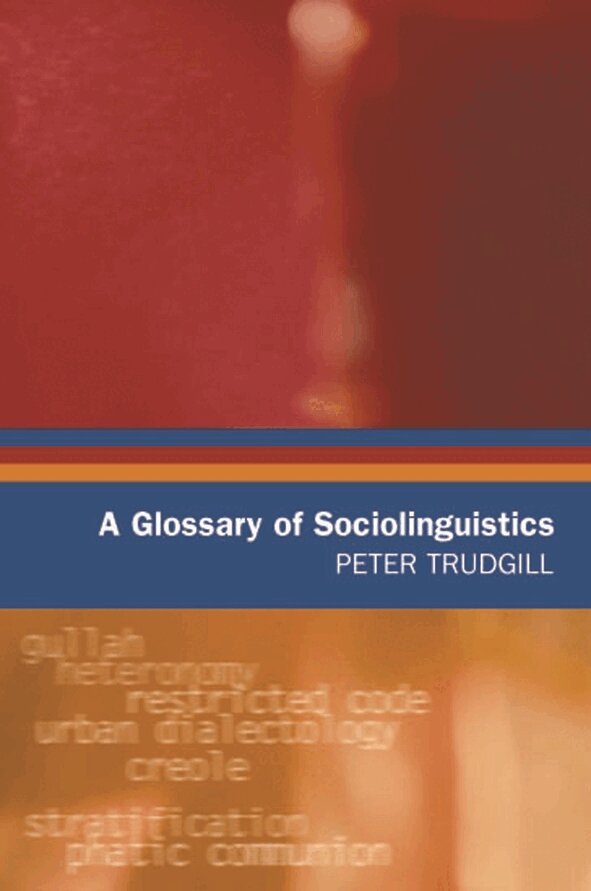
    Glossary of Sociolinguistics

    AvPeter Trudgill

    Häftad, Engelska, 2003

    Del i serien Glossaries in Linguistics

    295 kr

    Beställningsvara. Skickas inom 11-20 vardagar. Fri frakt över 249 kr.

    Beskrivning

    This pocket-sized alphabetic guide introduces popular terms used in the study of language and society. A central topic within modern linguistics, sociolinguistics deals with human communication and the use of language in its social context. Clearly written by a leading authority in the field, this glossary provides full coverage of both traditional and contemporary terminology, including the relatively new areas within sociolinguistics of sign language, gay language and cross-cultural communication.Key features:* An ideal companion to courses in sociolinguistics, language variation and change, dialectology, English language and language and gender* Contains illustrations, dialect maps and a bibliography* Provides linguistic examples of the terms defined* Supplies numerous cross-references to related terms.

    Produktinformation

    • Utgivningsdatum:2003-02-06
    • Mått:129 x 198 x 10 mm
    • Vikt:163 g
    • Format:Häftad
    • Språk:Engelska
    • Serie:Glossaries in Linguistics
    • Antal sidor:160
    • Förlag:Edinburgh University Press
    • ISBN:9780748616237

    Utforska kategorier

    • Referensverk och tvärvetenskap inom Samhälle och politik
    • Språkvetenskap och lingvistik inom Språk och ordböcker
    • Litteraturvetenskap inom Skönlitteratur

    Mer om författaren

    Peter Trudgill is Honorary Professor of Sociolinguistics at the University of East Anglia, Emeritus Professor of English Linguistics at the University of Fribourg, Switzerland, and Professor of English Linguistics at Agder University College, Norway.

    Recensioner i media

    Peter Trudgill's slim volume, A Glosssary of Sociolinguistics, contains a wealth of information for readers seeking definitions, explanations and examples of the technical terms most frequently employed in sociolinguistics and dialectology. The publication of A Glossary of Sociolinguistics is a landmark event. It signifies the dramatic growth of sociolinguistics over the past several decades and the level of interest it now attracts. Peter Trudgill has been through it all - as a pioneer, a developer and an internationally renowned authority. No one is in a better position to write a glossary of the field, and no one can match Trudgill's lucid, readable style. -- Professor Walt Wolfram, North Carolina State University Peter Trudgill's slim volume, A Glosssary of Sociolinguistics, contains a wealth of information for readers seeking definitions, explanations and examples of the technical terms most frequently employed in sociolinguistics and dialectology. The publication of A Glossary of Sociolinguistics is a landmark event. It signifies the dramatic growth of sociolinguistics over the past several decades and the level of interest it now attracts. Peter Trudgill has been through it all - as a pioneer, a developer and an internationally renowned authority. No one is in a better position to write a glossary of the field, and no one can match Trudgill's lucid, readable style.

    Innehållsförteckning

    • Sample entries: Abstand language (German /'apstant/) A variety of language which is regarded as a language in its own right, rather than a dialect, by virtue of being very different in its characteristics from all other languages. Such is the degree of linguistic distance (German Abstand) between this variety and other languages that, unlike Ausbau languages, there can be no dispute as to its language status. Basque, the language spoken in northern Spain and southwestern France, is a good example of an Abstand language. It is clearly a single language, because its dialects are similar. And it is clearly a language rather than a dialect because, since it is not related historically to any other European languages, it is completely different in its grammar, vocabulary and pronunciation from the neighbouring languages, French and Spanish; dialect contact Contact between linguistic varieties which results from communication between speakers of different but mutually intelligible dialects, often involving accommodation. Such communication is of course very common indeed, but, from the point of view of sociolinguistics, such contacts are particularly interesting where they occur on a large scale, such as at dialect boundaries (see isogloss) or as a result of urbanization or colonization. In these cases, phenomena such as dialect mixture and hyperadaptation may occur; genderlect A variety or lect which is specific to or particularly associated with male or female speakers. This term is in most usages misleading, in that it suggests that there may be communities where male and female speakers use radically different varieties. In fact, while there are some more-or-less gender specific usages in many if not most languages, these range from the use of a small number of words, phrases or conversational devices in some languages to particular vowels, consonants or grammatical endings in others. Most differences between male and female speech are quantitatively revealed tendencies rather than absolute differences.; isogloss A term from dialectology for a line drawn on a dialect map marking off an area which has one particular variant of a linguistic form from another neighbouring area which has a different variant. An additional term isophone is available in strict usage for referring to lines drawn between areas which have different phonetic or phonological variants, leaving isogloss to refer to lexical differences. In practice, however, most writers use isogloss to apply to phonetic, phonological, grammatical and lexical boundaries. Well-known isoglosses include the maken-machen line in Germany and the greasy /s/-/z/ line in the USA; Labovian sociolinguistics Another term for secular linguistics. The American linguist William Labov is the leading figure in this field and pioneered work of this type, notably in his 1966 publication, The Social Stratification of English in New York City; mutual intelligibility The extent to which speakers of one variety are able to understand speakers of another variety. Mutual intelligibility may be a matter of degree - Swedish speakers can understand Norwegian more readily than they can Danish. Note too that the variety of intelligibility may not be entirely mutual - speakers of variety A may be able to understand speakers of variety B more easily than vice versa. And mutual intelligibility can also be acquired - speakers can learn to understand a variety that they initially had considerable difficulty with; vitality A term used in the sociology of language for establishing a typology of language varieties. A language which has a community of native speakers is said to have the characteristic of vitality. Varieties which are undergoing language shift or language death have less vitality than other language varieties. Classical languages such as Latin and Sanskrit, which do not any longer have native speakers, and pidgin languages, which do not (yet) have native speakers, do not have the characteristic of vitality.