• Fri frakt över 249 kr
  • •
  • Snabba leveranser
  • •
  • Billiga böcker
Kundservice

Du är på sajten för privatpersoner.

Företag, bibliotek eller offentlig verksamhet?

Du handlar på classic.bokus.com, där alla dina funktioner finns intakta.
Till classic.bokus.com
Bokus logotyp. Gå till startsidan.
  • Erbjudanden
  • Nyheter
  • Student
  • Topplistor
  • Barn & ungdom
  • Bokus Play
  • E-böcker
  • Pocketböcker
  • Spel & pussel

10% rabatt på allt med kod NYSTART10 →

Sidfot

Mina sidor

    Hjälp

    • Kundservice
    • Vanliga frågor och svar
    • Frakt och leverans
    • Retur vid ångerrätt
    • Reklamera vara
    • Betalning
    • Köpvillkor
    • Allmänna villkor
    • Information om webbplatsens tillgänglighet

    Om Bokus

    • Om oss
    • Pressrum
    • För studenter
    • För företag
    • För bibliotek och offentlig verksamhet
    • För leverantörer
    • Hållbarhet

    Populärt

    • Aktuella erbjudanden
    • Presentkort
    • Studentlitteratur
    • Nya böcker
    • Topplistor
    • Signerade böcker
    • Engelska böcker

    Inspiration

    • Boktips
    • BookTok
    • Populära bokserier
    • Barnbokskaraktärer
    • Populära författare
    Logotyp för Bokus
    Följ oss på Facebook (extern länk)Följ oss på Instagram (extern länk)Följ oss på YouTube (extern länk)Följ oss på TikTok (extern länk)
    bokus @ CookiesAnpassa cookiesIntegritetspolicyKöpvillkor
    Till Citymail hemsida (extern länk)Till Budbee hemsida (extern länk)Till Postnord hemsida (extern länk)Till Schenker hemsida (extern länk)Till Early Bird hemsida (extern länk)Till Walleys hemsida (extern länk)
    1. Historia och arkeologi
    2. Historia
    3. Europas historia

    Holocaust

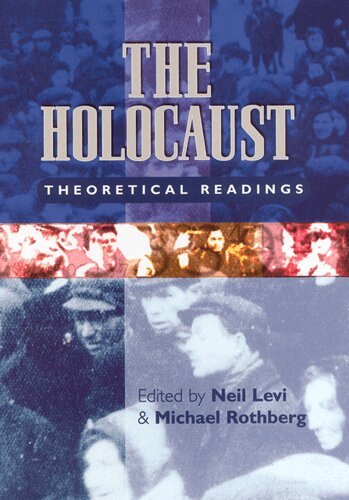
    Theoretical Readings

    AvNeil Levi,Michael Rothberg

    Inbunden, Engelska, 2003

    1 896 kr

    Beställningsvara. Skickas inom 11-20 vardagar. Fri frakt över 249 kr.

    Beskrivning

    The first anthology to address the relationship between the events of the Nazi genocide and the intellectual concerns of contemporary literary and cultural theory in one substantial and indispensable volume. This agenda-setting reader brings together both classic and new theoretical writings. Wide in its thematic scope, it covers such vital questions as:* Authenticity and experience* Memory and trauma* Historiography and the philosophy of history* Fascism and Nazi antisemitism* Representation and identity formation* Race, gender and genocide* The implications of the Holocaust for theories of the unconscious, ethics, politics and aesthetics The readings, which are fully contextualised by a general introduction, section introductions and bibliographical notes, represent the work of many influential writers and theorists, including Primo Levi, Giorgio Agamben, Hannah Arendt, Cathy Caruth, Saul Friedlander, Emmanuel Levinas, Jean-Francois Lyotard, Theodor Adorno, Zygmunt Bauman, Paul Gilroy, Jacques Derrida, Hayden White and Shoshana Felman.

    Produktinformation

    • Utgivningsdatum:2003-06-15
    • Mått:172 x 244 x undefined mm
    • Vikt:1 021 g
    • Format:Inbunden
    • Språk:Engelska
    • Antal sidor:528
    • Förlag:Edinburgh University Press
    • ISBN:9780748616541

    Utforska kategorier

    • Europas historia inom Historia och arkeologi
    • Andra världskriget inom Historia och arkeologi
    • Allmän historia och världshistoria inom Historia och arkeologi

    Mer om författaren

    Neil Levi is an Assistant Professor in the English Department at Drew University and Sesqui Postdoctoral Research Fellow in the School of English, Art History, Film and Media at the University of Sydney. He is the author of articles on twentieth-century literature, culture and theory. Michael Rothberg is Associate Professor of English and Comparative Literature at the University of Illinois, Urbana-Champaign. He is the author of Traumatic Realism: The Demands of Holocaust Representation and numerous articles on twentieth-century literature and theory.

    Recensioner i media

    A highly intelligent collection of writings … While some of the pieces have already been published elsewhere their juxtaposition […] gives them renewed power and provocativeness. This anthology is a source of information, argument and debate that will sustain readers and students of the subject for years to come.

    Innehållsförteckning

    • The Holocaust: Theoretical Readings; Table of Contents; Acknowledgments; About this Book; Neil Levi and Michael Rothberg, General Introduction: Theory and the Holocaust; I. Theory and Experience; 1. Primo Levi, The Drowned and the Saved; 2. Jean Améry, Resentments; 3. Charlotte Delbo, Days and Memory; 4. Ruth Kluger, The Camps; II. Historicizing the Holocaust?; 5. Jürgen Habermas, On the Public Use of History; 6. Saul Friedlander, The 'Final Solution': On the Unease in Historical Representation; 7. Dan Diner, Historical Understanding and Counterrationality: The Judenrat as Epistemological Vantage; 8. Zygmunt Bauman, The Uniqueness and Normality of the Holocaust; 9. Omer Bartov, The European Imagination in the Age of Total War; 10. Henry Friedlander, The Origins of Nazi Genocide; III. Nazi Culture, Fascism, and Antisemitism; 11. Kenneth Burke, The Rhetoric of Hitler's 'Battle'; 12. Georges Bataille, The Psychological Structure of Fascism; 13. Max Horkheimer and Theodor W. Adorno, Elements of Antisemitism; 14. Philippe Lacoue-Labarthe, The Fiction of the Political; 15. Moishe Postone, Anti-Semitism and National Socialism; 16. Christopher Browning, Ordinary Men; IV. Race, Gender, and Genocide; 17. Klaus Theweleit, Floods, Bodies, History 18. Gisela Bock, Racism and Sexism in Nazi Germany; 19. Joan Ringelheim, The Unethical and the Unspeakable: Women and the Holocaust; 20. Pascale Rachel Bos, Women and the Holocaust: Analyzing Gender Difference; V. Psychoanalysis, Trauma, and Memory; 21. Cathy Caruth, Trauma and Experience; 22. Dominick LaCapra, Trauma, Absence, Loss; 23. Saul Friedlander, Trauma and Transference; 24. Eric Santner, History Beyond the Pleasure Principle: Some Thoughts on the Representation of Trauma; 25. Dori Laub, Bearing Witness or the Vicissitudes of Listening; VI. Questions of Religion, Ethics, and Justice; 26. Arthur A. Cohen, Thinking the Tremendum; 27. Emil L. Fackenheim, To Mend the World; 28. Emmanuel Levinas, Ethics and Spirit; 29. Hannah Arendt, Eichmann in Jerusalem; 30. Giorgio Agamben, What is a Camp?; 31. Jean-François Lyotard, The Differend; 32. Gillian Rose, New Political Theology: Out of Holocaust and Liberation; VII. Literature and Culture after Auschwitz; 33. Walter Benjamin, Theses on the Philosophy of History; 34. Theodor W. Adorno, Cultural Criticism and Society; 35. Theodor W. Adorno, Meditations on Metaphysics; 36. Irving Howe, Writing and the Holocaust; 37. Sigrid Weigel, Non-Philosophical Amazement/Writing in Amazement: Benjamin's Position in the Aftermath of the Holocaust; 38. Maurice Blanchot, The Writing of the Disaster; 39. Jacques Derrida, Schibboleth; 40. Geoffrey Hartman, Language and Culture after the Holocaust; 41. Sidra Dekoven Ezrahi, Representing Auschwitz; VIII. Modes of Narration; 42. Berel Lang, The Moral Space of Figurative Discourse; 43. James E. Young, Writing the Holocaust; 44. Hayden White, The Modernist Event; 45. Michael A. Bernstein, Against Foreshadowing; 46. Lawrence L. Langer, Deep Memory: The Buried Self; 47. Shoshana Felman, The Return of the Voice: Claude Lanzmann's Shoah; IX. Rethinking Visual Culture; 48. Saul Friedlander, Reflections of Nazism; 49. Jean Baudrillard, Holocaust; 50. Andreas Huyssen, Anselm Kiefer: the Terror of History, the Temptation of Myth; 51. Gertrud Koch, The Aesthetic Transformation of the Image of the Unimaginable: Notes on Claude Lanzmann's Shoah; 52. Lilliane Weissberg, In Plain Sight; X. Latecomers: Negative Symbiosis, Postmemory, and Countermemory; 53. Henri Raczymov, Memory Shot Through with Holes; 54. Marianne Hirsch, Mourning and Postmemory; 55. Dan Diner, Negative Symbiosis: Germans and Jews after Auschwitz; 56. James E. Young, The Countermonument: Memory Against Itself in Germany; XI. Uniqueness, Comparison, and the Politics of Memory; 57. Alan Milchman and Alan Rosenberg, Two Kinds of Uniqueness: The Universal Aspects of the Holocaust; 58. Yehuda Bauer, What Was the Holocaust?; 59. Paul Gilroy, The Black Atlantic; 60. Mahmood Mamdani, Thinking about Genocide; 61. Lilian Friedberg, Dare to Compare: Americanizing the Holocaust; 62. Peter Novick, The Holocaust in American Life; Index.