• Fri frakt över 249 kr
  • •
  • Snabba leveranser
  • •
  • Billiga böcker
Kundservice

Du är på sajten för privatpersoner.

Företag, bibliotek eller offentlig verksamhet?

Du handlar på classic.bokus.com, där alla dina funktioner finns intakta.
Till classic.bokus.com
Bokus logotyp. Gå till startsidan.
  • Erbjudanden
  • Nyheter
  • Student
  • Topplistor
  • Barn & ungdom
  • Bokus Play
  • E-böcker
  • Pocketböcker
  • Spel & pussel

10% rabatt på allt med kod: NYSTART10 →

Sidfot

Mina sidor

    Hjälp

    • Kundservice
    • Vanliga frågor och svar
    • Frakt och leverans
    • Retur vid ångerrätt
    • Reklamera vara
    • Betalning
    • Köpvillkor
    • Allmänna villkor
    • Information om webbplatsens tillgänglighet

    Om Bokus

    • Om oss
    • Pressrum
    • För studenter
    • För företag
    • För bibliotek och offentlig verksamhet
    • För leverantörer
    • Hållbarhet

    Populärt

    • Aktuella erbjudanden
    • Presentkort
    • Studentlitteratur
    • Nya böcker
    • Topplistor
    • Signerade böcker
    • Engelska böcker

    Inspiration

    • Boktips
    • BookTok
    • Populära bokserier
    • Barnbokskaraktärer
    • Populära författare
    Logotyp för Bokus
    Följ oss på Facebook (extern länk)Följ oss på Instagram (extern länk)Följ oss på YouTube (extern länk)Följ oss på TikTok (extern länk)
    bokus @ CookiesAnpassa cookiesIntegritetspolicyKöpvillkor
    Till Citymail hemsida (extern länk)Till Budbee hemsida (extern länk)Till Postnord hemsida (extern länk)Till Schenker hemsida (extern länk)Till Early Bird hemsida (extern länk)Till Walleys hemsida (extern länk)
    1. Samhälle och politik
    2. Social välfärd och brottslighet
    3. Brottslighet och kriminologi

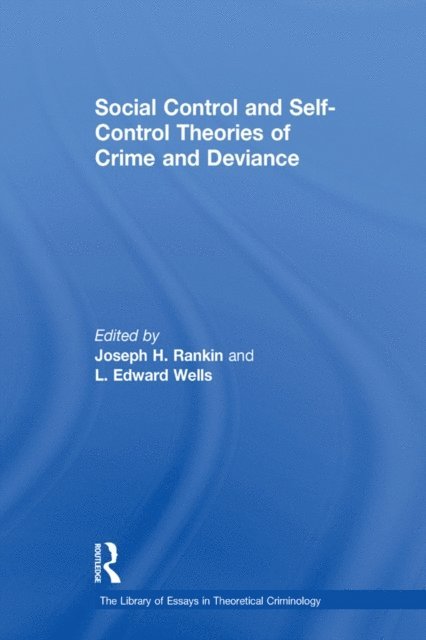
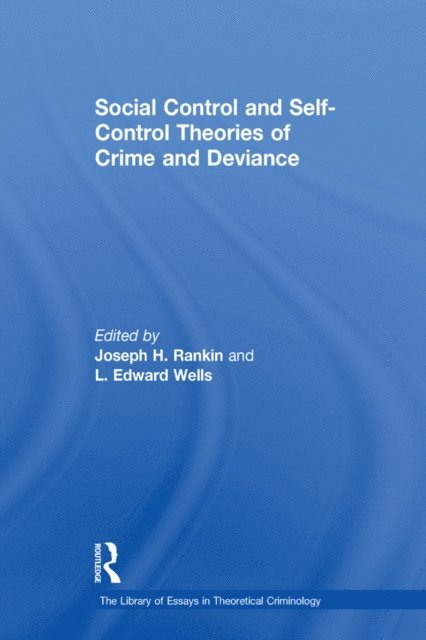
    Social Control and Self-Control Theories of Crime and Deviance

    AvL. Edward Wells,Joseph H. Rankin

    Inbunden, Engelska, 2011

    Del i serien Library of Essays in Theoretical Criminology

    7 304 kr

    Beställningsvara. Skickas inom 5-8 vardagar. Fri frakt över 249 kr.

    Fler format och utgåvor

    E-bok

    5 214 kr

    E-bok

    5 214 kr

    Beskrivning

    Control theories have dominated criminological theory and research since the 1969 publication of Hirschi's seminal work on the social bond. Social control and self-control theorists are unique in suggesting that patterns in criminal behaviors are better explained by variations in social constraints rather than by individual motivational impulses, thus indicating that their main concerns are the explication and clarification of the techniques, processes, and institutions of informal social control. The four major sections of this volume focus on: the similarities and differences among the major contributors to the early developmental stage of social control theory; the central importance of parents, peers, and schools in the creation of informal control mechanisms and their link to crime and delinquency; the theoretical underpinnings of self-control theory, including empirical tests and criticisms; and theoretical integrations of social control and self-control theories with various motivational theories of crime and delinquency.

    Produktinformation

    • Utgivningsdatum:2011-07-28
    • Mått:169 x 244 x undefined mm
    • Vikt:1 270 g
    • Format:Inbunden
    • Språk:Engelska
    • Serie:Library of Essays in Theoretical Criminology
    • Antal sidor:550
    • Förlag:Taylor & Francis Ltd
    • ISBN:9780754629443

    Utforska kategorier

    • Brottslighet och kriminologi inom Samhälle och politik

    Mer om författaren

    Joseph H. Rankin is Associate Dean and Professor of Criminal Justice, Wayne State University and L. Edward Wells is Professor of Criminal Justice Sciences, Illinois State University, USA

    Innehållsförteckning

    • Contents: Introduction; Part I Early Developments in Social Control Theory: Delinquency as the failure of personal and social controls, Albert J. Reiss; Social disorganization and stake in conformity: complementary factors in the predatory behavior of hoodlums, Jackson Toby; Techniques of neutralization: a theory of delinquency, Gresham M. Sykes and David Matza; A new theory of delinquency and crime, Walter C. Reckless; Delinquency, situational inducements, and commitment to conformity, Scott Briar and Irving Piliavin. Part II Sources of Social Control: Parental attachments and delinquency, Joseph H. Rankin and Roger Kern; Direct parental controls and delinquency, L. Edward Wells and Joseph H. Rankin; Parental monitoring: a reinterpretation, HÃ¥kan Stattin and Margaret Kerr; Parents, peers and delinquency, Mark Warr; A multilevel analysis of the relationships among communal school organization, student bonding, and delinquency, Allison Ann Payne. Part III Self-Control Theory: The empirical status of Gottfredson and Hirschi's General Theory of Crime: a meta-analysis, Travis C. Pratt and Francis T. Cullen; An empirical test of a General Theory of Crime: a four-nation comparative study of self-control and the prediction of deviance, Alexander T. Vazsonyi, Lloyd E. Pickering, Marianne Junger and Dick Hessing; Testing the core empirical implications of Gottfredson and Hirschi's General Theory of Crime, Harold G. Grasmick, Charles R. Tittle, Robert J. Bursik Jr and Bruce J. Arneklev; Self-control as an executive function: reformulating Gottfredson and Hirschi's parental socialization thesis, Kevin M. Beaver, John Paul Wright and Matt Delisi; A longitudinal test of the effects of parenting and the stability of self-control: negative evidence for the General Theory of Crime, Callie Harbin Burt, Ronald L. Simons and Leslie G. Simons; On the absence of self-control as the basis for a General Theory of Crime: a critique, Gilbert Geis; In defense of self-control, Travis Hirschi and Michael Gottfredson. Part IV Theory Integration: Substantive positivism and the idea of crime, Travis Hirschi and Michael Gottfredson; Toward an interactional theory of delinquency, Terence P. Thornberry; Self-control and social bonds: a combined control perspective on deviance, Douglas Longshore, Eunice Chang, Shih-chao Hsieh and Nena Messina; Crime and deviance over the life course: the salience of adult social bonds, Robert J. Sampson and John H. Laub; Enduring individual differences and rational choice theories of crime, Daniel S. Nagin and Raymond Paternoster; The class structure of gender and delinquency: toward a power-control theory of common delinquent behavior, John Hagan, A.R. Gillis and John Simpson; Name index.