• Fri frakt över 249 kr
  • •
  • Snabba leveranser
  • •
  • Billiga böcker
Kundservice

Du är på sajten för privatpersoner.

Företag, bibliotek eller offentlig verksamhet?

Du handlar på classic.bokus.com, där alla dina funktioner finns intakta.
Till classic.bokus.com
Bokus logotyp. Gå till startsidan.
  • Erbjudanden
  • Nyheter
  • Student
  • Topplistor
  • Barn & ungdom
  • Bokus Play
  • E-böcker
  • Pocketböcker
  • Spel & pussel

10% rabatt på allt med kod: NYSTART10 →

Sidfot

Mina sidor

    Hjälp

    • Kundservice
    • Vanliga frågor och svar
    • Frakt och leverans
    • Retur vid ångerrätt
    • Reklamera vara
    • Betalning
    • Köpvillkor
    • Allmänna villkor
    • Information om webbplatsens tillgänglighet

    Om Bokus

    • Om oss
    • Pressrum
    • För studenter
    • För företag
    • För bibliotek och offentlig verksamhet
    • För leverantörer
    • Hållbarhet

    Populärt

    • Aktuella erbjudanden
    • Presentkort
    • Studentlitteratur
    • Nya böcker
    • Topplistor
    • Signerade böcker
    • Engelska böcker

    Inspiration

    • Boktips
    • BookTok
    • Populära bokserier
    • Barnbokskaraktärer
    • Populära författare
    Logotyp för Bokus
    Följ oss på Facebook (extern länk)Följ oss på Instagram (extern länk)Följ oss på YouTube (extern länk)Följ oss på TikTok (extern länk)
    bokus @ CookiesAnpassa cookiesIntegritetspolicyKöpvillkor
    Till Citymail hemsida (extern länk)Till Budbee hemsida (extern länk)Till Postnord hemsida (extern länk)Till Schenker hemsida (extern länk)Till Early Bird hemsida (extern länk)Till Walleys hemsida (extern länk)
    1. Historia och arkeologi
    2. Historia
    3. Europas historia

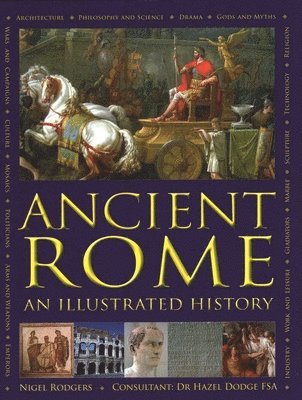
    Ancient Rome

    An Illustrated History

    AvNigel Rodgers

    Inbunden, Engelska, 2017

    218 kr

    Skickas . Fri frakt över 249 kr.

    Beskrivning

    The legacy of Ancient Rome shapes the world we inhabit today. The history of Rome - as a tiny primitive kingdom, as an ever-growing republic, as a world-ruling empire dominating the known world - is still influential. The first half of this book focuses on the political and military history of Rome. The assassination of Julius Caesar, Nero fiddling while Rome burns, the building of Hadrian's Wall - the truth behind these and many other events are revealed in this account of the rise and fall of a mighty empire. The second part of the book focuses on Rome's influence on the development of world art, architecture and society. Detailed drawings of the Colosseum and other World Heritage buildings reveal Roman techniques and architectural styles. Ancient letters, records and artworks are used to show how real people lived and worked during one of the cultural peaks of world history. With its magnificent combination of photographs, plans and illustrations, and an authoritative and absorbing text, this is the perfect reference guide for any student of history, archaeology and the classical world. It will provide inspiration for anyone planning to visit Italy or other sites in the once-great Roman Empire.

    Produktinformation

    • Utgivningsdatum:2017-09-29
    • Mått:198 x 258 x 32 mm
    • Vikt:2 238 g
    • Format:Inbunden
    • Språk:Engelska
    • Antal sidor:512
    • Förlag:Anness Publishing
    • ISBN:9780754834205

    Utforska kategorier

    • Europas historia inom Historia och arkeologi
    • Forntidens historia inom Historia och arkeologi

    Mer om författaren

    Nigel Rodgers, who has a degree in history and art history from Cambridge University, has written widely on history, philosophy and art. Among his published works are Ancient Greece: An Illustrated History (also published by Lorenz Books). Hazel Dodge FSA is Louis Claude Purser Senior Lecturer in Classical Archaeology at the School of Classics, Trinity College, Dublin. Her research covers all aspects of Roman construction and building technology. Her other published works include Marble in Antiquity (British School at Rome) and Ancient Rome - The Archaeology of the Eternal City (Oxford University Press). With Peter Connolly, she is the author of The Ancient City - Life in Classical Athens and Rome.

    Innehållsförteckning

    • Introduction 6Part OneThe Rise and Fallof Rome8The Archetypal Empire 10Timeline 14Rome: The World’sFirst Superpower 18Chapter I: An Empire ofForce and Law 20Legendary Beginnings22The Conquest of Italy24The Growth of Empire26Victory Abroad, Discord at Home28The End of the Republic30Peace Restored: The First Emperors32The Flavians and “The FiveGood Emperors”34Crisis and Catastrophe36Reconstruction and Revival38The Fall of the West40Chapter II: Great Romans 42Great Roman Generals44Julius Caesar48Pompey50Mark Antony51The Historians’ View52Roman Philosophers54Rome’s Enemies56Cicero: The Peaceful Roman60Chapter III: The Emperors 62Emperors of Rome64Augustus: The First Roman Emperor66Organizers of Empire68Best of Emperors70Evil Emperors72Saviours of the Empire76Constantine the Great80Women Behind the Throne82Chapter IV: Governingthe Empire 84A Self-governing Confederacy86The Oligarchical Republic88Rome’s Ruling Classes90The Secret Workings of RomanPolitics94The Principate: A Monarchy in Disguise96Republican Extortion, ImperialProbity98Taxation100Chapter V: Rome andthe Law 102Law in the Early Republic104How the Laws Worked in Times of Crisis106The Great Imperial Codifications108Police and Secret Police110Punishment112Chapter VI: Foreign Policy 114Early Beginnings: The Conquestof Italy116Ruler by Default118Defensible Frontiers: The Rhineand the Danube120Defensible Frontiers: Asia122Client and Buffer States124Reliance on the Germans126At the Empire’s Extremities:Egypt128At the Empire’s Extremities:Britain130the power of rome 132Chapter VII: The Roman Army134The People’s Army136Battle Hardening138The Fall of the Republic140Legions and Principate142Army of the Later Empire144Chapter VIII: Inside the Army146Organizing the Legion148Centurions and Officers150Training and Discipline152Pay and Conditions154Auxiliary Troops156Pitching Camp158Roads, Canals and Bridges160Fleets and Ships162Chapter IX: Arms and the Men164Armour166Arms168Artillery170Siege Warfare172Triumphs and Ovations174Permanent Fortifications176Great Forts of the Later Empire178City Walls180Chapter X: The Great Wars182Marching and Fighting184The Punic Wars186Conquering the Greeks188Caesar’s Conquest of Gaul190The Last Civil Wars192Along the Elbe194Conquest of Lowland Britain196Agricola’s Northern Campaigns198Trajan’s Campaigns200Chapter XI: Defendingthe Empire204The Dilemmas of Defence206Natural Frontiers208Colonies and Settlements214The Jewish Revolt216Siege of Masada218Chapter XII: Decline and Fall220The 3rd-century Crisis222The Eastern Problem224Foreign Invasions226Loss and Recapture of the East228The Splintering Empire230The First Recovery232The Tetrarchs’ Achievements234Constantine236Constantine’s Heirs238Britain Regained and Abandoned240The Gothic Problem242The Fatal Winter244The Sack of Rome246The Fall of Rome248Why Rome Fell250Part TwoThe Roman World254Rome’s Enduring Legacy256Timeline260Rome: the firstworld city 264Chapter XIII: Building theCity of Rome266Building Early Rome268The Later Republic270Augustus and his Heirs272Nero and the Flavians274Trajan and Hadrian276Rome in the Later Empire278Rome – The Christian City280Chapter XIV: BuildingTechniques and Styles282Building Materials284Vaults, Arches, Domes286Building Practices and Techniques 288Architectural Styles andLanguage290Chapter XV: Public Buildings292The Forum Romanum294The Imperial Forum296Rome’s Basilicas and the SenateHouse298Temples: The Republic and theEarly Principate 300Temples: The Pantheon and After 302Building the Theatres304Amphitheatres and theColosseum 306Aqueducts and Sewers310Imperial Baths312Circuses 316Triumphal Arches318Triumphal Columns 320Churches322Chapter XVI: Imperial Palaces324The Palaces of Augustus and hisHeirs 326Nero’s Golden Palace 328The Palatine: Palace of theEmperors 330Chapter XVII: Housing forRich and Poor334The Domus: Houses of the Rich 336Insulae: The First Apartments338Tiberius’ Villa at Capri 340Hadrian’s Villa at Tivoli342Villas of the Rich in Italy346Piazza Armerina 348Diocletian’s Palace at Split350Villas of the Empire: British Villas352Chapter XVIII: Cities of the Empire354Pompeii and Herculaneum 356Ostia and Portus 360Contrasting Cities: Carthageand Timgad362Lepcis Magna: An Emperor’s Birthplace364Athens: A Glorious Past366Trier: The Rome of the North368Ephesus: Wonder of the World370Vanished Cities of the East372Nîmes and Arles: Cities of Gaul374Romano-British Cities 376Roman arts andsociety378Chapter XIX: Literature380The First Roman Writers382Augustus’ Poets Laureate384Catullus and the Elegiac Poets386Ovid and Later Silver Age Poets388Great Prose Writers390Novelists and Satirists392Late Roman Writers394Literature and Literacy 396Chapter XX: The Arts398The Etruscans and the EarlyRepublic400Art in the Later Republic402Augustus and the Classical Revival404The Roman Zenith406Hadrian and the Greek Revival408Art of the Later Empire410Furniture 412Chapter XXI: Religion andMythology 414The Capitoline Gods 416Venus, Vulcan and Other Gods420Emperor Worship and the Goddess Roma422Bacchus and Cybele424New Gods from the East426Cult of the Sun428Christianity: Tribulation to Triumph430Chapter XXII: Sport andGames432Gladiatorial Combats434The Great Games436Wild Beast Games438At the Circus: Chariot Races 440At the Theatre: Farce, Mime andPantomime442Games and Exercises444Chapter XXIII: Science,Technology & the Economy 446Strabo and Graeco-RomanGeography448Astronomy450Water Mills 452Steam Engines 454Medical Principles and Practice456Perils of Urban Life: Plagues, Floodand Fire458Trade, Ships and Navigation460Passages to India462Farming464Chapter XXIV: People of Rome466Marriage, Divorce and the Power ofthe Father468Roman Women470Children: Education andUpbringing472Slaves and Freedmen474Aspects of Slavery 476Business and Commerce 478Leisure and Holidays480Dinner Parties 482Food for Rich and Poor 484Wine and Vineyards486Rome the Great Consumer488Tunics and Togas490Hairstyles and Cosmetics492Erotic Love494Funerals and the Afterlife496Index 500Acknowledgements510

    Betyg & recensioner

    4/5