• Fri frakt över 249 kr
  • •
  • Snabba leveranser
  • •
  • Billiga böcker
Kundservice

Du är på sajten för privatpersoner.

Företag, bibliotek eller offentlig verksamhet?

Du handlar på classic.bokus.com, där alla dina funktioner finns intakta.
Till classic.bokus.com
Bokus logotyp. Gå till startsidan.
  • Erbjudanden
  • Nyheter
  • Student
  • Topplistor
  • Barn & ungdom
  • Bokus Play
  • E-böcker
  • Pocketböcker
  • Spel & pussel

10% rabatt på allt med kod: NYSTART10 →

Sidfot

Mina sidor

    Hjälp

    • Kundservice
    • Vanliga frågor och svar
    • Frakt och leverans
    • Retur vid ångerrätt
    • Reklamera vara
    • Betalning
    • Köpvillkor
    • Allmänna villkor
    • Information om webbplatsens tillgänglighet

    Om Bokus

    • Om oss
    • Pressrum
    • För studenter
    • För företag
    • För bibliotek och offentlig verksamhet
    • För leverantörer
    • Hållbarhet

    Populärt

    • Aktuella erbjudanden
    • Presentkort
    • Studentlitteratur
    • Nya böcker
    • Topplistor
    • Signerade böcker
    • Engelska böcker

    Inspiration

    • Boktips
    • BookTok
    • Populära bokserier
    • Barnbokskaraktärer
    • Populära författare
    Logotyp för Bokus
    Följ oss på Facebook (extern länk)Följ oss på Instagram (extern länk)Följ oss på YouTube (extern länk)Följ oss på TikTok (extern länk)
    bokus @ CookiesAnpassa cookiesIntegritetspolicyKöpvillkor
    Till Citymail hemsida (extern länk)Till Budbee hemsida (extern länk)Till Postnord hemsida (extern länk)Till Schenker hemsida (extern länk)Till Early Bird hemsida (extern länk)Till Walleys hemsida (extern länk)
    1. Historia och arkeologi
    2. Historia
    3. Europas historia

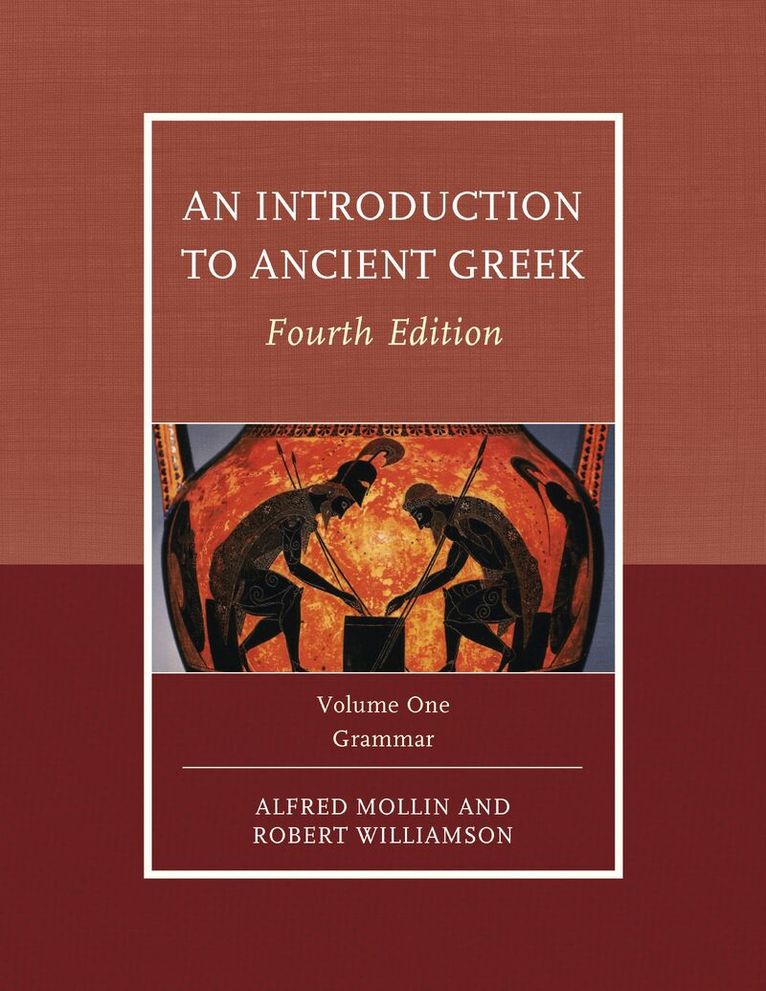
    Introduction to Ancient Greek

    2 Volumes

    AvRobert Williamson,Alfred Mollin

    Häftad, Engelska, 2017

    Del i serien Introduction to Ancient Greek

    1 065 kr

    Beställningsvara. Skickas inom 5-8 vardagar. Fri frakt över 249 kr.

    Fler format och utgåvor

    E-bok

    1 104 kr

    Beskrivning

    This textbook was conceived and written under the authors’ conviction that the feature of Greek grammar that lends itself most readily to understanding and discussion is syntax, especially the syntax of the verb and that such understanding has been unnecessarily complicated by the traditional use of a terminology derived more from the study of the Latin verb than the Greek. The principal feature of the Greek verb is no longer presented as that of “tense,” a term that conflates and confuses questions of the time of an action relative to the act of speaking with ways of representing an action in itself. Rather, emphasis is placed on the latter feature, the aspect of a verb, both as a means of organizing the many forms that the verb can take and as a means of making comparatively simple sense of the multiplicity of syntactical rules that govern its use.Volume One features twenty Lessons presenting basic Greek Grammar in a manner facilitating the early introduction of substantial and philosophically rich passages from Heraclitus Aeschylus, Xenophon, Aristotle, Euclid and especially Plato, each containing vocabulary, discussion and exercises to aid in retention and reinforcement. Volume Two contains extended readings, with grammatical and vocabulary notes, from Plato and Aristotle, including the complete dialogue Meno, as well as Appendices and comprehensive Vocabulary lists.The two most distinctive Lessons in the text occur close to the beginning. Lesson Four presents the six features that determine any Greek verb—aspect (progressive, aorist or simple, perfect), “tense” (past, present, future), mood, voice, person, number)—through a discussion that is carried out mostly in English. At the end of the lesson, students are in possession of all the conceptual elements upon which the syntax of the Greek verb is based.Lesson Five presents the Progressive System of the regular verb in all of its moods and voices. The burden of paradigms on the memory is lightened by means of an emphasis on analysis into a verb’s formative elements and through the use of linguistic rules that show how seemingly diverse forms arise from common origins. This early presentation of the non-indicative moods allows the student to appreciate the verb as a conveyer, not only of facts, but of the speaker’s doubts, wishes, speculations and feelings as well.

    Produktinformation

    • Utgivningsdatum:2017-07-31
    • Mått:218 x 281 x 34 mm
    • Vikt:1 533 g
    • Format:Häftad
    • Språk:Engelska
    • Serie:Introduction to Ancient Greek
    • Antal sidor:538
    • Upplaga:4
    • Förlag:University Press of America
    • ISBN:9780761869542

    Utforska kategorier

    • Europas historia inom Historia och arkeologi
    • Språkundervisning och språkinlärning inom Språk och ordböcker
    • Forntidens historia inom Historia och arkeologi

    Mer om författaren

    Alfred Mollin co-authored An Introduction to Ancient Greek while serving on the Annapolis faculty of St. John’s College. He later served as Senior Counsel in the Civil Division of the United States Department of Justice. He died in 2004.Robert Williamson is a Tutor Emeritus and former Andrew W. Mellon Tutor of St. John’s College in Annapolis.

    Recensioner i media

    This Introduction to Ancient Greek is a remarkable work. It will certainly accomplish what ordinary Greek primers do—and then go far beyond. As a Greek primer, it combines the necessary rote learning with rational rules for the formation of words and the composition of sentences, in such a way that students may often infer facts that they would be likely to forget. Together with enticing, well-annotated Greek selections, an interesting vocabulary, and helpful appendices, students are empowered to read real Greek very soon. Meanwhile the Introduction goes beyond this preliminary task of Greek competence to encourage reflection on language. It accomplishes this thinking by means of a thoughtful reworking of the traditional grammatical categories; thus it encourages such questions as; How do Greek linguistic structures differ from English ones, and with what effect on the conveyance of meaning? How, more generally, are the formalisms of language related to the expression of meaning, and how, in turn, is expressible meaning related to internal thinking?The Introduction will work both for a student’s self-study and for the classroom. The single learner, who wants to acquire Greek for its intelligent beauty and for access to its incomparable texts, will find copious help, while the classroom teacher will possess a tool for turning a weary slog into a vivid experience.

    Innehållsförteckning

    • Part One: GrammarLesson OneLesson TwoLesson ThreeLesson FourLesson FiveLesson SixLesson SevenLesson EightLesson NineLesson TenLesson ElevenLesson Twelve Lesson ThirteenLesson FourteenLesson FifteenLesson SixteenLesson SeventeenLesson EighteenLesson NineteenLesson TwentyPart Two: ReadingsVocabularyI Plato, MenoII. Aristotle, PhysicsIII. Aristotle, Nicomachean EthicsAppendicesVocabularyIndices